
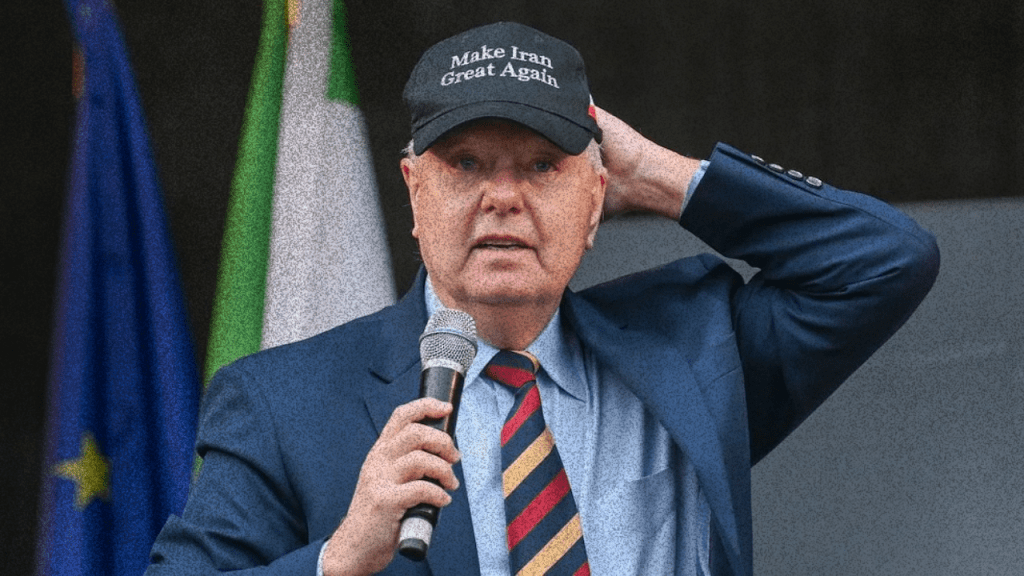
Lindsey Graham Iran war: a senator briefed by Israeli intelligence, coaching Netanyahu to sell war to Trump — while verified diplomacy was buried alive.
Diplomacy Was Working — That Is Why It Had to Be Stopped
On February 27, 2026, Omani Foreign Minister Badr Al-Busaidi announced a breakthrough. Iran had agreed to never stockpile enriched uranium and had accepted full IAEA verification. Talks were scheduled to resume March 2. The diplomatic architecture was not aspirational — it was operational, with a sitting mediator, a confirmed agreement in principle, and a timetable. One day later, the United States and Israel struck Iran. Al-Busaidi said he was dismayed. “Active and serious negotiations,” he stated, had been undermined. The gap between that diplomatic reality and the military outcome is not a mystery to be solved through battlefield analysis. It is the central political fact of this war, and it demands a structural explanation.
The question this article addresses is not what happened on the battlefield. It is what happened before February 28 that made the destruction of a functioning diplomatic process not only possible but effectively guaranteed. The answer is not found in Iranian aggression — Iran had just agreed to the core Western demand on enrichment. It is not found in independent American strategic calculation. It is found in the architecture of coordination between Israeli officials and specific American political actors who were not serving U.S. strategic interests. They were serving Israeli ones. That coordination is now documented. Its effects are confirmed by official testimony.
Fifteen Calls, Two Meetings, One Senator With Mossad Access
In the two months leading to the war, Benjamin Netanyahu and Donald Trump spoke by phone fifteen times and met in person twice, according to U.S. and Israeli officials briefed on the exchanges. This is not routine allied consultation — it is operational tempo. Axios reporting confirmed this through U.S. and Israeli officials and described the months of coordination as intensive and deliberate. Running alongside it was Senator Lindsey Graham, who made multiple trips to Israel and met directly with Mossad officials and with Netanyahu himself. JTA citing WSJ confirmed, citing the Wall Street Journal, that Graham told the paper: “They’ll tell me things our own government won’t tell me.” A sitting United States senator was receiving intelligence from a foreign government’s spy agency that his own government’s apparatus was not providing him. That is not alliance management. That is a parallel intelligence channel operating inside the American political system on behalf of Israeli strategic objectives.
The question of why that channel existed answers itself when you map what Graham did with the access. He did not return to Washington and brief the Senate Intelligence Committee on what Israeli officials had shared. He coached Netanyahu. Multiple outlets cited Wall Street Journal reporting confirming that Graham advised Netanyahu on how to present intelligence to Trump — specifically, how to package the threat assessment in terms that would move the president toward military action. The information flow was not American oversight of Israeli claims. It was American political expertise being lent to an Israeli lobbying operation targeting the American executive. The weaponization of access — the use of political relationships and parallel intelligence channels to shape American decision-making — does not only operate through think tanks and donor networks. It operates through senators with clearances and phone numbers.
Netanyahu’s Call Was the Culmination of Graham’s Lobbying
Axios reported exclusively on the call that set the war in motion. On February 23, Netanyahu called Trump from the White House Situation Room with a specific piece of intelligence: Iran’s supreme leader and top advisers would be gathered at a single location in Tehran on Saturday morning. They could all be killed in one strike. Three sources briefed on the discussion confirmed this account. Axios described the call as “a pivotal moment that set the Iran war in motion” and noted that what had not yet been decided was the timing — until Netanyahu called. The intelligence was real. The decision to use it to trigger American military action at that specific moment, foreclosing the March 2 diplomatic resumption, was a choice. It was Netanyahu’s choice. And it was made possible by two months of coordinated access, framing, and persuasion — including a U.S. senator who had spent that same period helping Israeli leadership understand exactly how to reach the American president.
The Wall Street Journal reported that “Netanyahu ultimately presented intelligence to the president that helped convince him to green-light the operation.” The word “ultimately” carries significant analytical weight. The presentation was the product of a process. Graham was inside that process. This is what perception management looks like when it reaches its operational conclusion. The intelligence did not speak for itself. It was packaged, timed, and delivered through a relationship that Graham had helped architect.
The Feedback Loop Is Confirmed By Those Inside It
The feedback loop between Israeli threat framing and U.S. military action is not a structural metaphor imposed from outside the event. It is the self-description of officials who participated in it. Axios cited officials saying one U.S. official described the situation as: “One side of the house was negotiating and the other side of the house was doing joint military planning with Israel.” That is a feedback loop as an institutional fact, confirmed by a named source inside the process. The negotiating track and the military planning track were running simultaneously, and the military planning track was running with Israel. When the February 23 call arrived, the military track was already operational. The diplomatic track had no institutional mass to counterbalance it.
Joseph Kent, the U.S. counterterrorism chief who resigned over the war, was more direct. His resignation letter stated that Trump had started the war against Iran — which had “posed no imminent threat” — “due to pressure from Israel and its powerful American lobby.” The White House denied Kent’s characterization. Marco Rubio insisted the operation “had to happen anyway” and was “simply a question of timing.” These denials are the confirmation, not the refutation. The White House denying Israeli pressure while a senior counterterrorism official names it explicitly in a resignation letter describes a government whose foreign policy had been captured to a degree that required internal rupture to name.
Diplomacy Was Not Outmaneuvered — It Was Consumed
RAND analysts concluded that “historical diplomatic off-ramps that de-escalated tensions or potential conflict appear to be nonexistent” in the current configuration. Al Jazeera’s analysis named the shift from targeting nuclear sites to “decapitation” strikes as the mechanism by which all diplomatic off-ramps were erased. Both analyses are correct, and both point to the same structural reality: the elimination of diplomacy was not a side effect of escalation. It was its purpose. Iran had agreed to the core Western demand. Oman had declared a breakthrough. A timeline existed. The strikes came one day before the diplomatic resumption was scheduled.
Every call between Netanyahu and Trump, every intelligence briefing Graham received from Mossad, every coaching session about how to present urgency to an American president — all of it was functioning to shrink the space in which an alternative outcome was possible. When Al-Busaidi said “active and serious negotiations” had been undermined, he was describing the functional consequence of two months of coordinated perception management. The war did not happen despite the diplomacy. It happened because the diplomacy was about to work, and that outcome was unacceptable to one side of the coordination architecture.
This Is What Foreign Capture of American Policy Looks Like
The United States went to war against a country that posed, in the words of its own counterterrorism chief, no imminent threat — while active diplomatic negotiations were days from resumption — following two months of intensive coordination with a foreign government whose prime minister had been coached by a U.S. senator on how to sell the war to the American president. No single element of this sequence is ambiguous. Graham’s access to Israeli intelligence is confirmed by Graham. His coaching of Netanyahu is confirmed by multiple outlets citing the Wall Street Journal. The February 23 call is confirmed by Axios with three sources. The destruction of the Omani diplomatic track is confirmed by the Omani foreign minister. Kent’s resignation over Israeli pressure is a matter of public record. What this adds up to is not a contested interpretation of alliance dynamics. It is a documented case of foreign influence over American war-making that operated through a sitting senator, a parallel intelligence channel, and a sustained campaign of threat framing designed to eliminate the conditions under which peace was possible.
The West’s standard for condemning foreign influence in democratic processes is loudly asserted whenever the country in question is Russia, China, or Iran. The foreign interference framework that Western governments deploy against adversaries has a consistent blind spot: it never applies to Israel. A senator who takes intelligence briefings from Mossad and uses them to coach a foreign prime minister on how to manipulate the American president is not a security threat in Western political discourse. He is a statesman. That asymmetry is not incidental to the analysis. It is the analysis. The war against Iran was made possible not only by the coordination between Graham and Netanyahu, but by a political culture in which that whole coordination apparatus — unnamed, uncharged, and undisturbed — while the country that agreed to enrichment limits and IAEA verification is the one reduced to rubble.
Sources
- Axios — Inside Trump, Netanyahu call on Iran that changed the Middle East (March 3, 2026)
- JTA — Graham urged Israel not to strike oil depots even as he said he helped make war happen (March 9, 2026)
- The Hill — Graham’s discussions with Israeli officials before Iran strikes (March 9, 2026)
- Al Jazeera — Graham on US war on Iran (March 9, 2026)
- Axios — Joe Kent resignation letter (March 17, 2026)
- RAND — War in Iran: Q&A with RAND Experts (March 2026)
- Al Jazeera — How 2025 Iran blueprint trapped US, Israel in longer war (March 11, 2026)
- Carnegie Endowment — The Problem With the Idea That Netanyahu Made Trump Attack Iran (March 2026)
- Wikipedia — 2026 Iran War
- Iran War Narrative Inverts Who Struck First — Spark Solidarity
- Weaponized Diaspora and the Witnesses Empire Needs — Spark Solidarity






 Spark Solidarity