
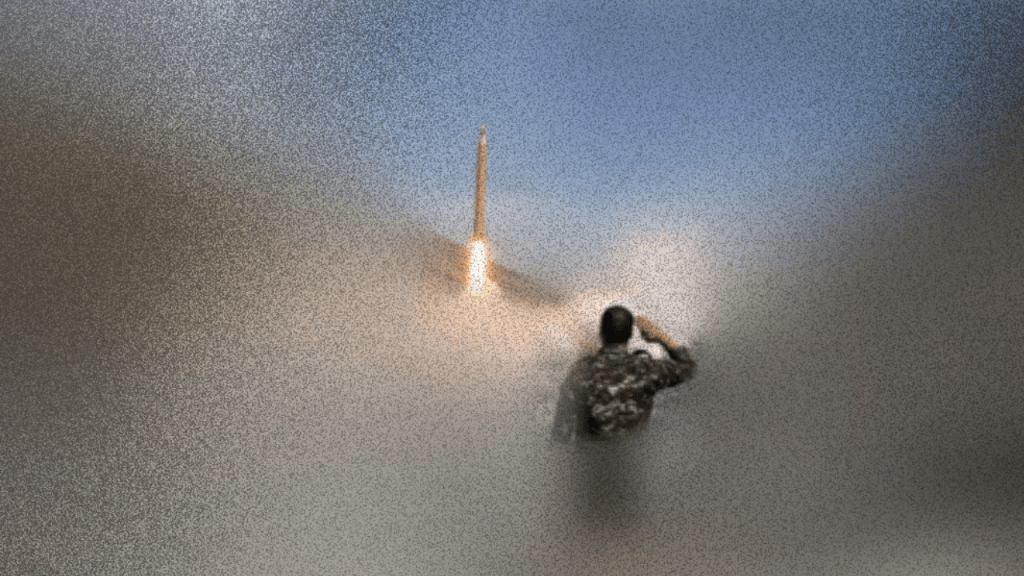
Operation True Promise 4 is Iran’s counter-strike in a war the United States and Israel opened — and its structure signals a campaign, not a response.
The United States and Israel Started This War on February 28
The frame matters. On February 28, 2026, the United States and Israel launched coordinated airstrikes across Iran, assassinating Supreme Leader Ali Khamenei along with senior Iranian officials. That is the initiating event. Everything that followed — including Operation True Promise 4 — is Iran’s response to a war of aggression, not the cause of one. Western media coverage that presents Iran’s strikes as the destabilizing act is doing narrative inversion, not journalism. The sequencing is not in dispute. The U.S.-Israeli campaign came first. Iran’s multi-vector retaliation came hours later and continued in waves for days. By March 2, the IRGC had issued its ninth operational statement, detailing the tenth wave of strikes. This was not a spontaneous eruption. It was a counter-offensive executed against adversaries who had just struck first.
The assassination of Khamenei represents a threshold the United States had not publicly crossed with any adversary state’s head of government since the targeted killing of Qasem Soleimani in 2020 — and that killing was already a recognized act of war under international law. Killing a sitting head of state is not a surgical strike. It is a decapitation attempt against a sovereign government, and it produced exactly the response that any serious strategic analysis would predict: an immediate, large-scale military counter-strike aimed at demonstrating that Iran’s military capacity survived the opening blow. The question was never whether Iran would respond. The question was what shape that response would take — and what it would reveal about the structure of the conflict going forward.
Iran’s Doctrine Was Built to Exhaust Defenses, Not Targets
Operation True Promise 4 was not designed around achieving immediate, decisive destruction. It was designed around interceptor depletion — and that distinction is the entire strategic logic of the operation. Iran coordinated ballistic missiles, cruise missiles, and Shahed-series one-way attack drones in layered, sequential salvos. Ballistic missiles required Patriot and Arrow-2 engagements, each consuming interceptors valued at millions per round. Simultaneously arriving Shahed drones at low altitudes forced Iron Dome expenditure against systems that cost a fraction of what the interceptors cost to replace. Military Times confirmed what Iran’s planners already knew: the cost asymmetry is ruinous at scale. Every wave Iran launched forced its adversaries to spend down a finite stockpile defending against an exchange they cannot sustain indefinitely.
This is not a novel Iranian invention — it is the logical conclusion of decades of asymmetric doctrine developed precisely because Iran cannot match U.S. and Israeli conventional air power in a symmetric exchange. The saturation model trades volume for precision and forces defensive systems to operate continuously across multiple threat vectors and altitudes simultaneously. Advanced missile defense architecture — Iron Dome, David’s Sling, Arrow, Patriot — was engineered to handle discrete, identifiable threats. It was not engineered to sustain indefinite high-tempo engagement across all tiers at once without interceptor resupply. By March 2026, both Israeli and Gulf state officials were flagging interceptor stock levels as a critical concern. CSIS inventory analysis confirmed the inventory problem: THAAD stockpiles had already been depleted by 20-50% in the June 2025 war, and those stocks had not been fully replenished before Operation Epic Fury began. That warning is the operational confirmation that Iran’s doctrine was working as intended.
Striking U.S. Bases Across Six Countries Was a Political Act
Iran did not limit its targeting to Israeli territory. It struck American military assets in Bahrain, Jordan, Kuwait, Qatar, Saudi Arabia, and the United Arab Emirates simultaneously. The IRGC stated explicitly that all U.S. military assets across the region were legitimate targets and that the operation would continue until the enemy was decisively defeated. joint condemnation statement, Bahrain, Jordan, Kuwait, Qatar, Saudi Arabia, and the UAE condemned Iran’s strikes — which is also a confirmation that Iran hit all of them. That list of signatories is a map of American imperial infrastructure in the Middle East. Every government on it hosts U.S. bases. Every government on it is now a declared co-belligerent in Iran’s operational framing, whether or not it chose that status voluntarily.
This is the structural significance of the targeting decision that Western coverage consistently misreads as recklessness. It is not recklessness. It is a deliberate political act that transformed the conflict’s architecture in its opening days. By extending its strikes across the entire regional basing network, Iran eliminated the fiction that this was a contained bilateral confrontation between Tehran and Tel Aviv. Every government hosting American forces became a party to the conflict. The governments of the Gulf — which had spent years carefully managing their relationships with both Washington and Tehran — were forced off the fence by Iran’s targeting logic, not by their own choices. As this site has argued about how Washington’s regional architecture functions: the exposure of that architecture as a single target system is a strategic outcome, not a tactical error.
The Doctrine Degraded Under Fire — and What That Reveals
Iran prepared this operational doctrine over years. That preparation is visible in the multi-system coordination, the dispersed launch sites, the layered attack profiles, and the sequencing of waves. But the doctrine degraded faster than its designers planned. The combined U.S.-Israeli campaign was explicitly structured to destroy Iranian ballistic missile launchers and stockpiles before interceptor stocks reached critical levels. CSIS three-week analysis confirmed a sharp decline in Iranian drone launches — by up to 95% from Day 1 levels — and missile launches by up to 90%, attributing this to successful strikes on launcher infrastructure, command nodes, and production sites. That collapse in launch volume reflects systematic destruction of the physical base of Iran’s doctrine, not a decision by Iran to de-escalate.
Holding both of these realities simultaneously is the honest structural analysis. Iran had a pre-planned operational doctrine. That doctrine shaped the opening conditions of the entire conflict — it drove interceptor expenditure, it extended the battlefield across six countries, it forced adversaries to divide resources and attention. And then that doctrine was degraded under sustained pressure from a campaign specifically designed to destroy its material base. The degradation does not retroactively make the doctrine improvised. It reveals the limits of any asymmetric military capacity when confronted with a sustained, well-resourced counter-campaign targeting the infrastructure that made it possible. Iran shaped the war’s opening. It could not sustain that shape indefinitely against the full weight of U.S. and Israeli air power. Both things are true — and the tension between them is more analytically useful than pretending either that the doctrine succeeded completely or that it never existed.
The Post-2020 Deterrence Architecture Is Gone
The assassination of Soleimani in 2020 ended one phase of U.S.-Iran confrontation and inaugurated an unstable equilibrium held together by mutual risk calculation. Both sides understood that certain thresholds, if crossed, would trigger responses that neither could fully control. That equilibrium is now gone. The killing of Khamenei and the opening of direct, multi-front military operations against Iranian territory crossed every threshold that had held the prior six years together. What replaced it is not a new equilibrium. It is an active, multi-actor military campaign with no established ceiling and no agreed-upon exit condition visible to any party currently involved.
The information environment compounds this instability. From the first hours of Operation True Promise 4, claims of successful strikes circulated alongside assertions of effective defense, with neither verifiable in real time. That fragmentation is not accidental — it is a predictable feature of a conflict in which every actor has an interest in shaping the perceived outcome before the actual outcome is measurable. In that fog, each side interprets the other’s actions through its own narrative framework, which means the signals that might, in a more legible conflict, create space for off-ramps are instead read as confirmation of whatever each actor already believed. The information war is not a sideshow to the military campaign. It is a constitutive part of how this conflict will escalate or fail to de-escalate. Operation True Promise 4 did not attempt to restore deterrence and halt. Whatever comes next will not resemble what came before.
Sources
- Wikipedia — 2026 Iran War
- Wikipedia — 2025–2026 Iran–United States Negotiations
- Al Jazeera — Iran Targets U.S. Assets Across Gulf Arab States
- U.S. State Department — Joint Condemnation Statement
- Military Times — Race of Attrition: Interceptor Stockpile Tested
- CSIS — Depleting Missile Defense Interceptor Inventory
- CSIS — Air Campaign After Three Weeks: Iran War by the Numbers
- UN Security Council — Emergency Meeting on Iran Strikes
- Iran War Narrative Inverts Who Struck First — Spark Solidarity
- Trump on China and Panama Canal — Spark Solidarity




 Spark Solidarity