
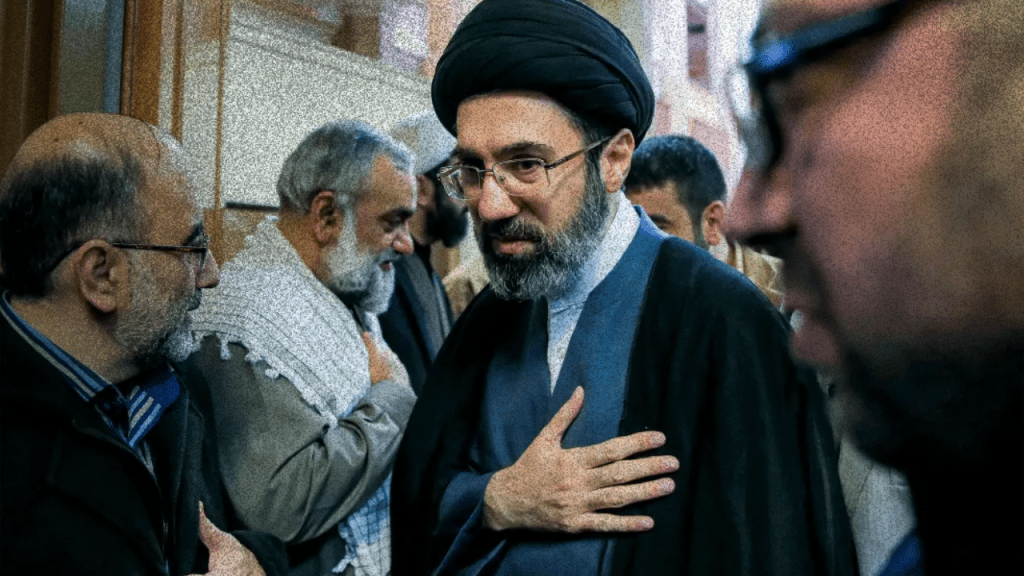
Mojtaba Khamenei injury reports are spreading online — timelines reversed, death tolls invented, conditional claims presented as confirmed fact.
The US-Israeli war on Iran launched on February 28, 2026. Within days, a second problem emerged alongside the military one: online coverage of the war began manufacturing a false picture of events — not through outright invention, but through a specific pattern of misreading real sources. Conditional assessments became confirmed facts. Timelines got reversed to produce more dramatic sequences. Numbers with no sourcing anywhere circulated at scale. Understanding what is actually happening in Iran requires clearing that record.
The Mojtaba Injury: What Iran Said
When Iran’s Assembly of Experts named Mojtaba Khamenei the country’s new Supreme Leader on March 8, Iranian state television broadcast coverage describing him as janbaz — a Persian honorific for someone wounded by the enemy in war. State media did not specify when, where, or how he had been injured. They used the term in the context of the ongoing conflict, which Iranian media calls the Ramadan War.
That was the primary source. One word. No timeline. No details. Yousef Pezeshkian, the son of Iranian President Masoud Pezeshkian, confirmed through state-affiliated ISNA that he had heard the new Supreme Leader was injured, but said he was “safe and sound.” Iran’s ambassador to Cyprus, Alireza Salarian, later told The Guardian that Mojtaba had been injured in the same airstrike that killed his father on February 28 — the first day of the war. Al Jazeera reported his appointment on March 8 and noted that he had not been seen publicly since the war began. As of this writing, Mojtaba has not appeared publicly or issued any statement.
What circulated online was something else entirely. Multiple accounts presented the Mojtaba Khamenei injury as a confirmed assassination attempt that happened after his appointment — a targeted strike on Iran’s brand new Supreme Leader within hours of taking power. That narrative has no basis in any source. It was built by reversing the timeline — an early, conditional Israeli intelligence assessment from March 7 (the day before his appointment) was reframed as something that happened on day one of his leadership. The conditional language was stripped. The sequence was inverted. The result was a fabricated story, assembled from real sources, that replaced the documented record.
Western outlets including the New York Times, CNN, and Reuters eventually confirmed the injury in more specific terms — all placing it on February 28, the opening day of the war, weeks before Mojtaba became Supreme Leader. That confirmation, when it came, was consistent with what Iranian state media and Iranian officials had already indicated. The story that spread online was not.
The January Protests: What’s Missing From the Story
A figure of 60,000 protest deaths has circulated in some online coverage of the January 2026 crackdown. That number does not exist in any source — not from human rights organizations, not from the UN, and not from the Iranian government itself. The documented range is already one of the worst episodes of state violence in modern history. Iran Human Rights verified at least 3,428 protesters killed as of January 14.
The Iranian government acknowledged 3,117 deaths. HRANA confirmed 7,015 by February 5, with 11,744 additional cases under review. The UN Special Rapporteur on Iran stated the toll could surpass 20,000. Time and The Guardian, citing physicians inside the country, reported estimates of 30,000 or more deaths on January 8 and 9 alone. Iran International, reviewing classified government documents, put internal IRGC figures at over 36,500. Inventing a figure beyond any of these does not honour the people killed — it introduces a claim that can be challenged and dismissed, eroding the evidentiary record rather than strengthening it.
But the inflation of death tolls is not the only distortion in how these protests have been covered. Western mainstream media has almost entirely omitted a dimension of the January events that is documented, on the record, and acknowledged by sources ranging from the Mossad itself to the Turkish foreign minister: the active role of foreign intelligence operations in escalating what began as an economic protest into armed violence.
The protests were real. The economic grievances — a collapsing currency, roughly 42% inflation, and food prices rising as much as 72% in a single year — were genuine and severe.
These conditions did not emerge in a vacuum. Iran’s economic crisis has unfolded under years of escalating international sanctions, particularly those imposed by the United States after withdrawing from the 2015 nuclear agreement and reinstating sweeping restrictions on Iran’s banking system, oil exports, and access to global financial markets.
Those sanctions severely limited Iran’s ability to sell oil, conduct international trade, and access foreign currency, driving a sharp depreciation of the rial and contributing to runaway inflation and shortages of imported goods. Economists and policy analysts have repeatedly noted that sanctions have played a major role in creating the inflation, unemployment, and loss of income that fueled public anger and social unrest.
What is also documented is that once those protests began, they became a target for external interference almost immediately. On December 29, 2025, a Farsi-language X account widely identified as affiliated with the Mossad published a direct call to Iranians: “Let’s come out to the streets together. The time has come. We are with you. Not just from afar and verbally. We are also with you on the ground.” On January 2, U.S. Secretary of State and CIA Director Mike Pompeo posted a message of support for the protests that included a direct implication that Mossad agents were among the demonstrators. These are not claims made by the Iranian government. They are statements that emerged from figures within the Israeli and American intelligence establishment itself.
Turkish Foreign Minister Hakan Fidan, speaking on January 10, was direct: “The Mossad is not hiding this. They are calling on the Iranian people to rise up against the regime through their internet and Twitter accounts.” John Mearsheimer, writing for Antiwar.com on January 20, documented how foreign actors worked with local agitators to turn peaceful demonstrations into violent confrontations — a tactic he placed in the broader context of the US-Israeli strategy of destabilization that preceded the February 28 military assault. Iranian authorities announced the arrest of an alleged Mossad operative found among protesters in Tehran, with weapons and ammunition discovered in safe house raids across the city. Iranian police chief Brigadier General Ahmadreza Radan confirmed that ringleaders had been “receiving dollar payments from outside the country.”
None of this erases the documented state violence. The IRGC killed protesters. That is confirmed by multiple independent sources. But the fact remains that the escalation of violence cannot be understood in isolation from the external actors who openly sought to inflame the unrest. It is highly unlikely that the protests would have become as violent, or that as many people would have been killed, if intelligence-linked networks had not been actively encouraging confrontation on the ground.
The picture that Western coverage produced — an organic uprising, peaceful protesters, and violence that began exclusively with the state — omitted a documented layer of the story that even Israeli and American officials were publicly acknowledging. The protests were genuine. They were also targeted for exploitation. Both things are true, and treating either one as sufficient on its own produces a false picture of what January 2026 actually was.
How Misinformation Serves the War
These errors are not neutral. They fit a context in which the information environment around the Iran war is being actively shaped by governments, militaries, and media ecosystems that reward confidence over accuracy. When online coverage inflates protest death tolls beyond any documented figure, or constructs a dramatic assassination narrative from a conditional intelligence assessment, it does not strengthen opposition to the war — it muddies the evidentiary record that serious accountability depends on.
The smaller errors follow the same logic. Al Jazeera reported that Mojtaba’s mother, wife, and sister were killed in the February 28 strike on the Khamenei compound. Iranian state media reporting cited by CNN named his wife and one of their children. Some online accounts got these specific family members wrong — minor in isolation, but part of a broader pattern of treating the Iran war as a narrative to be dramatized rather than a documented reality to be accurately reported.
Oil market coverage offers a further illustration. On March 9, WTI crude hit an intraday high of $119.48 before pulling back to settle at $94.77 — its largest weekly gain since futures trading began in 1983, according to CNBC. Some coverage described the market as “hovering around $100.” That framing missed both the scale of the spike and the speed of the pullback. The volatility was the story. Smoothing it into a stable figure missed what actually happened.
Across each of these cases, the problem is the same: the sources being cited are real. The reporting they’re drawn from is often serious. What is being added — the invented certainty, the reversed timeline, the unsourced numbers — is not in those sources. It is being layered on top of them.
The documented record of what the US-Israeli war on Iran is doing — to Iran’s leadership, to Iranian civilians, to the region — is already significant. It does not require a false picture to make the case.
Sources
- Al Jazeera, March 8, 2026 — Who is Mojtaba Khamenei, Iran’s new supreme leader amid war: https://www.aljazeera.com/features/2026/3/8/who-is-mojtaba-khamenei-a-contender-for-irans-leadership-amid-war
- Al Jazeera, March 8, 2026 — Iran names Mojtaba Khamenei as new supreme leader: https://www.aljazeera.com/news/2026/3/8/iran-names-khameneis-son-as-new-supreme-leader-after-fathers-killing-2
- Iran International, March 9, 2026 — Iran state TV calls Mojtaba Khamenei janbaz: https://www.iranintl.com/en/202603093317
- CNN, March 11, 2026 — Mojtaba Khamenei suffered fractured foot on first day of war: https://www.cnn.com/2026/03/11/middleeast/mojtaba-khamenei-injuries-iran-supreme-leader-latam-intl
- The Hill, March 11, 2026 — New Iranian leader Mojtaba Khamenei wounded early in US operation: https://thehill.com/policy/defense/5778681-new-iran-leader-khamenei-injured/
- Times of Israel, March 7, 2026 — Israel believes Mojtaba Khamenei still alive after targeted in strikes: https://www.timesofisrael.com/liveblog_entry/israel-believes-mojtaba-khamenei-still-alive-after-targeted-in-strikes-earlier-this-week/
- Jerusalem Post, March 9, 2026 — Mojtaba Khamenei injured but still functioning as Iran’s leader: https://www.jpost.com/middle-east/iran-news/article-889520
- Iran Human Rights (IHR), January 14, 2026 — At least 3,428 protesters killed: https://iranhr.net/en/articles/8529/
- Amnesty International, January 2026 — What happened at the protests in Iran: https://www.amnesty.org/en/latest/campaigns/2026/01/what-happened-at-the-protests-in-iran/
- Time, January 25, 2026 — More than 30,000 killed in Iran: https://time.com/7357635/more-than-30000-killed-in-iran-say-senior-officials/
- Iran International, January 25, 2026 — Over 36,500 killed in Iran’s deadliest massacre: https://www.iranintl.com/en/202601255198
- OHCHR, February 2026 — UN experts demand transparency following Iran protests: https://www.ohchr.org/en/press-releases/2026/02/iran-un-experts-demand-transparency-and-accountability-following-nationwide
- Jerusalem Post, January 2026 — Mossad spurs Iran protests, says agents with demonstrators in Farsi message: https://www.jpost.com/middle-east/iran-news/article-881733
- Jerusalem Post, January 2026 — Turkish FM accuses Mossad of stoking Iran protests: https://www.jpost.com/middle-east/article-882890
- Press TV, January 14, 2026 — How Mossad and CIA sabotaged economic protests in Iran: https://www.presstv.ir/Detail/2026/01/14/762313/how-mossad-cia-sabotaged-economic-protests-iran-stir-chaos-but-failed
- Antiwar.com / John Mearsheimer, January 20, 2026 — The Tag Team Fails in Iran: https://original.antiwar.com/john-mearsheimer/2026/01/20/the-tag-team-fails-in-iran/
- CNBC, March 9, 2026 — Oil prices surge above $100: https://www.cnbc.com/2026/03/09/oil-prices-iran-war-middle-east-us-israel-strait-of-hormuz.html
- CNBC, March 6, 2026 — Iran-US war oil prices: https://www.cnbc.com/2026/03/06/iran-us-war-oil-prices-brent-wti-barrel-futures.html


 Spark Solidarity