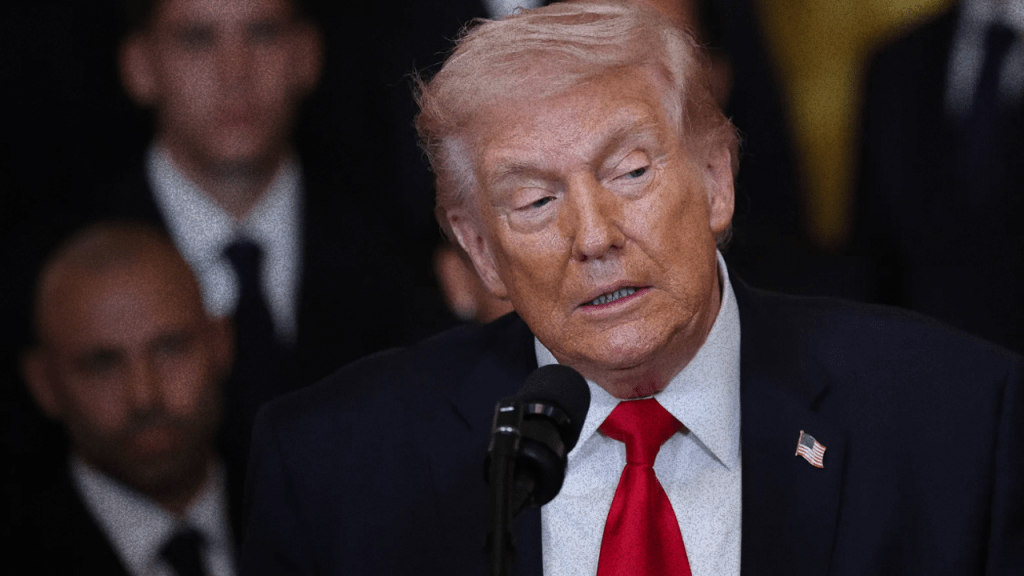
Trump’s “I guess” answer on Iran retaliation risk is already activating the security machine that manufactures the plots it claims to stop.
Trump Normalizes Fear of Domestic Attack
In the first week of the escalating conflict with Iran, Donald Trump was asked whether Americans should worry about retaliatory attacks at home. His answer was blunt: “I guess.” The remark was not delivered as warning or strategy. It sounded casual. But statements like that normalize the expectation that violence might soon reach domestic soil. Once that expectation enters public discourse, the familiar machinery of national security politics begins to move. Media outlets run stories about sleeper cells and lone-actor threats. Intelligence agencies warn of potential retaliation. Politicians discuss expanded surveillance powers and stronger domestic counterterrorism tools.
This pattern has repeated so often over the past two decades that it has become a governing reflex. War abroad produces fear at home. Fear produces political support for stronger security powers. And those powers lead to a steady stream of terrorism arrests that appear to confirm the severity of the threat. This cycle is the central subject of Trevor Aaronson’s Terror Factory investigation. The investigation argues that much of the post-9/11 counterterrorism apparatus does not simply uncover plots. In many cases, it creates them. The pattern was already visible before the current conflict: the Asif Raza case — charges against a Pakistani national alleged to have Iranian ties in a Trump assassination plot — arrived during a prior escalation cycle, fitting the same template of timely arrests tracking geopolitical tension. For how the information environment is simultaneously managed through media targeting, see the State Broadcaster piece.
FBI Built 15,000-Informant Network in Muslim Communities
After September 11, the FBI shifted from reactive law enforcement to preemptive counterterrorism. Instead of waiting for attacks to occur, investigators began searching for individuals who might be willing to commit them. By the early 2010s, the bureau had developed fifteen thousand informants, the largest in its history. Many operated inside Muslim communities across the United States. Mosques, student groups, and social networks were routinely monitored through individuals working with federal investigators.
The informants themselves often had powerful incentives to cooperate. Some were paid substantial sums. Others faced criminal charges and agreed to assist in exchange for reduced sentences. Some were immigrants concerned about their legal status. Because their compensation or legal benefits depended on producing useful information, the system created an incentive structure that encouraged informants to generate cases rather than observe potential threats. In many cases, informants did far more than report suspicious behavior. They played central roles in constructing the plots that eventually led to arrests.
Sting Operations Follow a Predictable Script
A pattern appears repeatedly in domestic terrorism prosecutions. First, investigators identify a target, often someone who has expressed anger toward U.S. foreign policy or sympathy for extremist groups online. In many cases, the person is socially isolated, financially desperate, or psychologically unstable. Second, an informant or undercover agent approaches the individual, posing as a representative of a terrorist organization. Third, the undercover operative introduces the idea of a specific attack. Fourth, investigators provide the tools needed to carry out the plot. Finally, the suspect is arrested at the moment he attempts to execute the attack, using weapons or explosives that are secretly controlled by law enforcement.
This pattern appears in dozens of cases prosecuted after 9/11. The result is a steady flow of dramatic arrests that appear to demonstrate the constant presence of domestic terror threats. Yet in many of these cases, the suspects lacked the means or capability to conduct an attack on their own.
Newburgh Four: FBI Supplied the Entire Plot
One of the most controversial examples is the Newburgh Four case from 2009. Four men from Newburgh, New York were arrested for plotting to bomb synagogues in the Bronx and shoot down military aircraft. The operation had been largely orchestrated by FBI informant Shahed Hussain. Hussain approached the men, proposed the bombing plan, and offered them large sums of money to participate. The explosives and missiles used in the plot were fake devices provided by federal agents. The informant even drove the suspects to the target locations.
When the men attempted to detonate the inert explosives, they were arrested. During sentencing, the presiding judge acknowledged the unusual nature of the case, noting that the government had supplied the plot, the weapons, and the opportunity. Another widely discussed example occurred in Portland, Oregon in 2010. A Somali-American teenager named Mohamed Osman Mohamud attempted to detonate a bomb at a Christmas tree lighting ceremony. Undercover FBI agents had contacted Mohamud after he expressed extremist views online, posed as members of al-Qaeda, and worked with him to plan the attack. The bomb was an inert device provided by investigators.
Canada’s Mr. Big Tactic Uses the Same Logic
Canada has long employed a controversial policing method known as the Mr. Big technique. In a typical operation, Mr. Big technique — undercover officers befriend a suspect and gradually recruit him into a fake criminal organization. The suspect participates in staged criminal activities designed to build trust. Eventually, he is introduced to the fictional crime boss known as Mr. Big. The boss explains that membership requires full honesty about past crimes. If the suspect confesses, the statement is secretly recorded and later used in court. The technique creates enormous psychological pressure on suspects, particularly those who are lonely or financially desperate. Some cases have resulted in false confessions.
BC Court: RCMP Sting Was a Travesty of Justice
The most controversial Canadian terrorism case occurred in British Columbia in 2013. Two suspects, John Nuttall and Amanda Korody, were accused of plotting to detonate pressure-cooker bombs outside the provincial legislature during Canada Day celebrations. Undercover officers posing as terrorists supplied the materials used to construct the bombs and helped guide the plot. In July 2016, Justice Catherine Bruce ruled that the RCMP had entrapped the suspects. The B.C. Court of Appeal upheld the stay in December 2018, with judges describing the operation as “a travesty of justice.” The ruling remains one of the strongest judicial rebukes of a terrorism sting in Canada.
Known Wolf Problem Exposes Surveillance State Limits
Despite the scale of modern surveillance and undercover operations, real attacks still occur. Two incidents in Canada in October 2014 highlight the contradictions of the modern security system. On October 20, Martin Couture-Rouleau drove a vehicle into Canadian soldiers in Saint-Jean-sur-Richelieu, Quebec. One soldier was killed. Two days later, Michael Zehaf-Bibeau shot and killed a soldier standing guard at the National War Memorial in Ottawa before entering Parliament Hill. Both were known to Canadian security agencies before the attacks.
Zehaf-Bibeau movement questions about how he moved undetected in the lead-up to the attack remain unresolved. The question of how CSIS missed both men despite active monitoring generated significant analysis. Parliament Hill analysis examined whether the attack represented an intelligence failure or something more systemic — a question the security establishment never fully answered. The incidents became examples of what analysts call the known wolf problem: attackers who appear on intelligence radar but still manage to act.
Attack-to-Legislation Cycle Expands Security Powers
The political consequences of those attacks were swift. Within months, the Canadian government introduced sweeping national-security legislation known as Bill C-51. The law expanded intelligence sharing between government agencies, broadened the definition of activities that could threaten national security, and granted CSIS new powers to disrupt suspected threats. The debate followed a familiar pattern seen in many countries. An attack occurs. Fear spreads. Governments introduce new security powers. Those powers are justified as necessary responses to the threat that has just been demonstrated.
The same diaspora networks and community ties that intelligence agencies already surveill as potential threats — as documented in Weaponized Diaspora analysis — become grounds for expanded monitoring during each new conflict. For how exile infrastructure is mobilized in parallel to generate domestic political cover, see the Exile Networks piece.
The Security Machine Is Already Moving
The War on Terror did not end when the wars in Iraq and Afghanistan wound down. It created a permanent domestic security infrastructure. That infrastructure includes surveillance networks, informant systems, specialized counterterrorism units, and legal frameworks designed to support preemptive investigations. Once such a system exists, periods of geopolitical tension naturally activate it. Foreign conflict generates fear of retaliation. Fear legitimizes expanded security measures. Those measures produce investigations and arrests that appear to confirm the severity of the threat.
The result is a self-reinforcing cycle in which the machinery of counterterrorism continuously justifies its own expansion. The Terror Factory investigation argues that the modern counterterrorism system does not simply respond to danger. It also shapes how danger is perceived, investigated, and sometimes produced. When war abroad raises fears of retaliation at home, the system is ready to react. The Vancouver attacker known to police before the attack, extending a pattern that decades of expanded security infrastructure has not broken. Meanwhile, CIA 9/11 intervention in the plea deal illustrates how deeply the security apparatus resists any accounting for what it actually knew and when. As tensions rise once again, the question is not whether that machinery still exists. It does. The question is whether the public recognizes the system when it begins to move again.
Sources
- FBI informant network exposed — Mother Jones, August 2011
- FBI Michigan kidnap informant — The Intercept, May 5, 2021
- Rethinking FBI entrapment tactics — Brennan Center
- Portland FBI sting operation — The Guardian, November 28, 2010
- Mr. Big technique examined — Luther & Snook, Journal of Forensic Practice, 2016
- BC entrapment ruling Nuttall — CBC News, July 29, 2016
- BC appeal travesty ruling — Global News, December 2018
- October 2014 attacks known — CBC News, October 2014
- Asif Raza Merchant charged — Spark Solidarity, August 2024
- How did Zehaf-Bibeau’s car avoid detection — Spark Solidarity
- How did CSIS miss them — Spark Solidarity
- Attack on Parliament security fail — Spark Solidarity
- Vancouver attacker was known to police — Spark Solidarity, April 2025
- CIA’s intervention in the 9/11 plea deal — Spark Solidarity, July 2025
- Weaponized Diaspora and the Witnesses Empire Needs — Spark Solidarity
- Iran State Broadcaster Strike: Silencing the War’s Own Story — Spark Solidarity
- Exile Networks: How Trump Runs Regime Change in 2026 — Spark Solidarity