
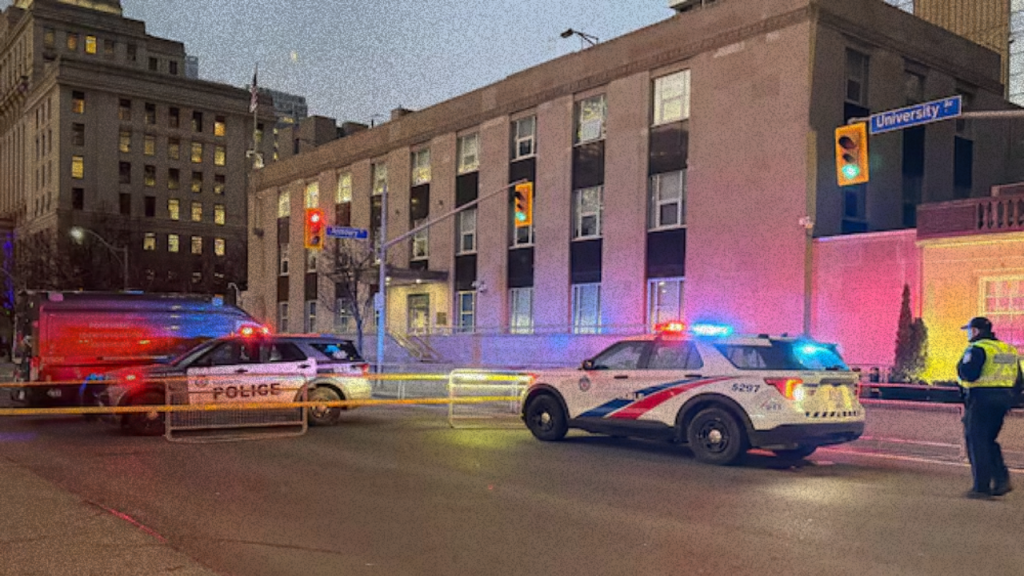
Toronto U.S. Consulate shooting exposes a documented pattern: the Canadian security state decides what gets solved, what stays open, and who pays the price.
Shots Fired. No Suspects. No Motive. No Surprise.
At approximately 4:30 in the morning on March 10, 2026, a white Honda CR-V stopped in front of the United States Consulate General on University Avenue in downtown Toronto. Two men stepped out of the vehicle, fired multiple rounds from a handgun at the front of the building, got back into the car, and drove south. Within hours, the political machinery of the Canadian state was fully activated. The Prime Minister condemned it. The Premier condemned it, invoking the spectre of “sleeper cells.” The Mayor condemned it. The RCMP’s Integrated National Security Enforcement Team was engaged. FBI coordination was announced. Security was increased at American and Israeli diplomatic facilities across Ontario.
No suspects have been identified. No motive has been confirmed. The car drove away.
This is a city blanketed by Automated License Plate Recognition technology — technology that Toronto Police have publicly called a “game-changer” for security operations, capable of scanning thousands of plates per hour. The consulate itself is under constant surveillance. There were cameras. There were shell casings. There was a vehicle description. The building is, by the Deputy Chief’s own description, “highly secure, highly fortified.” The staff inside may not have even noticed the gunfire, so encased in metal and glass is the structure.
The suspects drove south on University Avenue and disappeared.
This came three days after two synagogues in North York and Thornhill were struck by gunfire in the early hours of Saturday morning. Which came four days after Temple Emanu-El in North York was shot at shortly before 11pm following a Purim celebration. Which followed months of similar overnight incidents stretching back through 2024 across the Greater Toronto Area and Montreal — a series of shootings at Jewish schools, synagogues, and community institutions, consistently overnight, consistently without injuries, consistently without independent witnesses, consistently without public arrests.
The consulate shooting is not the beginning of a story. It is the latest chapter of one. And to understand what that story actually is, you need to start where it starts — not this morning, but October 7, 2023.
Since October 7: The Pattern Nobody Will Name
In the weeks and months following Hamas’s October 7, 2023 attack on Israel, and Israel’s subsequent military campaign that has killed tens of thousands of Palestinians in Gaza, Canadian political life was split along a fault line that has not closed since. On one side: a broad, sustained, and largely peaceful pro-Palestine movement demanding ceasefire, arms embargoes, and accountability. On the other: a coordinated institutional effort — from lobby organizations, federal politicians, and the security apparatus itself — to frame that movement as a threat to Jewish safety in Canada.
Into this environment, beginning in early 2024 and continuing with accelerating frequency through the beginning of 2026, came a wave of overnight shootings at Jewish institutions across the Greater Toronto Area and Montreal. The timeline, documented across public reporting:
May 2024: two masked suspects emerge from a vehicle at 4:52 in the morning and fire multiple shots at Bais Chaya Mushka, a Chabad girls’ school in Toronto’s North York. No injuries. No eyewitnesses. Evidence: security footage and police statements. Within a week, at least one bullet strikes the Belz Yeshiva Ketana at the Young Israel of Montreal synagogue overnight. Days later, a second Montreal Jewish school is struck. No injuries. No independent witnesses.
October 2024: Bais Chaya Mushka is struck again — on Yom Kippur. No injuries. December 2024: the same school is hit a third time, at 2:33 in the morning. March 2026: Temple Emanu-El in North York is struck by gunfire shortly before 11pm following a Purim celebration. Multiple shell casings at the front entrance, bullet holes in windows and doors. No suspect information confirmed. Within four days, Beth Avraham Yoseph in Thornhill and Shaarei Shomayim in North York are both struck by gunfire within roughly an hour of each other. By the count of UJA Federation of Greater Toronto president Adam Minsky, this marks at least four Jewish institution shootings in Toronto in two years. Three days later, the US Consulate is hit.
Across more than a dozen incidents in two cities over more than two years: overnight timing, no injuries, no independent witnesses, evidence limited to surveillance footage and police statements, investigations described as “relentless” with minimal public updates on arrests. The CBC reported on a Jewish community increasingly afraid and increasingly frustrated by the lack of resolution.
Now here is where most analysis stops, and where it shouldn’t. The dominant explanations on offer are either that this is antisemitic terrorism carried out by pro-Palestinian extremists, or that it is a Zionist conspiracy to manufacture a threat narrative. The first explanation ignores the empirical strangeness of the pattern.
The second is usually dismissed out of hand as conspiratorial. But that dismissal misses something obvious.
There is only one set of institutions in Canada with the power, reach, and historical track record capable of shaping narratives of domestic threat at this scale: the security state itself. Intelligence agencies, national security policing units, and the political apparatus that surrounds them have spent decades constructing, amplifying, and managing perceived threats in ways that justify surveillance, repression, and expanded authority.
This does not require some cartoonish centralized plot. What it suggests instead is something far more familiar in the history of national security politics: a symbiotic relationship.
Certain actors benefit from heightened threat narratives, while the security apparatus benefits from the legitimacy, funding, and expanded powers that those narratives produce.Once you understand how the Canadian security state actually operates, the pattern stops looking mysterious.
It starts looking institutional.And for that, you need the receipts.
Canada’s Documented Security State Record
In 1919, the German sociologist Max Weber delivered a lecture called “Politics as a Vocation” that established what remains the foundational definition of the modern state. The state, Weber argued, is the entity that claims a monopoly on the legitimate use of physical force within a given territory. Not just the entity that uses force — the entity that decides who is permitted to use it, under what conditions, against whom, and with what justification.
The monopoly has a maintenance requirement. It needs ongoing justification. A security apparatus without threats has no mandate, no budget, and no political cover. This is not a conspiracy — it is an institutional logic that operates whether or not any individual within the system consciously intends it. Police agencies need crime. Intelligence agencies need threats. The counterterrorism apparatus, built at enormous expense following September 11, needs terrorism. The question is never whether the security state will find ways to demonstrate its necessity. The question is how it does so, and at whose expense.
In Canada, the answers to that question are not theoretical. They are documented in court rulings, parliamentary records, and civil lawsuits. There are two distinct failure modes on the record: the apparatus manufacturing threats that do not exist, and the apparatus managing non-resolution of threats that do. Both matter here.
Manufacturing Threats: The Terror Factory on Canadian Soil
The most thoroughly documented case of the Canadian security apparatus manufacturing the threats it claims to be neutralizing is the BC Legislature bomb plot. John Nuttall and Amanda Korody were recovering heroin addicts living in Surrey, British Columbia. Recent converts to Islam, they held extreme views and were, by the trial judge’s assessment, entirely incapable of acting on them without outside direction. In early 2013, the RCMP launched “Project Souvenir” — a six-month undercover operation approved despite a “lack of evidence of any criminal activity or plans to engage in criminal activity.” An undercover officer posing as an Arab businessman befriended the couple, provided religious “guidance,” exploited their vulnerabilities, and steered their grandiose and incoherent ambitions — they had talked about hijacking nuclear submarines — toward something executable. The police provided the C-4 explosive. The police provided the fake detonators. The couple placed what they believed were functional pressure cooker bombs on the grounds of the BC Legislature on Canada Day 2013. They were convicted by a jury in 2015.
Then BC Supreme Court Justice Catherine Bruce stayed the proceedings. Her ruling: “Simply put, the world has enough terrorists. We do not need the police to create more out of marginalized people who have neither the capacity nor the sufficient motivation to do it themselves.” The BC Court of Appeal upheld the stay unanimously in 2018. One justice called the investigation “a travesty of justice.” Nuttall and Korody filed a civil lawsuit against the RCMP, Crown prosecutors, and both governments. Their lawyer: they “would not have been a threat to the Canadian public if it weren’t for the actions of the RCMP.”
The Toronto 18 case — Canada’s landmark 2006 anti-terror prosecution — involved two embedded informants. Mubin Shaikh was paid $300,000 by the RCMP, led training camps, and bought bullets for the group. He described the Toronto 18 as being “at a very low level of capability.” Shaher Elsohemy — who initially requested $15 million in compensation and received $4.1 million — arranged the phony ammonium nitrate purchase that formed the basis of the bomb plot charges. Charges were stayed against seven of the eighteen accused.
This is not unique to Canada. In the United States, researcher Trevor Aaronson documented in The Terror Factory that in the overwhelming majority of domestic terrorism prosecutions following September 11, an FBI informant was central to developing the plot — not merely observing it. In Australia, a Victorian court found undercover officers had groomed a 13-year-old autistic Muslim boy via Discord into a fake terrorism plot. The Five Eyes counterterrorism model produces this outcome not by accident but by design: informants are paid to find threats, and when threats don’t exist at the required level of prosecutability, informants help create them.
Managing Non-Resolution: When the State Looks Away
The apparatus’s second documented failure mode is the inverse: managing the non-resolution of real threats when resolution serves institutional purposes less well than continuation. The 2014 attacks are the clearest Canadian case.
On October 20, 2014, Martin Couture-Rouleau drove his car into two Canadian soldiers in Saint-Jean-sur-Richelieu, Quebec, killing Warrant Officer Patrice Vincent. RCMP Commissioner Bob Paulson confirmed his passport had been seized and that he was one of 90 suspected extremists under active investigation. He had been arrested at the airport in July attempting to travel to Turkey. The RCMP had enlisted his family in de-radicalization efforts and had spoken with him as recently as October 9 — eleven days before the attack. He killed a soldier anyway.
Two days later, Michael Zehaf-Bibeau shot Corporal Nathan Cirillo at the National War Memorial in Ottawa and stormed Parliament Hill. His email had been found on the hard drive of an individual the RCMP had charged with terrorist-related offences. The Commissioner confirmed the force had “uncorroborated information” he held extremist beliefs. He was, in the Commissioner’s words, “on their radar.” He penetrated the Centre Block of Parliament anyway. We have covered the Parliament Hill attack and the CSIS intelligence failures surrounding it in detail. Zehaf-Bibeau’s vehicle had a fake license plate fashioned from junk mail that evaded ALPR detection for nearly 24 hours — in a city with widespread ALPR deployment at the time.
The political aftermath is inseparable from the attacks themselves. On January 30, 2015 — three months after Parliament Hill — the Harper government introduced Bill C-51. It received Royal Assent on June 18, 2015. What C-51 actually did: gave CSIS the power to actively “disrupt” suspected threats rather than merely surveil them; expanded grounds for warrantless preventative arrest; allowed unprecedented inter-agency information sharing; permitted CSIS to seek judicial pre-authorization for measures that would otherwise violate the Charter. The Canadian Civil Liberties Association asked the obvious question — before expanding these powers, shouldn’t we understand why the powers that already existed failed to prevent the attacks? The question was not answered. The bill passed anyway.
The structure is worth naming plainly: two known individuals, both under active monitoring, carried out political violence. That violence became the primary justification for the largest expansion of Canadian surveillance and security powers since September 11. The security apparatus emerged from its own documented failure with more resources, a broader mandate, and fewer legal constraints.
More recently: in February 2026, an 18-year-old in Tumbler Ridge, British Columbia killed eight people at a school and family home. RCMP officials confirmed firearms had been seized from the family home due to documented mental health concerns, but were returned after a successful court petition. The killing followed. Pre-knowledge. Intervention. Reversal. Lethal outcome. We have also written about the Vancouver Lapu-Lapu Day attacker, Kai-Ji Adam Lo, who was known to police before he drove into a Filipino community festival and killed 11 people.
The payoff in each case is the same: violence that wasn’t stopped becomes the justification for expanded power. Open cases are perpetual justifications. Solved cases are yesterday’s news.
There is also a related concept from Italian political history called the “strategy of tension” — a documented phenomenon from the 1970s “Years of Lead,” in which right-wing groups connected to the state security apparatus carried out or facilitated bombings later attributed to the left. The resulting fear justified crackdowns on leftist organizing and expanded security powers. Operation Gladio, the NATO-connected stay-behind network confirmed by Italian parliamentary inquiry, operated within exactly this logic. The strategy of tension does not require a single mastermind. It describes a structural condition: violent incidents during periods of political tension consistently benefit certain institutional actors, and those actors have incentives to manage rather than resolve the conditions producing them.
Now — with the machine fully visible — return to October 7.
What October 7 Is For, in Canada
Go back to the pattern documented above. More than a dozen overnight incidents. Two cities. Two-plus years. No injuries. No independent witnesses. No meaningful public arrests. A school struck three times. Synagogues struck on Yom Kippur and after Purim celebrations. An apparatus with mass ALPR, coordinated RCMP-CSIS-FBI intelligence sharing, and a demonstrated ability to run six-month undercover operations against recovering heroin addicts — unable, apparently, to identify the occupants of a white Honda CR-V who opened fire on a diplomatic building in broad security infrastructure at 4:30 in the morning.
Apply what we now know about the machine.
The apparatus has a documented record of manufacturing prosecutable threats when institutional incentives require them. It has a documented record of managing non-resolution of real incidents when open cases serve institutional purposes better than solved ones. And post-October 7, the institutional incentives are among the most clearly aligned they have ever been: pro-Israel lobby organizations are pressuring the government to criminalize BDS and pro-Palestine speech; federal politicians are debating expanded hate speech legislation; security agencies are explicitly asking to treat pro-Palestine activism as a threat category; Israeli government officials are applying diplomatic pressure on Ottawa. We have tracked this pressure across pieces on Trump’s terror factory signaling, the architecture of crisis narratives, and Canada’s complicity in the imperial project.
In this context, a sustained pattern of antisemitic attacks with no arrests serves specific, identifiable political functions: it maintains a narrative of existential threat to Jewish communities in Canada; it justifies expanded security presence and surveillance infrastructure around Jewish institutions; it creates political pressure to treat criticism of Israeli policy as adjacent to — or causally connected to — physical violence; it provides diplomatic cover for Israeli pressure on the Canadian government; and it delegitimizes the pro-Palestine movement by placing it permanently in the same political frame as the unsolved shootings.
None of this requires the incidents to be fabricated. This is the critical point — and it is the same point the BC Court of Appeal made about the RCMP in the Nuttall/Korody case. The machine does not need a central coordinator deciding to manufacture a threat. It needs an institutional incentive structure that produces certain outcomes through the ordinary operation of its logic. Threats that justify the apparatus get manufactured. Investigations that resolve inconvenient open cases get under-resourced. Narratives that serve the expansion of power get amplified. This is not speculation — it is the documented operational history of Canadian counterterrorism, confirmed by two courts and a parliamentary record stretching back to the McDonald Commission in 1981.
Consider the data point that the mainstream press has conspicuously failed to connect to the synagogue shooting pattern. In November 2024, an assistant director of Honest Reporting Canada was charged with 17 counts of mischief for anti-Palestinian graffiti in an east Toronto neighbourhood. Multiple witnesses. Caught on camera. Charges laid within days. Those charges were withdrawn in March 2025 after the accused and co-defendants each made a $1,000 donation to SickKids Foundation. In the same city, during the same period: a dozen overnight shootings at Jewish institutions, overnight, no witnesses, no arrests. The apparatus that quickly identified and charged a graffiti vandal — three suspects, 17 counts, prompt arrest — has spent two-plus years unable to identify the network conducting coordinated overnight drive-by shootings across the GTA and Montreal.
The parsimonious explanation is not “shadowy anti-Zionist terror network outsmarts the most surveilled security apparatus in Canadian history.” The parsimonious explanation is the one that requires no leap: a machine that has institutional incentives to let certain cases stay open is letting them stay open.
This is what the primary political function of an unresolved antisemitic threat narrative looks like from the inside of the machine. Not a conspiracy. An incentive structure. The security apparatus built to monitor “terrorism” in Muslim communities following September 11 — the same apparatus that spent $4.1 million embedding an informant in a group of inept young men in the GTA — is now being explicitly asked to treat pro-Palestine activism as a security threat. Surveillance of mosques, infiltration of community organizations, monitoring of social media for “extremist content” — these are not hypothetical risks. They are the documented operational history of CSIS and the RCMP, applied first to Muslim communities and now increasingly to any organizing that challenges Israeli impunity.
When the state can point to a pattern of antisemitic violence — real, ongoing, unsolved — and then point to pro-Palestine organizing in the same political breath, the suggestion that the two are connected does not require evidence. It requires only repetition and institutional authority. Bill C-51, notably, originally included “lawful protest” within the scope of potential security threats. That language was removed under public pressure — but the instinct was there from the beginning. Canada’s history of aligning its security apparatus with American and Israeli imperial interests did not begin with October 7 and will not end when the bombs stop falling on Gaza.
The Question That Isn’t Being Asked
The consulate shooting will generate weeks of political commentary, security analysis, and geopolitical speculation. Most of it will ask: what does this mean for Canadian security? What does this mean for the US-Iran conflict? What does this mean for Jewish communities? These are not illegitimate questions. But they are not the most important one.
The most important question is structural: why does the pattern of what gets solved and what doesn’t correspond so precisely to institutional interest?
Serious accountability journalism would ask: what investigative resources were deployed in the synagogue and school shooting investigations, compared to the Toronto 18 or Nuttall/Korody cases? Have informants been deployed in these investigations, and if so, what is their relationship to the perpetrators? What political direction, if any, has been communicated to RCMP and CSIS regarding these investigations — what is communicated publicly, on what timeline, and by whom? Why has a network conducting coordinated overnight attacks across two major Canadian cities for more than two years remained substantially publicly unidentified?
These questions are not asked because the dominant media framework — in which the security state is essentially well-intentioned but resource-constrained, occasionally failing but never strategically — cannot accommodate them. The framework that can accommodate them is the one Weber gave us over a century ago and that two Canadian courts confirmed in the past decade: the state does not merely respond to violence. It manages it. It decides what constitutes a threat, who gets prosecuted, which narratives get amplified, and which investigations stay open.
That management has never been neutral. It is not neutral now. Understanding that it isn’t neutral — that the Toronto US Consulate shooting and the synagogue shootings before it are not simply failures of a well-meaning apparatus, but events functioning within a system with clear institutional beneficiaries — is not cynicism. It is the precondition for any accountability worth having.
The car drove south on University Avenue and disappeared. The investigation is ongoing. The political machinery is fully activated. The pattern continues.
Sources
- Toronto US Consulate Shooting — March 10, 2026
CBC News — Toronto police say US Consulate struck by gunfire
CTV News — Police release image of suspect vehicle
NBC News — Ford “sleeper cells” quote; INSET engagement
CBS News — US Consulate shots fired after synagogues attacked
CNN — US Consulate shooting Toronto - GTA and Montreal Synagogue/School Shootings — 2024–2026
Jewish Insider — Temple Emanu-El shooting, March 2026
Jewish Telegraphic Agency — Beth Avraham Yoseph + Shaarei Shomayim, March 2026
CP24 — “Relentless” investigation pledge
Cleveland Jewish News / JTA — UJA “fourth time in two years” count
Times of Israel — Montreal school shootings, May 2024
CBC News — Jewish community reaction to GTA shootings - Nuttall / Korody — BC Legislature Bomb Plot
CBC News — BC Appeal Court rules RCMP entrapment a “travesty of justice”; Justice Bruce quote
CBC News — Background: grandiose plans, vulnerability, RCMP conduct
Globe and Mail — Appeal Court ruling; “travesty of justice”; Sandford quote
Globe and Mail — Civil lawsuit; Project Souvenir approved without evidence of criminal activity
Global News — Lawsuit; “would not have been a threat… if not for actions of RCMP”
Global News — Appeal Court ruling detail - Toronto 18
CBC News — Shaikh paid $300,000; led training camp; bought bullets
CBC News — Elsohemy initially requested $15M; received $4.1M
CBC News — Key events: charges stayed against 7 of 18
Maclean’s — $4.1M payment “unprecedented in Canada” - October 2014 Attacks and Bill C-51
CBC News — Couture-Rouleau: passport seized; one of 90 under active investigation
CBC News — RCMP in contact with Couture-Rouleau as recently as October 9
Library of Parliament — C-51 introduced January 30, 2015; Royal Assent June 18, 2015
CBC News — C-51 powers: warrantless arrest, CSIS disruption mandate, Charter-override warrants
Canadian Civil Liberties Association — C-51 critique; “lawful protest” language history - Tumbler Ridge Shooting — February 2026
Global News — Firearms seized and returned; red flag law questions
CBC News — RCMP Deputy Commissioner confirms petition and return of firearms
RCMP — Official RCMP update: Tumbler Ridge fatal shootings - Honest Reporting Canada / Robert Walker
Jewish Telegraphic Agency — HRC assistant director charged: 17 counts mischief, anti-Palestinian graffiti, multiple witnesses
The Canadian Jewish News — Charges withdrawn March 2025 after $1,000 donation to SickKids Foundation
J-Source — HonestReporting Canada’s targeted harassment machine - Spark Solidarity Related Coverage
Trump’s “I Guess” Signals the Terror Factory Is Back
Architecture of Crisis: Fear First, Question Never
Canada’s Global Justice Mask Is Wearing Thin
The Myth of Canada’s Non-Involvement in the Iraq War
Reports Suggest Vancouver Attacker Was Known to Police
How Did Zehaf-Bibeau’s Car Avoid Being Detected?
Was the Attack on Parliament Hill a Simple Intelligence Failure?
Ottawa Attack: “How did CSIS miss them?”




 Spark Solidarity