
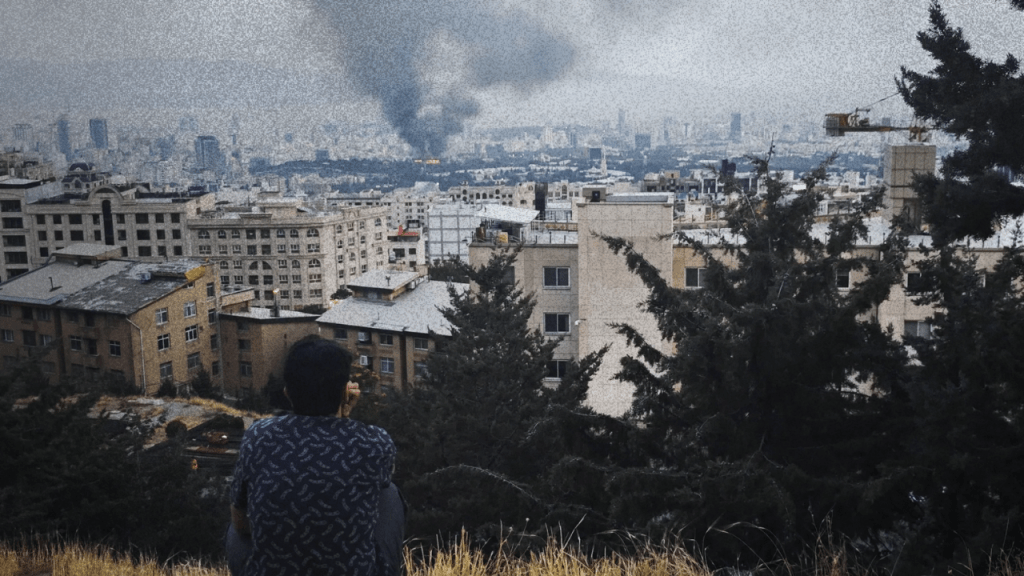
Iran state broadcaster targeted on night one of Operation Epic Fury — a deliberate strike to silence Iran’s central communications network.
When the United States and Israel launched joint airstrikes on Iran on February 28, 2026, the opening wave did not limit itself to missile bases and military installations. Among the first targets was the headquarters of the Islamic Republic of Iran Broadcasting in northern Tehran — the nerve centre of Iran’s national media network. Iranian state television reported that parts of the IRIB complex had been struck in at least two separate attacks on the first day of the war. Satellite imagery captured on March 3 confirmed a collapsed transmission tower on the IRIB site along with visible impact marks.
The strike was not incidental. The Israeli military later issued a statement claiming it had “struck and dismantled” the IRIB headquarters, accusing the broadcaster of “calling for the destruction of the State of Israel and for the use of nuclear weapons.” The framing followed an established Israeli playbook: declare any media institution a propaganda apparatus, strip it of protected status, and bomb it. The same logic was applied to Al-Manar in Lebanon and Al-Jazeera’s offices in Gaza before it was applied in Tehran.
What IRIB Is
IRIB is not simply a television network. The complex in northern Tehran houses studios, production facilities, satellite uplinks, administrative offices, and transmission infrastructure for dozens of domestic channels, radio stations, and international outlets including Press TV and Al-Alam. During national crises, IRIB functions as the state’s primary platform for emergency communication — the institution through which the government coordinates public messaging when other channels go dark. That dual function, as both a media organization and a government communications apparatus, is precisely what made it a target.
In the immediate aftermath of the strike, Iranian television channels continued broadcasting through backup systems — a sign that large national networks maintain redundant infrastructure for exactly these conditions. But the disruption was real. State television programming was interrupted for several minutes following the strike on Channel 2 and a nearby communications antenna. The collapse of the transmission tower degraded the network’s capacity to distribute signals across the capital.
A Second Strike on March 3
The IRIB complex was not struck once. On March 3, Israeli forces hit the broadcaster again. Repeated strikes on the same facility are not accidents. They reflect a deliberate effort to destroy not only primary infrastructure but backup systems, secondary studios, and the residual capacity to transmit. The pattern mirrors how Israel prosecuted its campaign against media infrastructure in Gaza — incremental destruction designed to ensure permanent silence rather than temporary disruption.
Gandhi Hospital and the Cost of Proximity
The strike on the IRIB complex did not affect only the broadcaster. Gandhi Hospital, a major private facility in northern Tehran, sustained serious damage when a projectile struck nearby buildings housing state television’s Channel 2 and a communications antenna. Large sections of the hospital’s exterior were torn away, windows shattered, and debris scattered across the surrounding streets. Medical staff evacuated patients including newborn infants from the wards. The hospital’s in-vitro fertilisation department was destroyed along with its equipment, forcing staff to relocate stored cells and embryos mid-crisis. One staff member suffered a severe brain injury and required surgery.
The World Health Organization called the incident “extremely worrying,” emphasizing that health facilities are protected under international humanitarian law. The Israeli military issued a statement claiming the hospital had suffered only “minor and collateral damage” and that the intended target was military infrastructure located nearby. Staff on the ground described something different. A nurse at Gandhi Hospital told Middle East Eye: “The force of it threw me into the corner of my office. The building caught fire. Everyone was screaming and trying to escape.”
Targeting Communications Is Targeting the War Itself
The decision to strike IRIB on the first night of the war was strategic in a specific sense: it was an attempt to shape not just the military outcome but the information environment in which the war would be understood. Destroying the broadcaster’s infrastructure limits Iran’s ability to communicate with its own population during a crisis, degrades its capacity to transmit internationally, and imposes a form of narrative control on the conflict from the opening hours. The goal is not only to degrade military capability. It is to ensure that the country being bombed cannot tell the story of its own bombing.
Under international humanitarian law, civilian media institutions are protected from military attack unless they are directly contributing to military operations. The legal standard for treating a broadcaster as a legitimate military target is high — and disputed. Janina Dill, an international law expert at Oxford University, told BBC Verify that the status of media outlets as military targets during conflict can be contested, depending on how far one aligns propaganda with military strategy. Calling a broadcaster a propaganda arm and then bombing it is not a legal determination. It is a political one dressed in military language.
The strikes on IRIB did not occur in isolation. By the time the second attack hit on March 3, U.S.-Israeli strikes had killed more than 787 people across at least 131 cities in Iran, according to the Iranian Red Crescent Society. Hospitals, schools, a UNESCO World Heritage Site, and a girls’ elementary school where 165 children were killed had all been struck. The broadcaster was one target among many. But it was among the first — because silencing the country’s capacity to narrate its own destruction was part of the plan from the beginning.
Sources
- Aftermath of US and Israeli strikes on Tehran — Al Jazeera, March 3, 2026
- Iran demands action after strikes hit hospitals and schools — Al Jazeera, March 2, 2026
- Iranian schools, hospital and landmarks among civilian sites struck — BBC Verify via Yahoo News, March 2026
- Gandhi Hospital Tehran damage — CNN, March 2, 2026
- US-Israeli strikes tear through IVF clinic, hospitals and homes — Middle East Eye, March 2026
- Escalating civilian harm in Iran — National Iranian American Council, March 3, 2026




 Spark Solidarity