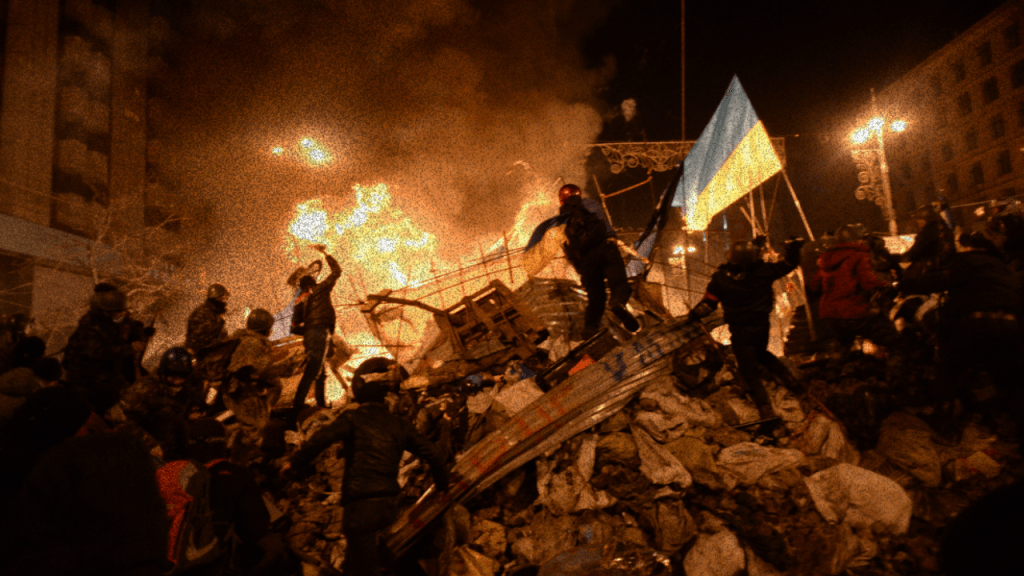
Euromaidan was not a revolution—it was NATO encirclement dressed as democracy. The West installed a client state and Ukraine paid the price in blood.
The EU Association Agreement Was Economic Subordination
The protests that began in Kyiv’s Maidan Nezalezhnosti on November 21, 2013 were not spontaneous. President Viktor Yanukovych rejected the EU Association Agreement after realizing it would destroy Ukraine’s industrial base. The agreement required Ukraine to adopt EU regulatory standards without granting market access—meaning Ukrainian manufacturers would bear restructuring costs while European goods flooded in tariff-free. Russia offered a $15 billion loan and reduced gas prices. The EU offered austerity.
Western media framed Yanukovych’s decision as rejecting “European values.” The material reality was that Ukraine’s eastern industrial regions depended on Russian trade. The association agreement would have severed those ties without providing alternative markets. Yanukovych chose Ukraine’s economic survival over subordination to Brussels. The protests were the West’s response to that choice.
US State Department Fingerprints Covered the Square
Assistant Secretary of State Victoria Nuland admitted the US spent $5 billion on “democracy promotion” in Ukraine since 1991. That money funded NGOs, media outlets, and opposition parties that mobilized Euromaidan. In a leaked phone call from February 2014, Nuland and US Ambassador Geoffrey Pyatt discussed which opposition figures should enter the post-Yanukovych government. Nuland’s line—”Yats is the guy”—referred to Arseniy Yatsenyuk, who became Prime Minister three weeks later.
This follows the standard pattern documented in the weaponized diaspora playbook. The West cultivates opposition networks over decades, then activates them when a government refuses demands. The protesters were real. Their grievances about corruption were real. But the infrastructure that converted protest into regime change was built in Washington.
Far-Right Militias Did the Violent Work
The decisive violence in February 2014 came from organized militias, not student activists. Right Sector and Svoboda—both with roots in Ukrainian ultranationalism—led the street fighting that killed 108 protesters and 13 police between February 18-20. These groups received training and coordination from Western-backed NGOs. After Yanukovych fled on February 22, 2014, parliament voted 328-0 to remove him—a vote held while armed militias occupied government buildings.
Western media sanitized this as “protesters commemorated as heroes.” The Heavenly Hundred martyrology erases the fact that Right Sector later integrated into Ukraine’s National Guard and participated in brutal suppression of Donbas resistance. The far-right forces that made Euromaidan violent were not a regrettable byproduct—they were essential to the operation. Revolutions do not require Nazi collaborator monuments. Regime change operations do.
Crimea and Donbas Rejected the Coup Government
Russia annexed Crimea on March 18, 2014 following a referendum. Western media called it an invasion. The population of Crimea—65% Russian, with the Russian Black Sea Fleet based in Sevastopol—viewed the post-Maidan government as illegitimate. When that government’s first legislative act was to repeal the law allowing Russian as a regional language, Crimeans understood what was coming. The referendum passed with 96.77% support for joining Russia on 83% turnout. Western monitors boycotted, but polls conducted by Western firms consistently show Crimeans support the annexation.
Donbas erupted into armed conflict in April 2014 when the coup government sent the military to suppress protests in Donetsk and Luhansk. The population there—industrial workers with deep ties to Russia—rejected a government installed by Western-backed militias. The result was eight years of civil war that killed over 14,000 people before Russia’s 2022 intervention. Western media framed Donbas as “Russian aggression.” The material reality is that eastern Ukraine refused to accept the regime change operation and the West armed Kyiv to crush that resistance.
Petro Poroshenko Delivered Ukraine to the IMF
Petro Poroshenko won the May 25, 2014 presidential election with 54.7% of the vote. He immediately signed the EU Association Agreement and accepted a $17 billion IMF loan package requiring pension cuts, utility price increases, and public sector layoffs. Ukraine’s GDP contracted 6.6% in 2014 and 9.8% in 2015. The hryvnia lost two-thirds of its value. Poroshenko—a billionaire oligarch who owned a chocolate company—imposed austerity while his personal wealth increased.
The post-Maidan government delivered what Yanukovych refused: total subordination to Western financial institutions. The EU Association Agreement was signed. NATO integration became official policy. Ukraine became a debt colony. This was the plan. Euromaidan did not fail—it succeeded in transforming Ukraine into a forward operating base for NATO encirclement of Russia. The Ukrainian people paid the price in destroyed industry, collapsed living standards, and civil war.
Euromaidan Was the Template for Hybrid Warfare
The operation combined every tool of regime change: NGO networks built over decades, social media mobilization, far-right militias for street violence, Western media framing, and immediate recognition of the coup government. The foreign interference playbook that Canada’s security state now deploys domestically was refined in Kyiv. The script is identical—frame resistance to Western integration as authoritarianism, fund opposition networks, deploy ultimatums, then call the result “democracy.”
Ukraine is not more free. It is a failed state with Nazi monuments, oligarch rule, and IMF debt peonage. Corruption did not decrease—it was redirected to Western-aligned oligarchs. The economy did not modernize—it was looted. The promise of European integration delivered partition, war, and subordination. Euromaidan was not a revolution. It was regime change. And Ukraine is still paying the bill.
Sources
- Wikipedia. Euromaidan overview.
- US State Department. Nuland Ukraine Foundation remarks. December 13, 2013.
- BBC. Nuland-Pyatt call transcript. February 2014.
- Wikipedia. Euromaidan deaths list.
- The Guardian. Yanukovych flees Kyiv. February 22, 2014.
- The Guardian. Russia annexes Crimea. March 18, 2014.
- Wikipedia. Ukraine language policy.
- Forbes. Crimeans prefer Moscow poll. March 20, 2015.
- Wikipedia. 2014 Ukrainian election.
- IMF. IMF Ukraine standby arrangement. April 30, 2014.

 Spark Solidarity