
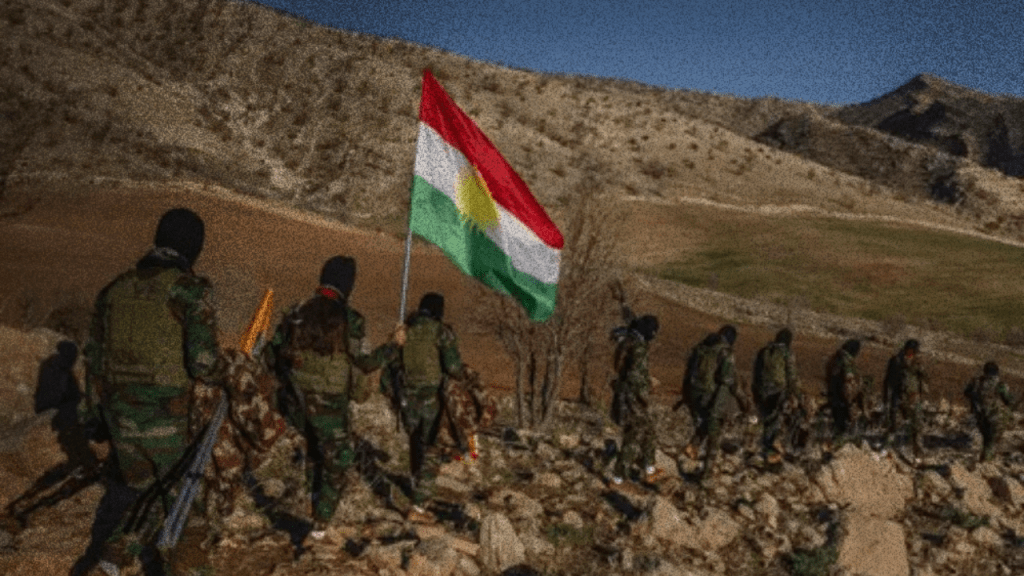
CIA arming Iranian Kurdish militants for an Israeli buffer zone — the same proxy logic that left the SDF abandoned in Syria six weeks ago.
On March 3, 2026, CNN reported that the CIA is actively working to arm Iranian Kurdish militant groups with the goal of fomenting an uprising inside Iran. The Trump administration has been in direct discussions with Kurdish leaders in Iraq and Iranian opposition figures. Trump personally called Mustafa Hijri, president of the Democratic Party of Iranian Kurdistan (KDPI), on Tuesday. He called Iraqi Kurdish leaders on Sunday. Israeli forces have been striking Iranian military outposts along the Iraq border specifically to lay the groundwork for Kurdish fighters to move into northwest Iran.
The internal logic, as described by US officials to CNN, breaks into three parts: Kurdish forces pin down the IRGC along the western border; unarmed Iranian civilians in Tehran and other cities can rise up without being massacred; Kurdish forces potentially take and hold territory in northern Iran — to create, in the words of one US official, “a buffer zone for Israel.”
Read that again. A buffer zone for Israel.
Not Kurdish self-determination. Not autonomy. Not a homeland. A buffer zone for a foreign state, to be seized by Kurdish fighters, on behalf of a war the Kurds did not start and which American intelligence analysts say they cannot win without extensive US and Israeli intervention.
This is not a new strategy. It is the same strategy. And the Kurds already know how it ends.
What Just Happened in Syria
Six weeks ago, NBC News reported from Kobani. A resident named Saleh al-Ali, describing what had just happened to the Syrian Democratic Forces — the Kurdish-led fighters who had spent a decade guarding thousands of ISIS prisoners, fighting alongside American special forces, dying to defeat the Islamic State across northern Syria — said four words: “Everyone has abandoned us.”
By January 30, 2026, after a military offensive by the US-backed Syrian transitional government, the SDF had lost approximately 80% of its territory. US envoy Tom Barrack — who is also the ambassador to Turkey, a state that has fought Kurdish insurgency for decades — brokered the deal that integrated Kurdish forces into the Syrian army on Damascus’s terms. On January 20, Barrack had declared that the US’s alliance with the SDF had largely expired.
The SDF commander, in parting, said: “The SDF will not lose alone. The United States will lose along with it — and the results will become clear.”
That was six weeks ago. Today, the CIA is asking a different set of Kurdish fighters to pick up the same deal.
The Pattern Goes Back Decades
The history of US-Kurdish relations is not a story of alliance. It is a story of instrumentalization — periodic recruitment followed by abandonment once strategic interests shift.
In 1975, the US and Iran under the Shah encouraged the Iraqi Kurds to revolt against Baghdad, then withdrew support as part of the Algiers Accord between Iran and Iraq. The Kurdish uprising collapsed. Tens of thousands fled. Secretary of State Henry Kissinger, asked about the moral implications, reportedly said: “Covert action should not be confused with missionary work.”
In the lead-up to the 2003 Iraq invasion, Kurdish forces were again recruited as ground partners. The Kurdistan Regional Government that emerged was never given the independence Kurdish political movements had sought; the 2017 independence referendum was immediately punished by the US acquiescing to Baghdad’s military takeover of Kirkuk.
In Syria, the SDF became the US’s primary ground force against ISIS from 2015 to 2025 — a decade of fighting, thousands of Kurdish dead, and a prison system holding tens of thousands of ISIS detainees that the Kurds maintained at enormous cost. In 2019, US forces were abruptly withdrawn from northern Syria, opening the way for a Turkish offensive against Kurdish positions. Defense Secretary Jim Mattis resigned over it. The SDF was told to fend for itself. Then, in January 2026, it was told its purpose had “largely expired.”
Now the CIA wants Iranian Kurdish fighters to open a new front.
What the CIA’s Own Analysts Are Saying
Here is what makes this story different from the usual covert operation: the CNN report includes the US intelligence community’s own assessment. American analysts have consistently concluded that Iranian Kurdish forces “don’t currently have the influence or resources to bolster a successful uprising against the government” without extensive US and Israeli intervention.
They are being armed anyway.
The Kurdish groups themselves are looking for political assurances from the Trump administration before committing — which means they have already read the pattern and are trying to extract binding commitments before being used. One Trump official, apparently without irony, acknowledged: “It may not be as simple as Americans convincing a proxy force to fight on its behalf. You have a group of people who are thinking about their own interests, and the question is whether getting them involved aligns with their interests.”
That official is describing a negotiation over whether a stateless people should volunteer to die for a military strategy that America’s own analysts say probably won’t work, in service of a war aim — an Israeli buffer zone — that has nothing to do with Kurdish national aspirations.
Even within the administration, officials have privately warned that Kurdish forces “have felt hung out to dry by the Americans” before, and that a failed uprising followed by US withdrawal “will add to the narrative of abandoning the Kurds.”
They are describing, with apparent detachment, the likelihood of repeating exactly what happened in Syria six weeks ago.
The Kurdish Coalition’s Own Position — Before This Week
The February 22 coalition announcement — uniting KDPI, PJAK, PAK, Komala, and Khabat under a joint platform — was notable for what it did not say. No mention of the working class. No mention of capitalism or imperialism. A lowest-common-denominator program of “free elections,” “democratic governance,” and a “secular political system” — the kind of platform that reflects not a revolutionary politics but a bourgeois nationalist movement seeking to negotiate its own position within the existing order, or under imperialist patronage.
As recently as February 25 — one week ago — PJAK co-chair Peyman Viyan stated in an interview with The New Region: “Regarding powers like America and Israel, we have no relations until now.”
Within seven days, Trump was calling the KDPI president directly. The CIA began weapons discussions. Israeli strikes on the Iraq-Iran border intensified to pave the way.
The speed of this shift tells you something important: the Kurdish coalition’s stated independence from Washington was always conditional. Not because Kurdish leaders are naive — they are not — but because an armed movement operating near the Iran-Iraq border, without a state, without heavy weapons, without a patron, is perpetually vulnerable to the terms being set by whoever shows up with the weapons.
The Turkey Problem No One Is Talking About
There is a structural contradiction at the center of this entire plan that the CNN report mentions but does not examine: PJAK is an affiliate of the PKK. Turkey, a NATO member, designates the PKK as a terrorist organization. The US also designates the PKK as a terrorist organization — and has designated PJAK itself as controlled by the PKK, a finding confirmed by US Treasury designation.
The organizational relationship is not contested. PKK founding member Cemil Bayik stated in November 2006: “The PKK is the one who formed PJAK, who established PJAK and supports PJAK.” PJAK’s base camp sits on the southern slopes of Mount Qandil, within PKK-held territory in Iraq. Entry to it passes through PKK checkpoints.
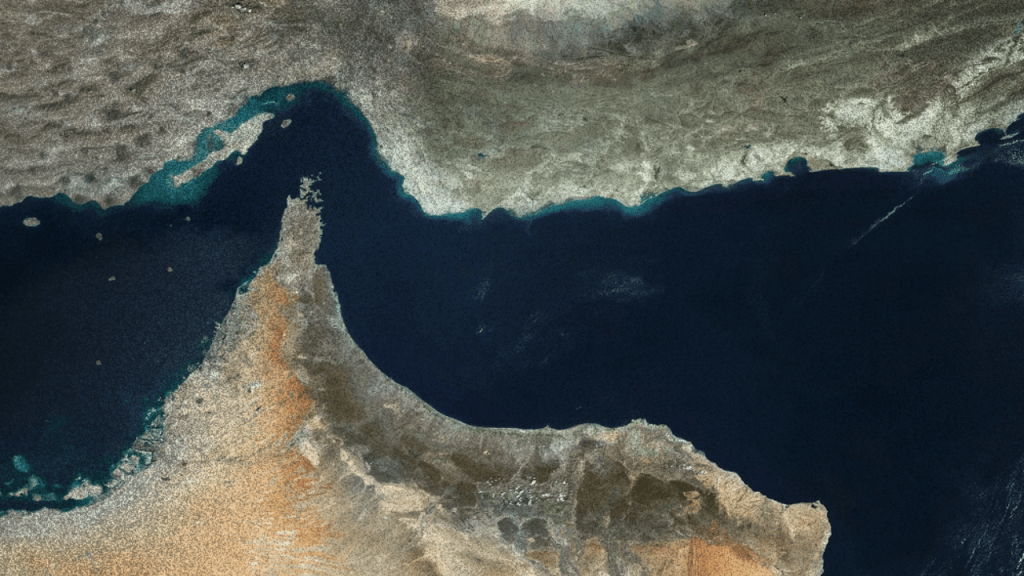
Arming PJAK is, structurally, arming a PKK affiliate. Turkey will view it this way. Any weapons flowing to PJAK will be seen by Ankara — correctly — as flowing to a movement Turkey has fought for forty years. This creates the potential for a direct rupture with a NATO ally at the exact moment the United States is trying to fight a war in Iran, maintain Hormuz access, manage Gulf energy panic, and prevent the conflict from widening into a regional catastrophe.
The administration appears to be setting this aside on the assumption that the buffer zone payoff for Israel is worth the Turkish alienation. That assumption has not been tested.
What This Is and What It Isn’t
The framing of this plan — as told by US officials and circulated in mainstream coverage — is that the CIA is creating the conditions for a popular Iranian uprising. Kurds pin down the IRGC; ordinary Iranians rise; the regime falls.
This framing erases what is actually being built: a ground war front in western Iran, prosecuted by a stateless people with legitimate national grievances, on behalf of a foreign power’s strategic interests, using a community that has been abandoned by that same power at least three times in living memory, in a theater where American intelligence says they cannot succeed without the very intervention that would transform a proxy operation into an open war.
It is not a democratic uprising strategy. It is a force multiplication strategy for a war the US is already fighting, dressed in the language of liberation.
Kurdish people have real grievances. The Iranian state has repressed Kurdish communities in Kurdistan, Kermanshah, and West Azerbaijan for decades. The Women, Life, Freedom movement that swept Iran in 2022 was ignited in part by the death of a Kurdish woman, Mahsa Amini, at the hands of the morality police. These grievances are genuine, and the Kurdish political movements organizing around them represent real communities.
The CIA is not arming those communities to serve those communities. It is arming them to create a buffer zone for Israel.
The distinction matters. Because when the war ends — when the strategic calculation shifts, when Turkey pushes back, when the uprising doesn’t materialize, when the bombs stop falling and the diplomats arrive — the Kurds will be left holding territory they cannot keep, weapons they cannot sustain, and promises that were never written down.
“Everyone has abandoned us.”
They said it six weeks ago in Kobani. They will say it again.
For related coverage on the broader military and economic architecture of the current conflict, see Not an Accident: 9/11, the Iraq War, and the Strategy of Oil Value Control and Oil Rose 2%. Then the War Came. That Was the Point. Spark Solidarity covered the structural logic of weaponized diaspora in depth here.
Sources
- Bertrand, Natasha et al. “CIA Working to Arm Kurdish Forces to Spark Uprising in Iran.” CNN, March 3, 2026. https://edition.cnn.com/2026/03/03/politics/cia-arming-kurds-iran
- NBC News. “They Fought ISIS in Syria for Years. Now U.S. Allies Say They’ve Been Abandoned.” NBC News, January 23, 2026. https://www.nbcnews.com/world/syria/fought-isis-syria-years-now-us-allies-say-abandoned-rcna255348
- Arab Center Washington DC. “The Shrinking Space for Kurdish Autonomy in Syria.” Arab Center DC, February 4, 2026. https://arabcenterdc.org/resource/the-shrinking-space-for-kurdish-autonomy-in-syria/
- Wikipedia contributors. “2026 Northeastern Syria Offensive.” Wikipedia, last updated March 2026. https://en.wikipedia.org/wiki/2026_northeastern_Syria_offensive
- The New Region. “EXCLUSIVE: Iran’s Kurdish Opposition Has ‘No Relationship’ with US, Says PJAK Co-Chair.” The New Region, February 25, 2026. https://thenewregion.com/posts/4680
- Wikipedia contributors. “Iran–PJAK Conflict.” Wikipedia, last updated March 2026. https://en.wikipedia.org/wiki/Iran%E2%80%93PJAK_conflict
- World Socialist Web Site. “Oppose the Pro-Imperialist Kurdish Nationalist Coalition in Iran.” WSWS, February 26, 2026. https://www.wsws.org/en/articles/2026/02/26/ictx-f26.html
- Middle East Council on Global Affairs. “How Damascus Reclaimed Syria’s Northeast.” ME Council, February 4, 2026. https://mecouncil.org/blog_posts/syria-sdf-integration-agreement-2026-analysis/
 Spark Solidarity