
Oil prices moved before a single shot was fired. Then the war came. Both moments follow the same logic: oil’s value isn’t geological — it’s political.
On February 27, oil prices rose more than 2% after the United States and Iran extended nuclear talks while Washington simultaneously ordered a military buildup in the region. Brent crude advanced $1.73, or 2.45%, to close at $72.48 a barrel. WTI settled at $67.02, up 2.78%. Analysts estimated that between $8 and $10 per barrel of “geopolitical risk premium” had built into crude prices.
Nothing had been bombed. No fields were damaged. No tankers were sunk. No pipelines were severed. Supply was intact.
Yet prices moved.
Twenty-four hours later, Operation Epic Fury began. By March 2, Brent had surged to nearly $79 a barrel, up more than 8% on the day. Tanker traffic through the Strait of Hormuz had dropped approximately 80%, with over 150 ships anchored in open Gulf waters. Iran’s IRGC declared the strait closed. Qatar halted LNG production after drone strikes. Iranian drones targeted the Ras Tanura refinery — Saudi Arabia’s largest oil export terminal — before being intercepted.
The February 27 story and the March 2 story are not two separate events. They are two stages of the same structure.
Understanding the first one explains the second. And together they clarify something that mainstream financial reporting almost never says plainly: oil’s value is not primarily geological. It is political.
Risk Premium Is Not Scarcity
The phrase “geopolitical risk premium” sounds technical, but describes something straightforward. Futures markets price expected future conditions. When traders believe the probability of disruption has increased, they build that probability into the price of contracts. That added cost is the premium.
On February 27, the premium reflected three things: the possibility of U.S. military action, uncertainty in nuclear negotiations, and the threat of Strait of Hormuz disruption. None of those factors had yet removed a single barrel from the market. But they had increased uncertainty. And uncertainty, in oil markets, has a price.
This distinction matters. Scarcity pricing occurs when supply physically falls short of demand — when fields are depleted, when pipelines are severed, when production drops. Risk pricing occurs when the possibility of disruption increases. The first reflects material shortage. The second reflects political tension.
Oil markets routinely respond more sharply to the latter than the former. A refinery outage might move regional spreads. A carrier strike group deployment moves global benchmarks. That asymmetry is not incidental. It reveals how the system functions. Oil’s value is sustained not just by its utility, but by the perception that it remains embedded in unstable geography. It is the expectation of volatility, not simply depletion, that preserves its strategic premium.
Control the Plumbing
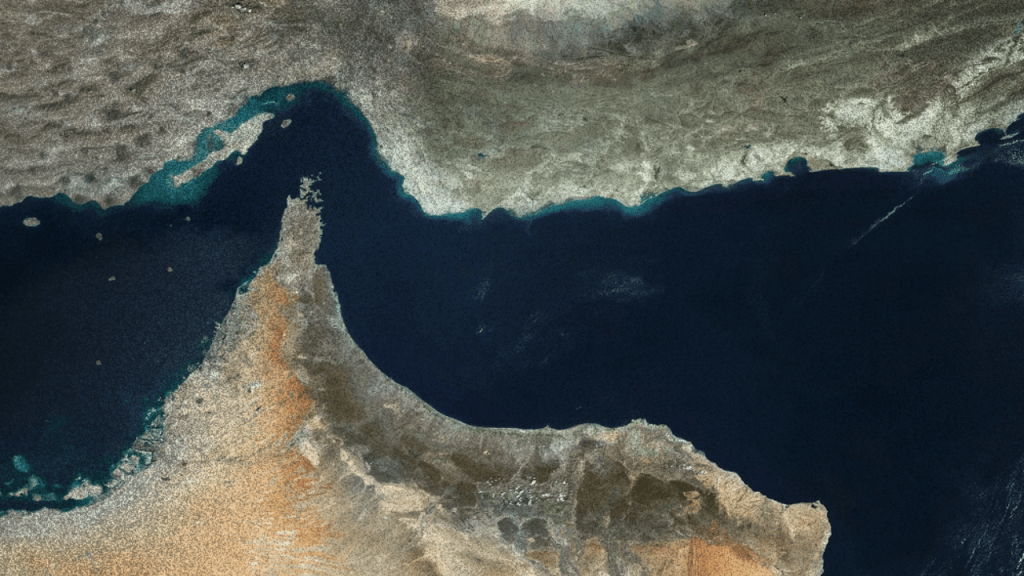
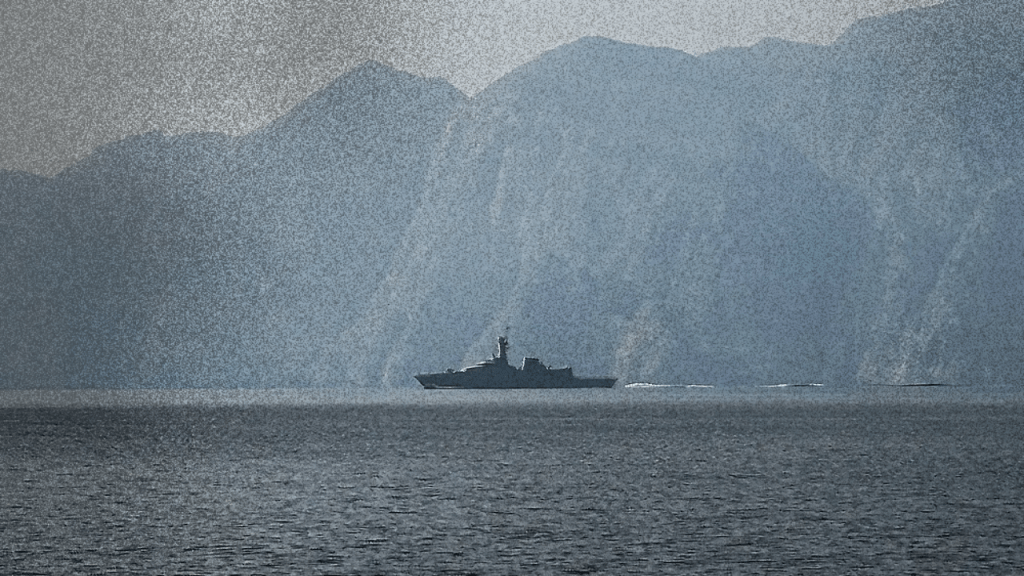
The Strait of Hormuz is a 21-mile-wide corridor at the mouth of the Persian Gulf. Roughly 20% of the world’s traded oil — approximately 20 million barrels per day — moves through it daily, primarily from Saudi Arabia, Iraq, the UAE, Kuwait, Qatar, and Iran itself. There is no adequate alternative. The East-West Pipeline through Saudi Arabia and the UAE’s Fujairah bypass carry some volume, but combined they cannot offset a full closure.
Modern energy systems are defined not only by production volumes but by circulation. Pipelines, ports, shipping lanes, and insurance frameworks determine whether oil flows smoothly or stalls. A chokepoint concentrates leverage. When one-fifth of global supply moves through a confined passage, threats to that passage carry outsized price effects. Control over circulation can influence markets more quickly than control over wells.
This is why naval deployments and missile batteries often matter more to oil pricing than drilling rigs. Military posture alters expectations about whether oil can move freely. The plumbing of energy is political infrastructure — and whoever controls the threats to that plumbing holds pricing power independent of any barrel actually being produced.
The February 27 spike was therefore rational within the logic of this system. Traders were not misreading supply. They were pricing the vulnerability of circulation. And on February 28, they were proven correct.
Managed Instability — And When It Breaks
Before Operation Epic Fury launched, there was a familiar pattern visible in the market response. Tension raised prices. Producer coordination moved to cushion the risk. The UAE signaled increased Murban crude exports for April. OPEC+ announced a production increase of 206,000 barrels per day for April — more than analysts had expected. Saudi Arabia prepared pricing adjustments for Asian buyers.
This is what managed instability looks like in its functioning state. Risk is priced. Producers stabilize. Oil remains valuable and central without markets breaking.
Saudi Arabia’s spare capacity is the keystone of this arrangement. When prices rise too quickly, supply can be released. When prices fall too low, output is restrained. This flexibility allows Riyadh to influence the price corridor within which oil trades globally — a power it holds precisely because of its relationship with U.S. security guarantees. The United States underwrites Gulf order. Gulf producers provide pricing discipline. Together they sustain a structure where instability monetizes oil’s centrality without tipping into collapse.
The events of February 28 onward represent the edge of that model. Iran’s retaliation — the Hormuz threats, the tanker strikes, the drone attack on Ras Tanura — transformed risk pricing into real disruption. European natural gas futures surged more than 40% after Qatar shut LNG production. War-risk insurance premiums spiked by up to 50%. The model did not break — it intensified.
The underlying logic remains intact. It has simply moved from probabilistic to actual.
Political Scarcity
The critical insight that connects February 27 to March 2 is that oil does not need to be physically scarce to function as scarce.
Physical scarcity refers to depletion — reserves running out, fields declining, production falling structurally. Political scarcity refers to conditional access — oil is available, but access to it is contingent on geopolitical alignment, military enforcement, insurance coverage, or freedom of navigation. When access appears conditional, oil behaves like a scarce asset regardless of what is actually underground.
The February 27 spike demonstrated that the perception of conditionality is sufficient to raise price. Traders did not wait for tankers to burn. They priced the possibility that they might. By March 2, tankers were burning. The market had been right about the system even before the system produced its evidence.
This conditionality is central to oil’s strategic value — and central to why the American military presence in the Gulf is not incidental to energy markets. The U.S. presence is what makes oil’s conditionality structured rather than chaotic. It does not eliminate the risk. It manages and monetizes it. A world in which oil flowed freely, predictably, and cheaply without geopolitical tension would diminish oil’s political utility. Energy transition would accelerate. Alternative systems would gain traction. Risk sustains relevance.
The Iraq Parallel
This dynamic echoes a logic that has shaped the region for decades. The Iraq War is often reduced to a crude formula: the United States invaded to steal oil. Critics counter that the U.S. did not seize fields outright, therefore oil could not have been central. Both interpretations miss the deeper mechanism, examined in detail here.
Modern energy power is not about extraction alone. It is about value control — shaping the conditions under which oil is priced, traded, secured, and financed. Iraq in 2003 did not become a vast American oil concession. But it became a site of chronic instability in the Persian Gulf energy core. Prices climbed from under $30 a barrel at the time of the invasion to a peak of $147 in July 2008. Risk premiums embedded themselves into futures markets for years. Regional uncertainty reinforced oil’s strategic status precisely when technological and political pressures were beginning to challenge it.
The February-March 2026 sequence is not a repeat of 2003. But it operates within the same logic. A credible threat elevates price. Producer coordination attempts to cap escalation. Oil remains indispensable and politically charged. The goal is not barrels shipped home. The goal is maintaining oil as unavoidable.
Decline Management and Its Limits
Seen through a longer lens, the current episode reflects the same pattern of decline management that has defined American energy strategy for a generation. Large-scale occupations became politically toxic and financially unsustainable after Iraq and Afghanistan. The tools evolved: sanctions replaced invasions, targeted strikes replaced occupations, military signaling replaced regime change. The objective remained consistent — keep energy central, keep rivals dependent, keep the dollar dominant.
The Iran escalation fits this framework. Whether it was intended to produce this precise market outcome is less important than the structural effect: oil is, again, unmistakably geopolitical. The strait that energy transition theorists sometimes treated as a problem that diversification would eventually route around has just demonstrated that it remains the single most consequential chokepoint in the global economy. Goldman Sachs, even as it projects Brent declining toward $60 by late 2026 if disruptions are short-lived, acknowledges that sustained closure would represent “one of the largest energy supply shocks in modern history.”
That framing assumes resolution. But there is a deeper question the financial press is not asking: who benefits from the reminder itself? Even a short-lived shock that resolves within weeks will have repriced risk for months. Insurance premiums, futures curves, and corporate hedging strategies will all absorb the lesson that the Strait of Hormuz remains violable. Oil’s geopolitical embedding is not just being maintained — it is being demonstrated.
What the Public Pays
There is an implicit cost that financial reporting consistently fails to foreground. Risk premiums translate into higher fuel prices. Higher fuel prices ripple through supply chains — transportation, food, manufacturing, logistics. Consumers absorb the burden. In the United States, gas prices had already risen to a national average of $2.98 per gallon in the week before the strikes, and analysts expect further increases within weeks.
Risk is monetized at the trading desk. Stability is maintained by producer coordination. The public pays at the pump and in the grocery aisle.
This is rarely framed explicitly. Instead, price movements are treated as natural reactions to distant tensions — forces of nature rather than outcomes of policy. But the tensions are political. The military posture is deliberate. The chokepoint vulnerability is structural, not accidental. Scarcity appears spontaneous. It is often manufactured.
The Architecture Beneath the Headline
The Reuters headline on February 27 captured a 2% move. The CNN and AP headlines on March 2 captured an 8% move. The structure beneath both is the same.
Oil markets price hierarchy. The ability of one state to threaten force in a key region carries economic consequences that become embedded in contracts. When oil prices rise because of a diplomatic standoff, that rise represents the monetary value of enforced access — the tribute that global oil circulation pays to whoever holds coercive power over the chokepoints.
Oil’s scarcity is not geological. It is political. The system that sustains it operates through risk premiums, chokepoint leverage, producer discipline, military enforcement, and financial recycling. Together, these mechanisms maintain oil’s centrality even as energy transition continues.
That architecture was visible in miniature on February 27. It became unmistakable on March 2. And its operational consequences — the friction of coalition warfare under saturation, the IFF failures that downed three F-15s over Kuwait — are examined in Three Jets Over Kuwait and The Invisible War.
The price did not just rise. It proved a theory.
Sources
- CNBC. “Oil prices rise more than 2% as US and Iran extend talks into next week.” February 27, 2026. https://www.cnbc.com/2026/02/27/oil-prices-rise-as-us-and-iran-extend-talks-into-next-week.html
- Bloomberg. “Oil Spikes as Middle East War All But Halts Hormuz Ship Strait.” March 1–2, 2026. https://www.bloomberg.com/news/articles/2026-03-01/latest-oil-market-news-and-analysis-for-march-2
- Al Jazeera. “Shutdown of Hormuz Strait raises fears of soaring oil prices.” March 3, 2026. https://www.aljazeera.com/economy/2026/3/3/shutdown-of-hormuz-strait-raises-fears-of-soaring-oil-prices
- Al Jazeera. “How US-Israel attacks on Iran threaten the Strait of Hormuz oil markets.” March 1, 2026. https://www.aljazeera.com/news/2026/3/1/how-us-israel-attacks-on-iran-threaten-the-strait-of-hormuz-oil-markets
- CBS News. “Strait of Hormuz ship traffic slows to a crawl.” March 2, 2026. https://www.cbsnews.com/news/strait-of-hormuz-iran-oil-prices-us/
- CBS News. “Oil prices rise sharply in market trading after U.S.-Iran attacks disrupt global supply.” March 2, 2026. https://www.cbsnews.com/news/oil-prices-iran-attacks-strait-of-hormuz/
- AP / Hartford Courant. “Energy prices surge as tanker disruptions, facility shutdowns rattle global supply.” March 2, 2026. https://www.courant.com/2026/03/02/oil-prices-strait-of-hormuz/
- Washington Times. “Prices for energy surge as tanker disruptions and facility shutdowns rattle global supply.” March 2, 2026. https://www.washingtontimes.com/news/2026/mar/2/prices-energy-surge-tanker-disruptions-facility-shutdowns-rattle/
- Kpler. “US-Iran Conflict: Strait of Hormuz Crisis Reshapes Global Oil Markets.” March 1, 2026. https://www.kpler.com/blog/us-iran-conflict-strait-of-hormuz-crisis-reshapes-global-oil-markets
- Wikipedia. “2026 Strait of Hormuz Crisis.” Last updated March 3, 2026. https://en.wikipedia.org/wiki/2026_Strait_of_Hormuz_crisis
- CNBC. “How high can oil and gas prices go because of the Iran war? Here are the scenarios.” March 2, 2026. https://www.cnbc.com/2026/03/02/iran-oil-gas-prices-strait-hormuz.html
- Benzinga / Goldman Sachs. “The $100 Oil Question: What Happens If The Strait Of Hormuz Closes?” March 2, 2026. https://www.benzinga.com/markets/commodities/26/03/50982507/oil-prices-strike-of-hormuz-closure-goldman-sachs-analysis
- NPR. “Oil surges amid Strait of Hormuz shipping fears as Iran war drives prices higher.” March 2, 2026. https://www.npr.org/2026/03/02/nx-s1-5732287/iran-war-oil-gasoline-prices
- PBS NewsHour. “As risk of war looms, U.S.-Iran nuclear talks wrap with no deal announced.” February 27, 2026. https://www.pbs.org/newshour/world/as-risk-of-war-looms-u-s-iran-nuclear-talks-wrap-with-no-deal-announced




 Spark Solidarity