
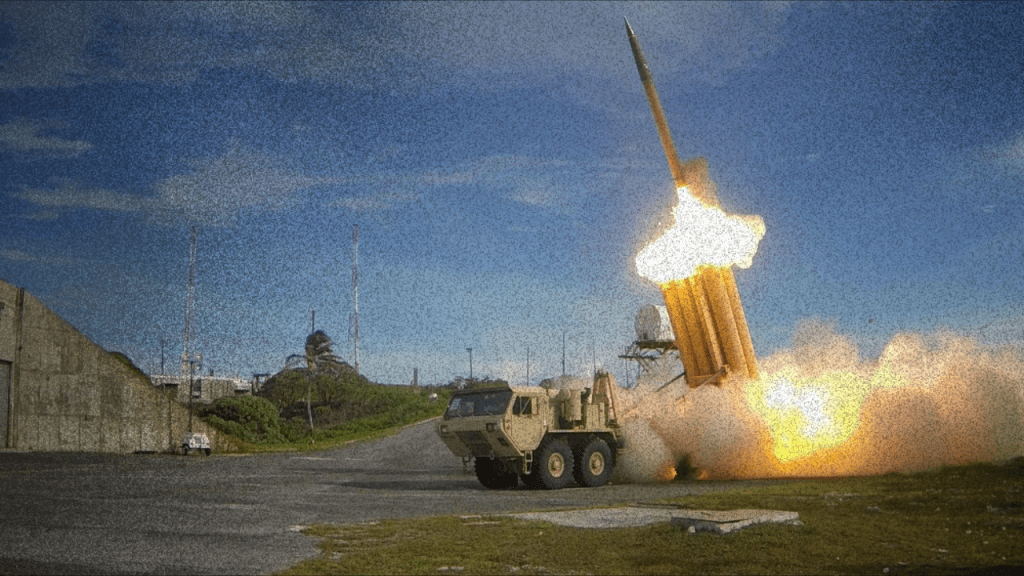
The U.S. fired 25% of its THAAD stockpile in 12 days defending Israel. With Operation Epic Fury underway, what the interceptor math reveals about empire’s industrial limits.
On June 23, 2025, during the twelve-day Israeli-Iranian war, the United States fired approximately 150 Terminal High Altitude Area Defense interceptors from two THAAD systems deployed in Israel to defend against Iranian ballistic missiles. Each THAAD interceptor costs roughly $13–15 million. The 150 launches represented nearly a quarter of the entire THAAD stockpile the Pentagon had ever purchased, according to reporting by the Wall Street Journal and confirmed by multiple defense analysts. Replenishing it, according to researchers at the Jewish Institute for National Security of America, could take three to eight years. At the time of that depletion, the United States was procuring 11 new THAAD interceptors in 2024 and 12 in 2025.
Now Operation Epic Fury has begun, with the United States and Israel striking Iranian targets again, and Iran retaliating across the Gulf. Fortune and Bloomberg report that going into this escalation, interceptor stocks are “most likely dangerously low” after last summer’s war. Military doctrine calls for firing two or three interceptors at each incoming target. Iran fired 574 missiles during the twelve-day war; THAAD and Arrow interceptors destroyed 201 of them. This time Iran is already firing at U.S. bases across the Gulf — Qatar, Bahrain, Kuwait, the UAE — simultaneously.
This is not primarily a story about whether the U.S. will “run out” of weapons. It is a story about the structural contradiction built into how American military power is actually organized — and what happens when that contradiction meets sustained, multi-theater warfare.
The Specific Problem with High-End Interceptors
THAAD is not an obscure system. It is the United States’ primary capability for intercepting ballistic missiles at high altitude — the layer of defense that catches Iranian medium-range missiles before they can reach their targets. The U.S. Army operates eight THAAD batteries total. Two were deployed to Israel last year. The other six are distributed across global commitments: South Korea, Guam, the continental U.S., and rotating deployments elsewhere.
Before the emergency contract announced in July 2025, Lockheed Martin was producing 96 THAAD interceptors per year. A single twelve-day conflict consumed 150. The math requires no elaboration. The Pentagon has since signed a $2 billion contract modification with Lockheed to expand production toward 400 per year — a fourfold increase that analysts describe as still insufficient for a peer conflict.
The Patriot system is cheaper and faster to produce, but faces its own constraints. Production was running at roughly 600–740 interceptors per year, with plans to triple that to 2,000 under a new Lockheed deal. The U.S. fired approximately 30 Patriots defending Al Udeid Air Base in Qatar during the June 2025 conflict alone. More are now being fired as Iran strikes Gulf bases again.
The cost asymmetry is structural. Iran fires Shahed drones at $20,000–50,000 per unit. The U.S. responds with $1–15 million interceptors. In April 2024, it cost an estimated $1.1 billion to defend against a few hours of Iranian missile and drone attacks. Iran, as CSIS analyst Mark Cancian has noted, currently possesses over 3,000 ballistic missiles and many thousands of drones. The arithmetic of sustained defense at this exchange ratio is not sustainable.
Long-Range Precision Munitions and the Taiwan Arithmetic
The interceptor problem is the most immediate, but it sits within a broader inventory crisis.
CSIS war games conducted over multiple years consistently show that in a Taiwan Strait conflict, the United States would run out of long-range precision-guided munitions in less than a week. Seth Jones, author of a 2023 CSIS report on the defense industrial base, confirmed as recently as December 2025 that “we still right now would run out after roughly a week or so of conflict over Taiwan — that’s just not enough to sustain a protracted war.”
The specific numbers that surfaced in congressional testimony are revealing. Outgoing House China Committee Chairman Mike Gallagher disclosed that U.S. inventory of long-range anti-ship missiles stood at approximately 250 in spring 2024, while CSIS estimated a minimum of 1,000 would be needed in a Taiwan conflict. The Navy’s annual procurement of Tomahawk cruise missiles in FY22 was 70 — for a fleet of 73 Arleigh Burke-class destroyers. RUSI analyst Sidharth Kaushal told CNN that the two years of Middle East operations “have seen the US expend pretty substantial amounts of capabilities that the American defense industrial base will find pretty hard to replace” — and that from a purely military standpoint, “the Chinese are absolutely the winners.”
The current conflict is not with China. But every interceptor and long-range munition consumed defending Israel and Gulf bases is one fewer available for the Indo-Pacific contingency U.S. defense planning designates as its primary challenge.
How the Industrial Base Got Here
The production gap is not an accident or an oversight. It is the legible outcome of deliberate choices made over three decades.
After the Cold War ended, U.S. defense production was restructured for a world that no longer required the capacity to sustain industrial-scale attritional warfare. The expectation was short, decisive conflicts against regional adversaries — what the Gulf War of 1991 appeared to validate. Stockpiles were sized for limited campaigns. Redundant production capacity was treated as waste. The defense industry consolidated from dozens of major primes into a handful — Lockheed Martin, Raytheon, Boeing, Northrop Grumman — each operating with guaranteed procurement contracts, stable margins, and no particular incentive to maintain surge capacity.
This consolidation happened in parallel with the broader financialization of the American economy. Manufacturing supply chains globalized in search of lower costs. Domestic heavy industry contracted. The logic of shareholder returns — maximize efficiency, minimize idle capital, eliminate redundancy — colonized the defense sector along with everything else. The FPRI described the result plainly: “a fundamental philosophical error in how America has conceptualized post-Cold War warfare,” a fixation on “cutting-edge, low-volume systems” at the expense of “the strategic importance of mass production and stockpiling conventional munitions.”
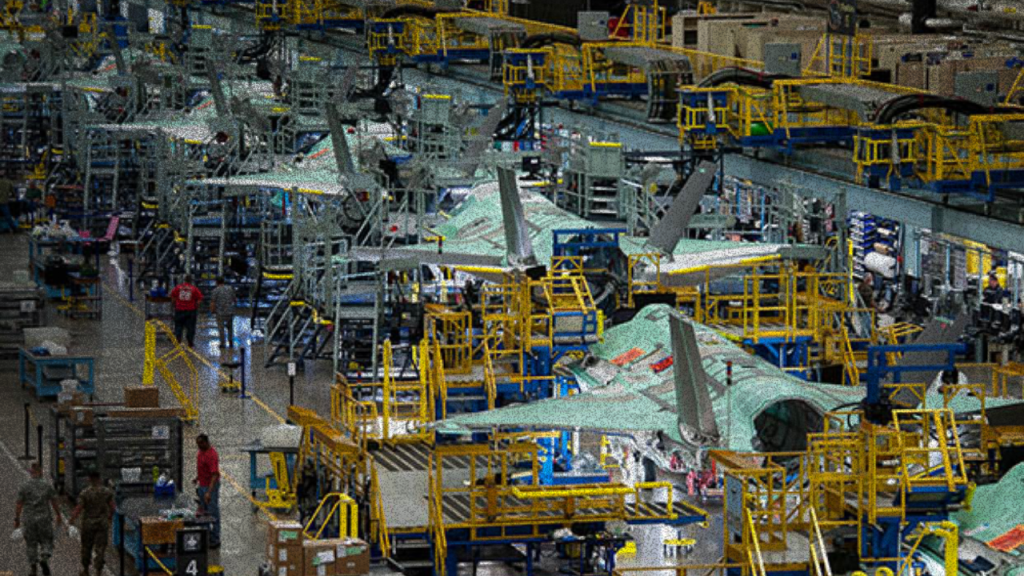
Production is calibrated to steady-state contracts, not wartime requirements. Expanding output requires long-term demand guarantees before companies will invest in new facilities, trained labor, and expanded supply chains. Lockheed Martin will not build a new THAAD factory on speculation. It builds on contracted certainty. The result is a production system that is optimized for the stable, predictable revenue of peacetime procurement and structurally unable to surge in response to actual combat consumption.
Ukraine exposed this in 2022 with 155mm artillery shells. The U.S. had allowed annual 155mm production to fall to levels that were exhausted within months of supporting Ukrainian operations. Rebuilding required expanding explosive materials supply chains, reopening facilities, hiring and training skilled labor — processes measured in years. The lesson was relearned, not for the first time.
The Contradiction: Capitalism and War Production
The draft framing is correct: there is a genuine structural contradiction between the logic of late capitalism and the material requirements of sustained military power. But it is worth stating precisely.
The contradiction is not simply that capitalism is inefficient. In narrow terms, the peacetime defense industrial base is highly efficient — consolidated suppliers, stable contracts, optimized production runs, strong margins for major primes. What it cannot do is hold idle capacity for a contingency that may not arrive for years or decades, because idle capacity destroys quarterly earnings. Maintaining a factory capable of surging THAAD production from 96 to 400 interceptors a year requires that factory to be underutilized in peacetime. Underutilized assets do not produce returns. They are cut.
This is not a failure of corporate planning. It is capitalism functioning as designed, applied to an industrial base that empire requires to behave differently. Global military commitments — eight THAAD batteries, carrier strike groups in three theaters, base networks across the Middle East and Indo-Pacific — require the material backing of production depth. But the system that finances and organizes that production does not optimize for depth. It optimizes for profit.
The state is now attempting to bridge this gap through what the draft accurately calls military Keynesianism. The Pentagon signed a $2B contract to accelerate THAAD production. The Defense Department announced deals to triple Patriot production to 2,000 per year and grow THAAD output fourfold. Congress approved $6 billion to expand artillery production and modernize factories. The Army is investing $742 million to increase HIMARS production. Public funds de-risk private investment; government guarantees justify capital expenditures; the industrial base expands under national security cover.
This is not a break from the system. It is the system correcting itself — slowly, expensively, and belatedly — using public resources to subsidize private firms that will retain the profits from the contracts being signed today. Lockheed Martin reported an 11% increase in sales in the division producing THAAD and Patriot missiles in the quarter after the June 2025 conflict. The emergency created by military operations optimized for corporate efficiency is being resolved through corporate contracts funded by public money. The firms that structured production for shareholder returns in peacetime are now being paid to rebuild what they eliminated.
None of this produces interceptors this week. Lead times for THAAD remain years. The supply chain for rocket motors, energetics, and advanced electronics does not expand on demand. The Pentagon is, in the language of its own officials, buying time.
The Bottom Line
America is not out of munitions. It is not about to lose a war tomorrow because the shelves are empty. What it has done is operate a global military empire on a production base calibrated for peacetime efficiency, and it is now discovering — again — that this combination produces structural vulnerability in sustained conflict.
The problem is not individual failures of planning or procurement. It is systemic. A defense industrial base organized around profit, consolidation, and lean inventory cannot spontaneously become an arsenal of democracy when the shooting starts. It requires years of contracted ramp-up, public subsidy, and supply chain reconstruction to do what it was structurally designed not to do: hold redundant capacity for contingencies that reduce quarterly returns.
For an analysis of how the same conflicts depleting these stockpiles are generating the political conditions for their continued use, read Why the U.S.–Israel War on Iran Was Always Coming.
Sources
- Stars and Stripes. “US Spends $2B to Rebuild THAAD Arsenal After Iran Fight Drains Stockpile.” July 30, 2025. https://www.stripes.com/theaters/us/2025-07-30/washington-thaad-iran-interceptor-18607580.html
- CNN. “US Used About 25% of Its THAAD Missile Interceptors During Israel–Iran War.” July 28, 2025. https://www.cnn.com/2025/07/28/middleeast/us-thaad-missile-interceptor-shortage-intl-invs
- Stars and Stripes. “US Used 14% of Its THAAD Stockpile Against Iran, a Report Says. It Could Take Years to Replenish.” July 23, 2025. https://www.stripes.com/theaters/us/2025-07-23/thaad-burn-rate-israel-iran-18524355.html
- Fortune / Bloomberg. “Iran’s Missile Barrage Tests Whether U.S. Has Enough Interceptors.” February 28, 2026. https://fortune.com/2026/02/28/iran-missile-barrage-us-interceptor-stockpile-thaad-patriot/
- Christian Science Monitor. “With Missile Stockpiles Low and Tensions With Iran High, US Moves to Increase Weapons.” February 5, 2026. https://www.csmonitor.com/USA/2026/0205/us-iran-war-nuclear-missiles
- Foreign Policy Research Institute. “America’s Scale Problem.” October 2025. https://www.fpri.org/article/2025/10/americas-scale-problem/
- Defense News. “Soaring US Munitions Demand Strains Support for Israel, Ukraine, Taiwan.” April 30, 2024. https://www.defensenews.com/pentagon/2024/04/30/soaring-us-munitions-demand-strains-support-for-israel-ukraine-taiwan/
- Fox News / Seth Jones, CSIS. “US Could Burn Through Key Missiles in ‘a Week’ if War With China Erupts.” December 9, 2025. https://www.foxnews.com/politics/us-could-burn-through-key-missiles-a-week-war-china-erupts-top-security-expert-warns
- Responsible Statecraft. “By the Numbers: US Missile Capacity Depleting Fast.” November 18, 2024. https://responsiblestatecraft.org/us-stockpiles-missiles/
- Defence Express. “U.S. Ramps Up THAAD Interceptor Missile Production Fourfold to Avoid Losing to Iran, But It’s Still Not Enough.” https://en.defence-ua.com/news/us_ramps_up_thaad_interceptor_missile_production_fourfold_to_avoid_losing_to_iran_but_its_still_not_enough-17354.html





 Spark Solidarity