
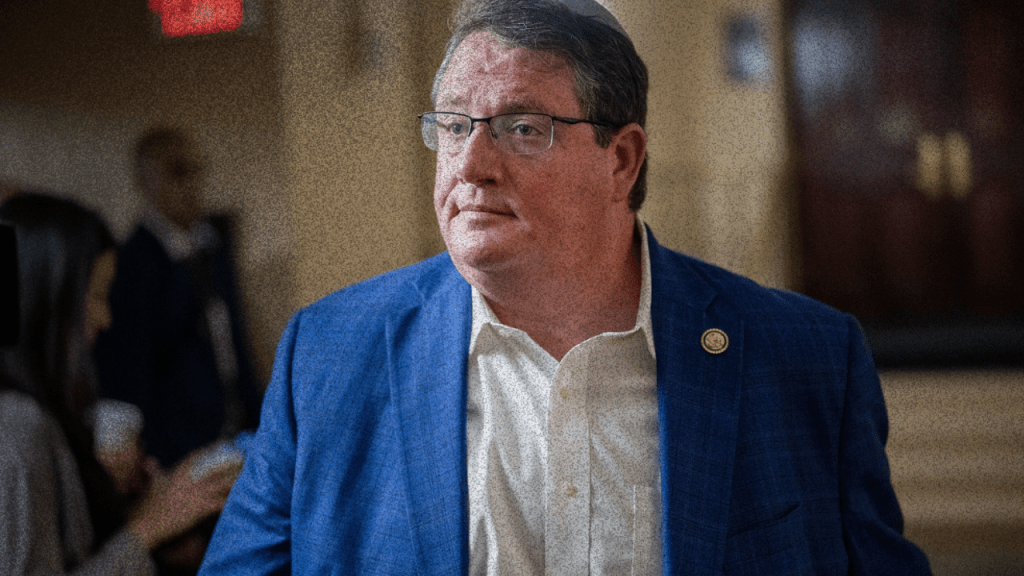
Iran 9/11 rhetoric deployed by Randy Fine on Newsmax is not a fringe provocation — it is a documented war-consent doctrine recycled for a new target.
Fine Said the Quiet Part Out Loud, and That Was the Point
“Imagine the same people who carried out 9/11 being able to carry out another 9/11 — this time with a nuclear weapon. That is not something we can allow to happen. PERIOD.” That is Florida Republican Congressman Randy Fine, posting to his verified account on March 1, 2026, above a screenshot of his Newsmax appearance. The statement names no evidence. It makes no direct accusation. It does not say Iran planned 9/11, funded 9/11, or knew about 9/11. It does not need to. Fine hands the audience a premise — “the same people who carried out 9/11” — and lets their own inference do the rest. The rhetorical power of the statement is located precisely in what it refuses to say out loud. That refusal is not a limitation. It is the mechanism.
Fine is a self-described “Hebrew Hammer,” a staunchly pro-Israel congressman with a pattern of Newsmax appearances on Iran-related topics. His presence on Newsmax is not incidental. Newsmax is the infrastructure through which the American right disseminates war-adjacent framing to an audience already disposed to receive it. Fine’s statement did not need to be verified by a clip before it did its damage — the association was made, the inference was planted, and the audience was moved. That is the entire operation. It is the same diaspora and media infrastructure that has been refined across two decades of practice to make exactly this kind of statement land.
The 9/11 Commission Record Fine’s Framing Requires Erasing
The 9/11 Commission Report is explicit: “We have found no evidence that Iran or Hezbollah was aware of the planning for what later became the 9/11 attack.” The Commission further noted that at the time al-Qaeda operatives transited through Iran, those operatives themselves were probably not aware of the specific details of the operation they would eventually carry out. Transit occurred — between eight and ten of the Saudi hijackers traveled through Iran between October 2000 and February 2001. The Commission confirmed it. What the Commission did not find, and explicitly stated it did not find, was foreknowledge, coordination, or operational involvement. No planning role. No financial chain. No directed relationship between the Iranian state and the 9/11 plot.
The gap between “transit occurred” and “Iran did 9/11” is not a matter of interpretation. It is the entire evidentiary record. U.S. civil courts, operating under a lower burden of proof than an intelligence commission, found Iran liable for material support through the facilitation of transit — a finding that itself illustrates how far removed the evidentiary standard must be from the Commission’s threshold before even a partial liability claim holds. Fine’s framing does not sit at the civil court standard. It sits at the level of implied perpetration. That is not a leap the evidence supports at any standard. It is a leap the rhetoric performs in place of evidence.
This Technique Has a Blueprint — Iraq Proved It Works
Fine did not invent this. Peer-reviewed research in Perspectives on Politics documented the Bush administration’s method with precision: Bush speeches from September 2002 through May 2003 placed September 11 and Iraq in the same paragraph repeatedly, and three times constructed a hypothetical scenario in which the September 11 hijackers were armed with WMD provided by the Iraqi government. That hypothetical construction — “Imagine those 19 hijackers with other weapons and other plans — this time armed by Saddam Hussein” — is structurally identical to Fine’s “imagine the same people.” The formula was not improvised under pressure. It was deployed deliberately, and it produced a measurable outcome: by late 2003, 69 percent of Americans believed Saddam Hussein was personally involved in the September 11 attacks. The doctrine works. That is why it persists.
The Iraq case confirms that the rhetorical architecture Fine is operating within is not analogous to the 2003 campaign by accident — it is the same campaign, restarted with a new target. The audience has been pre-processed. The emotional scaffolding is already in place. Fine’s statement does not need to build the case from scratch because the Iraq war built it for him. He is drawing on accumulated rhetorical capital, and the withdrawal requires no new deposit of evidence.
How Fragments of Truth Become War Justification
The technique operates through a specific transformation process. It begins with real facts: hijackers transited Iran, Iran has sustained relationships with armed groups in the region, Iran has had documented indirect contact with actors connected to al-Qaeda. Those facts exist. What the doctrine does next is the distortion: transit becomes collaboration, contact becomes coordination, proximity becomes responsibility. Each individual step is small enough to pass through the audience’s critical filter. The cumulative effect is that Iran is no longer adjacent to the 9/11 story — it is inside it. No single lie is told. A series of true statements are arranged so that the audience performs the inferential leap the speaker withholds. This is what targeted perception work looks like at the congressional-media nexus: not fabrication, but architecture.
The arrangement also functions as a political prophylactic. Because Fine never stated “Iran carried out 9/11,” no correction lands cleanly. A factual rebuttal has to chase an implication — and implication does not retract. The 9/11 Commission’s findings become a technicality the audience has already moved past. Evidence is not the terrain this argument occupies. Emotion is. And on emotional terrain, the side with the stronger image — a nuclear mushroom cloud superimposed over the memory of the Twin Towers — wins regardless of what the record says. The evidentiary bypass is not a flaw in Fine’s argument. It is its load-bearing structure.
Iran on Its Own Terms Requires Debate — Iran as 9/11 Continuation Does Not
Iran’s actual record in the region is a political and strategic question that carries real complexity. Iran has supported Hezbollah, backed the Houthis, maintained relationships with Iraqi armed factions, and sustained decades of conflict with U.S. strategic interests. That history is real, it is debated within Iran, and it has genuine consequences for regional stability. None of it is interchangeable with 9/11. The moment those histories are collapsed — as Fine’s framing requires — the political space for debate closes. If Iran is understood as a state with its own history, its own contradictions, and its own political logic, then U.S. policy toward Iran must be argued, justified, costed, and contested. If Iran is folded into the emotional shorthand of 9/11, none of that is necessary. The case is pre-made. The consent is pre-manufactured. The war is pre-justified. Fine’s statement is not analysis of Iran. It is the removal of Iran from the domain of analysis entirely.
9/11 as Reusable Weapon — Fine Is the Current Operator
The real danger in Fine’s Newsmax appearance is not that one congressman made an inflammatory statement. Inflammatory congressional statements do not by themselves move armies. The danger is structural: Fine’s statement is evidence that the 9/11 emotional trigger has been successfully converted into reusable infrastructure. It can be attached to Iraq. It can be attached to Iran. It can be attached to the next designated adversary after Iran. Each deployment degrades the historical record a little further and widens the gap between what 9/11 actually was — a specific attack, carried out by a specific organization, investigated by a specific commission that reached specific conclusions — and what it has become in political usage: a blank authorization that requires no new argument, no new evidence, and no new debate. Once 9/11 can mean anything, it can justify everything. Fine knows this. The infrastructure he is operating within was built to make exactly this possible.
Sources
- Randy Fine (@RepFine) — X/Twitter post, March 1, 2026
- The 9/11 Commission Report — National Commission on Terrorist Attacks Upon the United States
- Gershkoff & Kushner — Shaping Public Opinion: The 9/11-Iraq Connection in the Bush Administration’s Rhetoric, Perspectives on Politics, 2005
- Pew Research Center — A Look Back at How Fear and False Beliefs Bolstered U.S. Public Support for War in Iraq, 2023



 Spark Solidarity