
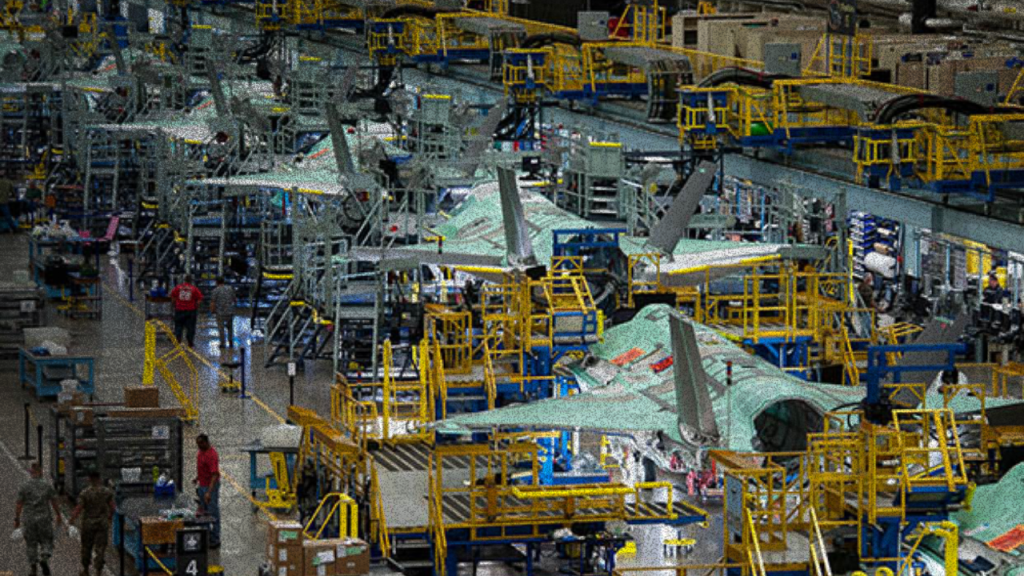
The U.S. isn’t running out of weapons — it’s consuming them faster than it can reproduce them. The structural tension between empire’s demands and capitalist production logic.
The standard metrics of American military power are snapshots: the size of the defense budget, the sophistication of weapons systems, the reach of alliances. These measure stock. But empire is not sustained by stock. It is sustained by flow.
The relevant question is not whether the United States can win a single confrontation. It is whether it can sustain multiple commitments over time without the velocity of consumption exceeding the velocity of reproduction. That distinction rarely mattered in the post–Cold War decades, when wars were geographically contained and geopolitically isolated. It matters now.
In the last several years the United States has simultaneously supported Ukraine, defended Israel, intercepted threats across the Red Sea and the Gulf, and maintained readiness in the Indo-Pacific. None of these engagements alone constitutes collapse. Together they expose the difference between projecting power and replenishing it. When commitments are continuous and replenishment is slow, stress accumulates even without battlefield defeat.
The Architecture of Permanent Obligation
The roots of this structural problem trace back further than contemporary procurement debates — to the postwar order itself.
After 1944, the United States anchored the global financial system. The dollar became the reserve currency. Trade flows and capital markets orbited American liquidity. Monetary centrality conferred enormous advantages and created obligations. Financial stability required political stability. Political stability required credible deterrence. Credible deterrence required forward deployment.
Economic leadership matured into security leadership. The United States did not accumulate bases and alliances arbitrarily. The system it built made continuous reassurance structurally necessary. Withdrawal in one theater risked signaling weakness in others. Credibility became indivisible.
A reserve currency regime thus became a permanent security regime. Permanent security commitments require permanent readiness. Permanent readiness requires depth. Depth requires industrial reproduction.
The link between monetary hegemony and munitions production capacity is almost never discussed in public debate. But the connection is direct. A system that promises protection across Europe, the Middle East, and the Indo-Pacific cannot rely on episodic mobilization. For decades that requirement was obscured by the absence of simultaneous stress across theaters. Today it is visible.
Military Spending as Demand Management
There is a reason large defense budgets have proven politically durable across administrations of both parties. Military expenditure performs a stabilizing function within the American political economy. It absorbs capital, sustains high-skill industrial sectors, justifies deficits under national security framing, and channels public money through private firms rather than redistributive social programs.
This is often described as military Keynesianism: the use of defense spending to stabilize economic activity. In the Cold War era it became normalized — military spending was embedded as demand management, not merely deterrence.
But stabilizing demand and sustaining depth are not the same thing. Appropriations can expand quickly. Production capacity expands slowly. Skilled labor pipelines, energetics plants, machine tooling facilities, and electronics supply chains cannot be scaled overnight. The political system can authorize billions in weeks. Factories require years. For much of the post–Cold War period the gap between funding and throughput was invisible because consumption was episodic. In an environment of sustained multi-theater commitments, that gap becomes measurable — and it is now being measured in interceptor stockpiles, artillery shell inventories, and precision munitions burn rates that exceed replenishment timelines by years.
What the Cold War Drawdown Actually Did
To understand why reproduction is slower than assumed, it is necessary to look at how the defense industrial base was reorganized after 1991.
With the Soviet Union gone, policymakers concluded large-scale attritional warfare was unlikely. The Gulf War reinforced this. Precision munitions and rapid air superiority seemed to promise short, decisive conflicts. The industrial base adjusted accordingly. Redundant production lines were eliminated. Consolidation reduced the number of major contractors from dozens to a handful. Supply chains were streamlined for efficiency rather than redundancy. Idle capacity was treated as waste. Procurement cycles prioritized high-end systems produced in predictable quantities at stable margins.
These changes were not irrational. They were logical responses to the strategic environment as it appeared. They were also consistent with broader economic trends. The American economy was financializing. Firms were disciplined by shareholder expectations. Return on capital became the central metric. Underutilized assets were liabilities to be restructured away.
This logic permeated the defense sector. The result was a production system optimized for steady-state peacetime procurement — technically sophisticated, financially efficient, and structurally incapable of rapid surge. That distinction is now decisive.
Slack Versus Profit Discipline
The structural tension is straightforward. Attritional security requirements reward slack: idle lines that can be activated quickly, multiple suppliers for the same component, stockpiles that may sit unused for years. Financialized capitalist production disciplines slack. Idle capacity lowers return on investment. Redundant suppliers dilute margins. Excess inventory ties up capital.
This is not a moral failure. It is how capital operates.
When the state demands depth, it must compensate firms for maintaining capacity that markets consider inefficient. It does so through multiyear contracts, guaranteed procurement, and subsidy. Risk is socialized. Profit remains private. This arrangement can work — it has worked before — but it requires sustained political commitment and acceptance of lower capital efficiency in strategic sectors. The more permanent and geographically dispersed military commitments become, the more sustained that override of market discipline must be. If the override is partial or slow, reproduction lags consumption.
The emergency contracts now being signed — the $2 billion THAAD interceptor deal, the tripling of Patriot production, the artillery shell expansion — are the state attempting to retroactively impose this override after decades of market discipline prevailed. They are the right correction applied late, financed by public funds that will flow to the same firms whose shareholder logic created the shortage.
Attrition as a Rate Problem
The public conversation treats military strength as binary: dominant or declining, strong or weak. Strength is a rate. It is the rate at which commitments can be met relative to the rate at which resources are consumed.
Recent engagements illustrate this without requiring apocalyptic framing. In each theater the United States has demonstrated tactical success — intercepting Iranian missiles, striking nuclear facilities, suppressing Houthi operations. In each case it has also expended high-end munitions and reallocated stockpiles across theaters. The issue is not that any single expenditure is catastrophic. It is that they are cumulative. A single engagement does not test the system. Repeated, overlapping engagements do.
When replenishment timelines stretch into years while commitments remain immediate, the question shifts from capability to sustainability. Historical analogies to sudden imperial collapse are misleading. Empires rarely fall because of a single decisive defeat. They erode when the gap between promise and reproduction becomes visible to rivals — who then adjust their strategies accordingly.
This is how multipolarity emerges: not through surrender, but through incremental recalibration based on perceived constraints. Rivals do not need to defeat a hegemon. They need to observe its limits.
The Strategic Fork
There are only two structural responses available.
The first is deeper state direction of strategic production: guaranteed multiyear procurement at elevated levels, mandated redundancy in key inputs, protection of domestic supply chains, and acceptance of lower capital efficiency in defense-adjacent industries. This does not require nationalization. It requires subordinating shareholder discipline to strategic necessity in critical sectors — a partial and targeted suspension of the market logic that created the shortage.
The second is narrowing commitments. If industrial throughput cannot expand sufficiently to sustain global promises at attritional speed, those promises must be prioritized. Some theaters receive full backing. Others are deemphasized. The geographic scope of credible deterrence shrinks.
Both paths are politically difficult. The first requires sustained public expenditure and structural intervention in private industry. The second risks signaling weakness and accelerating the very strategic recalibration policymakers seek to prevent. But the choice cannot be deferred indefinitely. Commitments and capacity must eventually align. The gap between them is not sustainable as a permanent condition — it can only be tolerated, at increasing cost, until one side adjusts.
Not Decline. Stress.
The United States remains extraordinarily powerful. Its economy is large, its technological base advanced, its military capabilities formidable. The issue is not whether American power exists. It is whether it can be reproduced at the scale its global commitments require, at the speed those commitments consume it.
Power projected once is spectacle. Power reproduced repeatedly is structure.
The structural tension now visible is not a crisis in the sense of immediate breakdown. It is a stress test. If industrial expansion proceeds and depth is restored, the system stabilizes. If expansion lags while commitments remain constant or grow, the stress compounds. This is arithmetic, not prophecy.
For decades the United States could rely on the absence of simultaneous attritional pressure across multiple theaters. That assumption no longer holds. The question now is whether a political economy organized around efficiency and profitability can sustain the redundancy and depth that permanent global security commitments demand.
Capitalism can finance empire. That has been demonstrated repeatedly. Whether it can reproduce empire at attritional speed — without reshaping its own production logic — is the question the current moment is forcing open. If it cannot, commitments must contract. If commitments do not contract, production must change.
There is no third option. And the answer will not arrive in a speech or a doctrine. It will arrive in procurement cycles, factory expansions, and supply chain redesigns.
Not in rhetoric. In throughput.
For the specific figures behind this argument — THAAD depletion rates, long-range missile inventories, and the emergency contracts now being signed — read U.S. Missile Stockpile Shortage: The THAAD Depletion Crisis Explained.
Sources
- Stars and Stripes. “US Spends $2B to Rebuild THAAD Arsenal After Iran Fight Drains Stockpile.” July 30, 2025. https://www.stripes.com/theaters/us/2025-07-30/washington-thaad-iran-interceptor-18607580.html
- Christian Science Monitor. “With Missile Stockpiles Low and Tensions With Iran High, US Moves to Increase Weapons.” February 5, 2026. https://www.csmonitor.com/USA/2026/0205/us-iran-war-nuclear-missiles
- CNN. “US Used About 25% of Its THAAD Missile Interceptors During Israel–Iran War.” July 28, 2025. https://www.cnn.com/2025/07/28/middleeast/us-thaad-missile-interceptor-shortage-intl-invs
- Stars and Stripes. “US Used 14% of Its THAAD Stockpile Against Iran, a Report Says. It Could Take Years to Replenish.” July 23, 2025. https://www.stripes.com/theaters/us/2025-07-23/thaad-burn-rate-israel-iran-18524355.html
- Foreign Policy Research Institute. “America’s Scale Problem.” October 2025. https://www.fpri.org/article/2025/10/americas-scale-problem/
- Fox Business / CSIS. “US Could Quickly Run Out of Munitions in Conflict with China, Defense Industry Unprepared.” January 2023. https://www.foxbusiness.com/politics/us-could-quickly-run-out-munitions-conflict-with-china-defense-industry-unprepared-report
- Defense News. “Soaring US Munitions Demand Strains Support for Israel, Ukraine, Taiwan.” April 30, 2024. https://www.defensenews.com/pentagon/2024/04/30/soaring-us-munitions-demand-strains-support-for-israel-ukraine-taiwan/
- Responsible Statecraft. “By the Numbers: US Missile Capacity Depleting Fast.” November 18, 2024. https://responsiblestatecraft.org/us-stockpiles-missiles/






 Spark Solidarity