
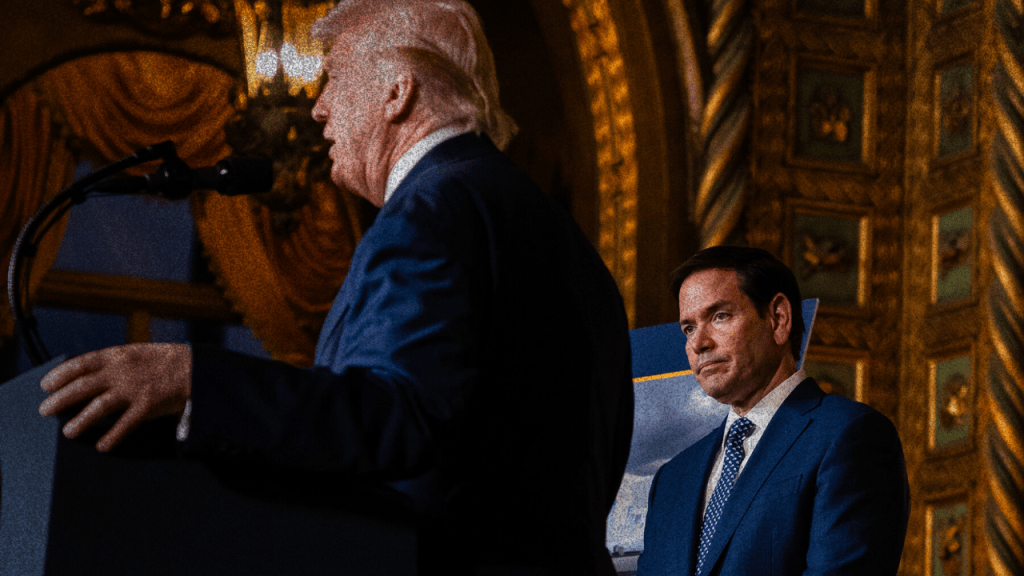
Iran war started February 28 with talks 48 hours out — Washington chose the bombs over the table, and three incompatible justifications prove it.
The Facts Precede Every Frame Washington Built Around Them
On February 28, 2026, the United States and Israel launched coordinated airstrikes on Iran. Natanz was hit with bunker-buster bombs. Military bases, command infrastructure, and leadership compounds were struck. Supreme Leader Ali Khamenei was assassinated. These are not disputed. They are the material foundation from which every subsequent claim about justification, legality, and responsibility must be assessed. Less than 48 hours before the bombs fell, U.S. Special Envoy Steve Witkoff and Jared Kushner had met with Iranian Foreign Minister Abbas Araghchi in Geneva for a third round of talks. A fourth round had already been scheduled for the following week. Washington knew the table was set. It chose to bomb it instead. That choice is not background context. It is the story.
The immediate regional effects were total and instantaneous. Gulf military forces repositioned. Air defense systems activated. Naval assets shifted to protective postures. Iran struck the southern Israeli city of Dimona in response to the Natanz hit. Within hours, what Washington had framed as a surgical operation was being processed by every actor in the region as the opening of a war. The Security Council met the same day, with the Secretary-General stating that the strikes “undermine international peace and security” and had “squandered an opportunity for diplomacy.” The escalation was not gradual. The question the material facts force onto the table is the one Washington spent the next 24 hours scrambling to answer incoherently: what was the justification?
Three Incompatible Justifications Is Not a Messaging Failure
Washington reached for the post-9/11 preemption playbook. But the Trump administration could not agree on what the threat was. Secretary of State Marco Rubio argued Iran posed an imminent danger because it would retaliate against U.S. forces in response to Israeli strikes — preemptive self-defense against a hypothetical Iranian response to a separate hypothetical Israeli action. Trump offered a different account in his State of the Union address, claiming Iran was planning to strike the United States directly, on its own initiative. Witkoff placed Iran a week from nuclear bomb-making material. Arms Control Association confirms and confirms that none aligned with intelligence assessments, which placed Iran years from a deliverable weapon and found no evidence of a weaponization decision.
Three separate threat framings, from the same government, within 24 hours, none of them consistent. This is not a messaging failure. Messaging failures produce a single incoherent story. This produced three incompatible ones — which is precisely the point. When a state cannot produce a consistent justification for military action, the function of that inconsistency is to drown the space where accountability would otherwise live. Each audience gets the version most likely to secure its support. Hawks get the nuclear threat. The diplomatic wing gets preemptive defense. The international community gets Article 51 language. The contradictions only become visible when the framings are placed side by side — which Western media, by and large, declined to do. What they actually prove is that the decision to strike preceded any specific legal or strategic rationale. The justification was assembled after the fact to fit a decision already made.
Striking During Active Talks Was a Choice, Not a Failure
Iran’s counter-narrative was not propaganda — it was corroborated by Oman, the neutral mediator. Omani Foreign Minister Badr bin Hamad Al Busaidi stated publicly that “active and serious negotiations” had been undermined by the strikes. Iran’s UN representative made the structural argument directly: the United States had, for the second time during negotiations, committed unprovoked aggression. The UN Secretary-General confirmed the sequence, noting the joint operation occurred following Oman-mediated talks, “squandering an opportunity for diplomacy.” These are not competing interpretations. They are a documented sequence: third round of talks concluded, fourth round scheduled, bombs fell in the interval.
The pattern this fits is not exceptional. It is the standard operating logic of U.S. hegemonic maintenance. Washington uses diplomatic processes as intelligence-gathering and delay mechanisms, not as paths toward resolution it actually intends to reach. The 2003 Iraq inspections process, terminated by invasion before Hans Blix completed his work, is the template. Libya’s negotiated disarmament, rewarded with regime change in 2011, is another. The lesson every targeted state has drawn from these precedents is that engagement with U.S.-mediated diplomacy is a vulnerability, not a path to security. Iran engaged anyway — and the result confirmed the lesson. As this site has analyzed in the context of how Washington deploys pretext, the invocation of threat and diplomacy in sequence is not contradiction — it is method.
The Narrative Fracture Is a Weapon, Not a Consequence
Three irreconcilable accounts of the same event emerged simultaneously: U.S. preemptive defense, Iranian rightful retaliation, and the structural critique that framed the strikes as imperial force deployed to maintain geopolitical dominance. Western outlets treated this as a coverage problem — a he-said-she-said to be managed with balance. It is not. When no shared factual baseline exists, accountability becomes structurally impossible. There is no forum, no evidentiary standard, no international mechanism capable of rendering a verdict that the party with the most military force is required to accept. The UN Security Council is vetoed into irrelevance by the United States the moment it becomes inconvenient. The infrastructure of permanent enmity exists precisely to make this fracture feel natural rather than engineered.
Killing Khamenei while claiming preemptive defense makes de-escalation structurally impossible. Leadership assassination removes the interlocutor. It collapses whatever institutional continuity might allow a negotiated halt. It forces the surviving Iranian state apparatus into a posture of retaliation or existential retreat — and then whatever retaliation follows gets absorbed by Western media as evidence of Iranian aggression, retroactively validating the original strike. The assassination was not a side effect of the operation. It was its logic. A state whose supreme leader has been killed by a foreign military cannot be seen to negotiate with that military without an internal political collapse. Washington built a conflict architecture designed to be self-sustaining. The narrative chaos — multiple incompatible justifications, no shared factual ground — is what that architecture produces. The chaos is the cover.
Sources
- Arms Control Association — Trump’s Chaotic Iran Nuclear Policy (published Feb 26)
- Arms Control Association — Did Iran’s Nuclear Programs Pose an Imminent Threat? No.
- UN Security Council — Emergency Meeting on Iran Strikes, February 28, 2026
- UN News — Iran Strikes Squandered Chance for Diplomacy: Guterres
- Wikipedia — 2025–2026 Iran–United States Negotiations
- Wikipedia — 2026 Iran War
- 2001 Authorization for Use of Military Force
- Trump on China and Panama Canal — Spark Solidarity
- Weaponized Diaspora and the Witnesses Empire Needs — Spark Solidarity



 Spark Solidarity