
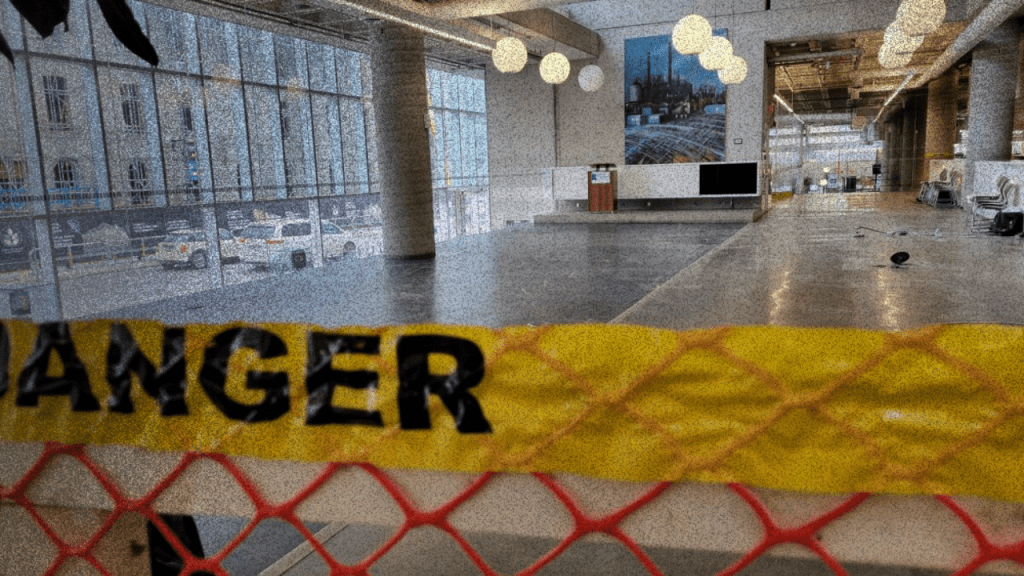
Ontario’s library overdoses aren’t a breakdown of order. They’re the result of closing harm-reduction sites and pushing risk into public spaces.
The spike in overdoses and emergency responses inside Ontario public libraries is being framed as a local breakdown of order. It is not. Ontario is where the crisis is being forced into the open because the provincial government has spent the past year removing harm-reduction infrastructure and then responding to the consequences with enforcement. The library stories are the surface. The base layer is a toxic drug supply, mass housing insecurity, and service gaps that exist across Canada.
This piece makes two claims. First, Ontario’s library overdose headlines are the direct result of policy choices that displace risk into unmanaged public spaces. Second, the same underlying conditions exist nationally — multiple provinces already show the same pattern of overdoses appearing in libraries and other public institutions — which means Ontario’s political distinctiveness is one of style and direction, not of unique social conditions.
The Hamilton Situation
Hamilton’s downtown Central Library has become a focal point for the provincial story. Since December 2024, paramedics have been called to the branch 105 times. Security staff administered naloxone on 44 separate occasions. In the first five weeks of 2026 alone, there were 771 documented security incidents inside the building. In late January, the library announced it would close on Sundays and shift its weekday opening from 8:00 a.m. to 9:00 a.m. — a service reduction attributed directly to the volume of overdoses and the absence of non-profit and public health partners on weekends.
At a February 18 library board meeting, chief librarian Paul Takala raised the possibility of a temporary closure of the Central branch to “disrupt the pattern of drug use” — and described the library as having become, de facto, a supervised consumption site. The board did not support a full closure; as of February 23, Takala said that option was “off the table,” and the library was instead exploring measures such as card-checking at the entrance. But the conversation itself — a public library discussing whether to close its main branch because the provincial healthcare system has stopped absorbing the people who need it — documents the condition clearly.
Ward 2 Councillor Cameron Kroetsch, who also chairs Hamilton’s Board of Health, made the causal link explicit at the board meeting: he said the worsening conditions at Central tracked directly with the provincial shutdown of Hamilton’s supervised injection site. That connection is not speculative. It is operational. When supervised spaces close, drug use does not end. It moves into unmanaged environments. Libraries are open, warm, free, and accessible. They become default refuges when housing, shelters, and clinical infrastructure fail to hold the line.
The Policy Mechanism: Displacement by Design
Ontario’s supervised consumption sites did not close due to lack of demand or evidence. They closed because the Ford government passed legislation in late 2024 banning sites located within 200 metres of schools or daycares, and because the HART Hub conversion model — which replaced supervised consumption with abstinence-focused treatment — stripped the transitioning sites of the services that kept people alive long enough to access treatment.
Nine sites closed or converted on March 31, 2025, despite an Ontario Superior Court injunction granted just days before — an injunction the province ignored, withholding funding from any site that continued to provide supervised consumption under the new model. A tenth site, the privately funded Kensington Market Overdose Prevention Site, remained open after a successful Charter challenge, but the province has not acknowledged any obligation to restore what was closed elsewhere.
The government’s own announcement framing the HART Hub transition described it as providing four times more funding per site — but that funding came with the explicit condition that needle exchange, safer supply, and supervised consumption services were banned. The Registered Nurses’ Association of Ontario warned publicly that this replacement logic removes life-saving services that keep people alive long enough to access treatment. Toronto Public Health’s own pre-closure report predicted adverse impacts to emergency responders and flagged that outdoor overdoses had risen in surrounding areas the last time a supervised site paused operations during COVID-19. In the years before the closures, between March 2020 and May 2024, trained workers at Ontario’s supervised consumption sites medically intervened to prevent nearly 22,000 overdose deaths, according to the Ontario auditor general.
The province’s response to the visible fallout has followed the same logic. Reporting on the Ford government’s interest in expanding arrest and charge powers for transit constables explicitly situates the move alongside the closure of supervised consumption sites. Removal of supervised care, followed by use of enforcement against the displaced population, is the consistent pattern.
The broader pattern of progressive-branded policy producing austerity outcomes — and how that veneer functions to insulate governments from accountability for the consequences — is examined in the analysis of Mark Carney’s neoliberalism and its progressive veneer unmasked.
The workforce documentation fills in the rest. A CUPE survey of library workers across 16 cities found that more than 38 percent had responded to an overdose at work, while only about half felt confident in their ability to use naloxone. That is the provincial and national system pushing clinical risk onto untrained public workers and calling the resulting arrangement a public service.
The Pattern Is Not Ontario-Specific
If the library overdose story were read as a purely Ontario phenomenon, the implication would be that something distinctively permissive or uniquely failed in Ontario produced it. The evidence runs in the opposite direction.
Saskatoon’s Frances Morrison Central Library and Dr. Freda Ahenakew Library closed temporarily in March 2025 explicitly due to overdose concerns. Staff at those two locations had responded to at least 48 overdoses or poisonings in the early weeks of 2025 — nearly double the same period in 2024. Saskatchewan does not have the Ford government’s harm-reduction policy history. It has the same underlying conditions.
Edmonton’s public library system had by 2023 already committed significant resources to security, naloxone, outreach workers, and washroom attendants as operational responses to opioid overdoses and social disorder pressures in its branches. Vancouver’s library system reversed a policy in 2018 to allow trained staff to respond to overdoses with naloxone — reflecting the reality that overdoses were already a documented concern inside library buildings years before they became headline news in Ontario. In Calgary, library branches stocked naloxone from 2018, and CUPE documented union discussions about equipping security guards with naloxone as a matter of standard practice. The Hamilton local’s union president said this winter: “I just like to point out this is a national issue” — and that her local is in active contact with other library unions across the country about it.
The geographic spread of these examples — BC, Alberta, Saskatchewan, Ontario — across an eight-year span eliminates the possibility that this is a story about any single province’s policy failures. It is a story about the national toxic drug supply and mass housing precarity being absorbed, without plan or compensation, by public institutions.
The National Crisis Behind the Local Stories
Canada’s opioid toxicity crisis is documented in federal public health surveillance. Health Infobase records over 53,000 apparent opioid toxicity deaths from January 2016 to June 2025, with British Columbia, Alberta, and Ontario accounting for the majority in recent years. That dataset is not about libraries. It is about the harm burden that produces the library stories.
The crisis concentrates in housing insecurity. Health Canada’s analysis documents that people who are homeless or housing insecure are consistently overrepresented among acute toxicity deaths. A Public Health Agency of Canada study analyzing national data found people without housing represented 8.9 percent of substance-related acute toxicity deaths despite comprising under one percent of the overall population. Statistics Canada’s February 2026 publication continues to document the dramatic increase in accidental drug poisonings since 2016 and their disproportionate distribution across populations.
The causal chain is not complicated. A toxic and unpredictable drug supply drives overdose risk across all settings. Housing insecurity and homelessness increase exposure to unmanaged environments and isolate people from supervised care.
The structural conditions producing that housing insecurity — and why federal housing policy consistently converts public crisis into private profit opportunity — are examined in the analysis of Carney’s $26B modular housing plan as profit scheme rather than fix.
Under-resourced healthcare systems leave public institutions — libraries, transit stations, warming centres — to absorb overdose response without training, funding, or clinical backup. The Canadian Public Health Association describes the toxic drug crisis as rooted in homelessness, poverty, trauma, mental illness, and decades of criminalizing drug policy. That structural account is what the library stories, taken together, are documenting from the ground up.
Ontario as the Warning Label
Ontario produces outsized headlines not because it has a uniquely severe drug crisis relative to BC or Alberta, but because the provincial government keeps making choices that amplify the visibility of displacement while actively reducing capacity to manage it. Supervised sites close, and the population that depended on them migrates into washrooms and stairwells. Libraries and transit systems register the crisis in their incident logs. The province then uses the visibility of those incidents to justify expanding enforcement powers.
The political logic of this cycle is self-reinforcing. Visibility is treated as the problem. Enforcement is marketed as the solution.
The political conditions that produced and sustained this cycle — how Doug Ford’s government won re-election despite its record, and what that reveals about how the system works against the people bearing its costs — are examined in the analysis of Doug Ford’s win and how the system works against the people.
These underlying conditions — toxic supply, housing collapse, service gaps — are not addressed, because addressing them would require acknowledging that the closure policy contributed to the crisis. Ontario thus keeps generating new evidence of its own displacement effect while insisting the displacement is proof that the people being displaced deserve further coercive intervention.
What the evidence across provinces actually points toward is a system question rather than a behavioral one. Jurisdictions that have maintained or expanded harm-reduction infrastructure show those investments intercepting overdoses before they reach libraries and emergency rooms. The pattern in the data — Toronto Public Health’s own modeling, the pre-closure auditor general numbers on overdoses reversed, the Saskatoon doubling — is consistent: when supervised care capacity is removed or absent, unmanaged public spaces fill the gap. When that gap is filled by enforcement instead of care, the people inside it face more legal jeopardy without improved outcomes on any public health metric.
Ontario is not the only province where public institutions are absorbing overdose response. It is the province where government choices keep forcing that absorption into sharper visibility — and then using the visibility to justify more of the same choices.
Sources
- CP24/CTV. “Drug Use and Overdoses Run Rampant in Canada’s Public Libraries.” CP24, February 27, 2026. https://www.cp24.com/news/canada/2026/02/27/drug-use-and-overdoses-run-rampant-in-canadas-public-libraries/
- Beattie, Samantha. “Hamilton Library Asks for 5.25% Budget Increase as It Faces ‘Social Crises’ at Downtown Branches.” CBC News, January 27, 2026. https://www.cbc.ca/news/canada/hamilton/central-barton-libraries-budget-9.7063040
- Coleman, Joey. “Hamilton’s Library Board Considers Temporary Closure of Central Library in Response to Problematic Drug Use.” The Public Record, February 18, 2026. https://thepublicrecord.ca/2026/02/hamiltons-library-board-considers-temporary-closure-of-central-library-in-response-to-problematic-drug-use/
- Chandler, Justin. “Closing Hamilton Central Library ‘Off the Table’ for Now as Staff Look at Other Ways to Stop On-Site Drug Use.” CBC News, February 23, 2026. https://www.cbc.ca/news/canada/hamilton/central-branch-temporary-closure-9.7100222
- CHCH News. “Hamilton Central Library to Close Sundays Amid Downtown Safety Concerns.” CHCH, January 23, 2026. https://www.chch.com/chch-news/hamilton-central-library-to-close-sundays-amid-downtown-safety-concerns/
- CBC News. “9 Ontario Supervised Drug Consumption Sites Set to Close Under New Law Will Become Treatment Hubs.” CBC News, January 2, 2025. https://www.cbc.ca/news/canada/toronto/supervised-consumption-sites-hart-hubs-ontario-1.7421744
- Casey, Liam. “Nine Ontario Supervised Consumption Sites to Close Despite Injunction, Minister Says.” CBC News, March 31, 2025. https://www.cbc.ca/news/canada/toronto/consumption-sites-ontario-1.7498128
- Raveendran, Rochelle. “Ontario Opens Homelessness and Addiction Hubs, Replacing Consumption Sites Near Schools and Daycares.” CBC News, April 1, 2025. https://www.cbc.ca/news/canada/toronto/ontario-opens-nine-hart-hubs-1.7498827
- Lang, Ethan. “Closure of Supervised Consumption Sites Could Lead to More Overdoses, Paramedic Stress: TPH Report.” CBC News, January 19, 2025. https://www.cbc.ca/news/canada/toronto/tph-report-supervised-consumption-sites-ontario-1.7431843
- Registered Nurses’ Association of Ontario. “RNAO Welcomes Judge’s Ruling to Keep Supervised Consumption Services Sites Open.” RNAO, March 31, 2025. https://rnao.ca/news/media-releases/rnao-welcomes-judges-ruling-to-keep-supervised-consumption-services-sites-open
- Ontario Government. “Ontario Approves Transition of Nine Drug Injection Sites into Treatment Hubs.” Ontario Newsroom, January 2, 2025. https://news.ontario.ca/en/release/1005531/ontario-approves-transition-of-nine-drug-injection-sites-into-treatment-hubs
- FlamboroughToday. “Ford Government Eyes More Powers for Transit Constables to Arrest, Charge Drug Users ‘to Keep Families Safe’.” FlamboroughToday, February 2026. https://www.flamboroughtoday.com/local-news/ford-government-eyes-more-powers-for-transit-constables-to-arrest-charge-drug-users-to-keep-families-safe-11926912
- CUPE. “Working in an Unsafe Consumption Site: A Library Perspective.” CUPE, October 16, 2025. https://cupe.ca/working-unsafe-consumption-site-library-perspective
- Global News. “Saskatoon Public Library Temporarily Closes Two Locations Due to Overdose Concerns.” Global News, March 24, 2025. https://globalnews.ca/news/11096009/saskatoon-public-library-temporarily-closes-two-locations-overdose-concerns/
- Saskatoon Public Library. “Frances Morrison Central Library & Dr. Freda Ahenakew Libraries Closing Temporarily.” Saskatoon Public Library, March 21, 2025. https://saskatoonlibrary.ca/about/news/frances-morrison-central-library-dr-freda-ahenakew-libraries-closing-temporarily/
- CKOM. “Two Saskatoon Libraries to Temporarily Close Over Safety, Drug Concerns.” CKOM, March 21, 2025. https://www.ckom.com/2025/03/21/two-saskatoon-libraries-to-temporarily-close-over-safety-drug-concerns/
- Global News. “Edmonton Public Library Spending on Social Disorder.” Global News, January 10, 2023. https://globalnews.ca/news/9400554/edmonton-public-library-social-disorder/
- Global News. “Vancouver Public Library Reverses Staff Policy on Responding to Overdoses.” Global News, March 23, 2018. https://globalnews.ca/news/4102745/vancouver-public-library-reverses-staff-policy-on-responding-to-overdoses/
- CityNews Calgary. “Calgary Public Library Stocking Branches with Naloxone.” CityNews Calgary, August 22, 2018. https://calgary.citynews.ca/2018/08/22/calgary-public-library-stocking-branches-naloxone/
- CUPE. “Terrill Budd: Other Duties as Assigned.” CUPE, August 15, 2019. https://cupe.ca/terrill-budd-other-duties-assigned
- Health Infobase. “Opioids and Stimulants: Data and Surveillance.” Government of Canada, last updated December 11, 2025. https://health-infobase.canada.ca/substance-related-harms/opioids-stimulants/
- Health Canada. “Homelessness and Substance-Related Acute Toxicity Deaths.” Health Canada, June 23, 2022. https://www.canada.ca/en/health-canada/services/opioids/data-surveillance-research/homelessness-substance-related-acute-toxicity-deaths.html
- Public Health Agency of Canada. “Housing Status and Accidental Substance-Related Acute Toxicity Deaths in Canada, 2016–2017.” Health Promotion and Chronic Disease Prevention in Canada, vol. 44, no. 7/8, August 14, 2024. https://www.canada.ca/en/public-health/services/reports-publications/health-promotion-chronic-disease-prevention-canada-research-policy-practice/vol-44-no-7-8-2024/housing-status-accidental-substance-related-acute-toxicity-deaths-canada-2016-2017.html
- Statistics Canada. “Accidental Drug Poisoning Deaths in Canada.” Statistics Canada, February 18, 2026. https://www150.statcan.gc.ca/n1/en/catalogue/82-003-X202600200002
- Canadian Public Health Association. “Toxic Drug Crisis.” CPHA, January 28, 2025. https://www.cpha.ca/toxic-drug-crisis








 Spark Solidarity