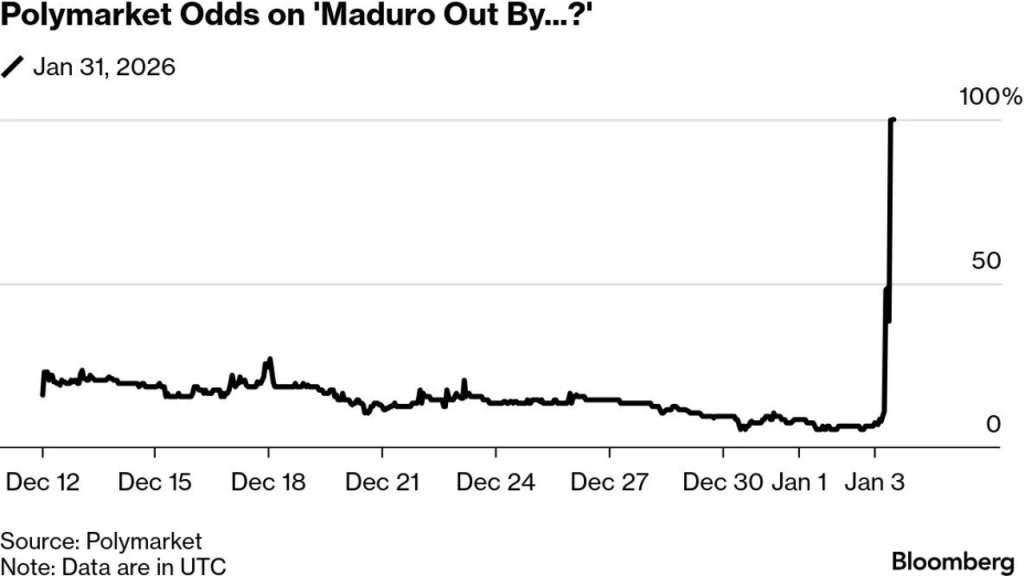
Maduro Polymarket bets made an anonymous trader more than $400,000 after the U.S. captured Venezuela’s president. Who knew what, and when?
Before the United States sent troops into Caracas to capture Venezuelan President Nicolás Maduro, a newly opened account on the prediction platform Polymarket was buying contracts that would pay if he lost power by the end of January. The trader was willing to put tens of thousands of dollars behind an outcome the market still considered unlikely. Hours later, U.S. forces carried out the operation, and the bet turned into a payout worth hundreds of thousands of dollars.
The January 3 raid was a major act of U.S. military intervention in Venezuela. American forces seized Maduro and his wife, Cilia Flores, and removed them from the country. President Donald Trump publicly described the operation that day, while questions were already mounting over Washington’s intentions for Venezuela and the legality of taking another country’s head of state by force. An Associated Press account published January 3 detailed the capture and the administration’s plans for the country.
The raid also created a winner far from the scene of the operation. By January 5, NPR had identified the account’s earlier screen name, Burdensome-Mix, and reported a profit of more than $400,000. The account holder remained unknown. The trades show how a secret U.S. operation can become a financial opportunity before the public learns what its government is doing.
The Money Behind Burdensome-Mix
Polymarket sells contracts on future events. A YES share purchased at a few cents can pay one dollar if the event occurs by the contract’s deadline. That structure made a bet on Maduro’s departure enormously lucrative: a comparatively modest investment could produce a large return if a result considered unlikely suddenly became certain.
Reporting published January 4 described a recently created account that had bought nearly $34,000 in contracts tied to Maduro’s removal and possible U.S. action in Venezuela. Most of the money went into the market asking whether Maduro would be out of office by January 31. That position cost approximately $32,537 and generated more than $404,000 in profit, according to the reported market data. Smaller bets concerned U.S. troops, an invasion and the possible use of war powers.
The trader did not risk $400,000. The gain came from buying cheap contracts before the operation became public and collecting after the capture. NPR reported the main stake as roughly $32,000 and the profit as more than $400,000. The available January reporting did not establish who provided the capital, whether anyone else controlled the account, or how the trader arrived at that level of confidence.
The account’s original handle, Burdensome-Mix, was later replaced with an alphanumeric display name. That did little to settle the mystery. Trading activity was visible on the platform, but a visible wallet and a visible trade are not the same as a verified person. A public record of a transaction can establish its timing and size without identifying the trader or the source of the information behind it.
The Timing Raises the Harder Question
The bet was striking because it was concentrated on a closely held government action, not simply because it won. Traders routinely put money behind unlikely results. Most lose. A sudden jackpot, even a large one, is not by itself proof that the winner had inside information. What drew attention here was the combination of a recently opened account, a narrow set of wagers tied to U.S. action against Venezuela, and purchases before news of the raid reached the public.
The January 4 reporting also described a late shift in Polymarket’s odds as the assault approached. It said the market price for Maduro’s departure, which had stayed below six percent for much of the preceding week, began climbing in the early morning of January 3. Those numbers describe trading expectations on the platform, not a verified probability that the operation would occur. They nevertheless illustrate how an emerging pattern of bets can attract attention before the public receives an official explanation.
As of January 5, the person behind Burdensome-Mix remained publicly unidentified. NPR reported that blockchain-analysis firm Chainalysis could not determine the account holder’s identity from the visible activity. The account’s use of cryptocurrency exchanges offered potential investigative leads, but none of the public evidence answered whether the trader acted on a remarkable reading of public developments, a private tip, or information obtained from someone connected to the operation.
That uncertainty is the point of scrutiny, not a reason to declare the account guilty. The United States had kept the details of a military raid secret from the public while someone else was taking an unusually profitable position on the result. The people affected by the operation were given no comparable ability to participate in the decision. A prediction market can turn that imbalance of information and power into a balance of money.
When Military Action Becomes a Contract
The political character of the wager gets lost if the story ends with a lucky or suspicious trader. Maduro’s removal was not a company earnings announcement or a sports result. It was the outcome of a U.S. military operation inside a sovereign country, involving armed force, detention and the future of Venezuela’s government. Yet Polymarket could present the event as a question with a deadline, a price and a payout.
Buying the contract did not require the trader to defend the legality of the raid or take responsibility for what happened in Caracas. Profit depended only on predicting the event correctly. That is the peculiar attraction of event-based speculation: the human and political circumstances that make an event consequential are stripped down to a financial settlement condition. War, sanctions, detention and regime change become contracts that can be bought and sold.
There is a long history of fortunes being made around war and state policy. Oil companies, arms manufacturers, bondholders and currency traders can all gain from political upheaval. Prediction markets make the connection unusually direct. Instead of betting that an oil price will move after an intervention, a trader can buy a contract on whether the intervention’s intended political outcome happens at all.
That design gives special value to information held near the centres of state power. Anyone who knows about troop movements, a private executive decision or the timing of an operation has an advantage over ordinary market participants. Whether anyone used that advantage in the Burdensome-Mix case remained an open question on January 5. The market had already demonstrated how lucrative such knowledge could be.
A Visible Market, an Unknown Trader
Prediction markets are often promoted as tools that combine scattered knowledge into a useful forecast. A price can reflect how thousands of people assess the same public information. It can also reflect the willingness of a smaller number of participants to spend heavily on information other people do not have. The screen displays a price, but it cannot tell observers why the price moved or what a particular trader knew.
That creates a problem for public accountability. Cryptocurrency records can show a transaction while obscuring the human being behind it. The public sees the payoff but may not learn whether the account belonged to a government official, an intermediary, an unusually attentive observer or an ordinary speculator. Suspicious timing invites investigation; it does not settle the investigation’s outcome.
The regulatory setting offered little reassurance. NPR reported that the Commodity Futures Trading Commission oversaw prediction markets such as Polymarket and Kalshi and could pursue fraud, but had far fewer staff than the Securities and Exchange Commission. NPR also described Donald Trump Jr.’s advisory relationships with both platforms and his venture-capital firm’s investment in Polymarket. Those political and commercial ties created concerns about the independence and intensity of oversight, whatever their actual effect in any particular case.
The scale and timing of the trade warrant scrutiny of its funding and possible links to people with advance knowledge of the raid. Any investigation must establish evidence rather than infer guilt from an exceptional win. It must also examine the incentives of platforms selling contracts on secret government action.
Who Profits from State Secrets?
As of January 5, the person behind Burdensome-Mix had not been publicly identified. No available evidence established that the account was operated by a government insider, and there was no public finding that the money came from unlawful trading. Those facts do not erase what the wagers made visible: someone could stake roughly $32,000 on a U.S. intervention that had not been disclosed and emerge with more than $400,000 in profit once it happened.
The larger problem is the power relationship behind that opportunity. Military decisions are made by a small number of officials, with information withheld in the name of national security. The consequences are borne by people whose governments, safety and futures may be altered by the operation. Prediction markets allow others to put a personal price on that uncertainty, and potentially reward proximity to information the public has been denied.
The January mystery deserves an answer about the trader. It also demands an answer about the market itself: why should the timing of a secret military operation be available as a private financial bet, and what safeguards protect the public when someone with privileged knowledge may stand to profit?