
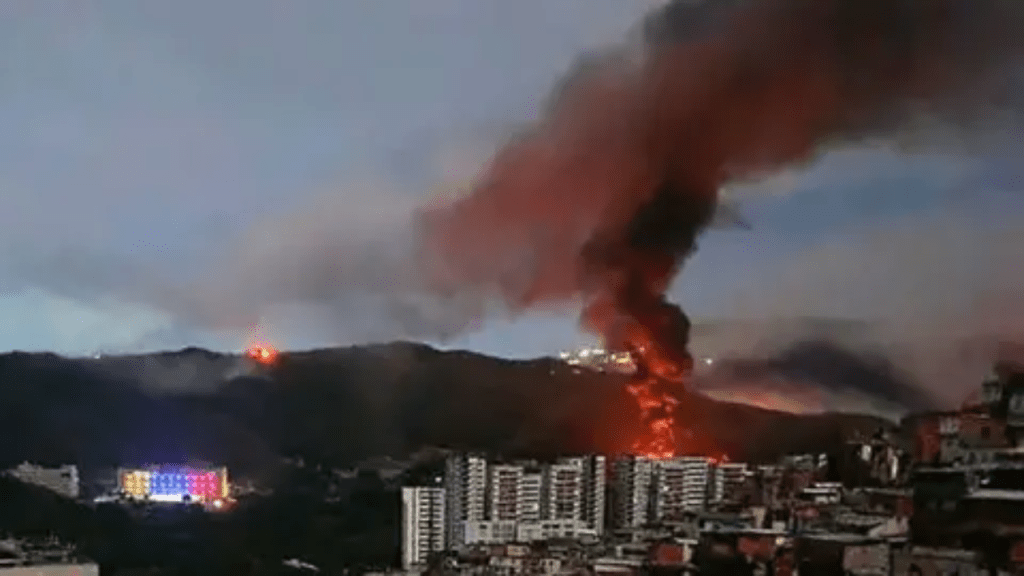
A murky extraction, minimal resistance, and global silence suggest Venezuela may mark a shift from open invasion to negotiated regime management.
As of this writing, the basic facts surrounding the United States’ sudden military action in Venezuela remain incomplete and contested. Official statements, fragmented footage, and early reporting paint an outline of events, but not yet a fully coherent picture. What follows is not a declaration of certainty, but an attempt to assess what has been claimed, what appears anomalous, and what this moment may represent if those anomalies hold.
According to US officials, American forces carried out coordinated airstrikes across multiple Venezuelan states and seized President Nicolás Maduro, who was then transported to New York to face criminal charges. Venezuelan authorities have acknowledged deaths among both civilians and military personnel but have not released numbers. The United States claims no American fatalities and minimal equipment damage. Independent verification remains scarce.
This uncertainty matters. Moments like this are often when narratives harden before evidence does. It is precisely when information is incomplete that analysis must slow down, not speed up. That restraint does not mean ignoring patterns, historical context, or political signals. It means distinguishing between what is confirmed, what is plausible, and what is being actively sold.
What is already clear is that, whatever exactly happened on the ground, this did not resemble the chaotic, grinding invasions of the early 2000s. It looked cleaner. Quieter. Almost rehearsed. And that, more than any single claim, is what demands scrutiny.
The Event as Described
By official US accounts, American aircraft struck Venezuelan military targets in four or five states, degrading air defenses and command infrastructure. Shortly thereafter, US forces extracted Maduro from Caracas. Charges announced against him include weapons-related offenses and narcotics conspiracy allegations, framed under US law.
The Venezuelan government has not released a detailed timeline. Footage circulating online shows American helicopters operating over Caracas with little visible resistance. State television images of damaged military installations depict limited destruction: destroyed buses, a single disabled armored vehicle, intact surrounding structures. No comprehensive casualty assessments have been made public.
US officials insist the operation was precise, successful, and resulted in no American deaths. They emphasize discipline, legality, and necessity. These claims may eventually be corroborated or contradicted. For now, they stand largely alone.
What is notable is not only what has been said, but what has not. There has been no public accounting of how Venezuelan air defenses were neutralized so thoroughly, nor how an extraction of this magnitude encountered so little resistance in a capital city. Even allowing for Venezuela’s limited military capacity, the apparent absence of engagement raises questions.
A Pressure Campaign Twenty-Five Years in the Making
This moment did not arise in a vacuum. US pressure on Venezuela has been continuous for a quarter century, intensifying after the election of Hugo Chávez in 1998. Chávez represented a break with the post–Cold War norm: a government that asserted sovereignty over natural resources and resisted automatic alignment with Washington.
From that point forward, Venezuela became a bipartisan fixation in American foreign policy. Sanctions regimes expanded. Financial isolation deepened. Diplomatic recognition was weaponized. Economic dysfunction inside Venezuela cannot be understood without acknowledging this sustained external pressure.
Oil sits at the center of this relationship, not as a slogan but as a structural reality. Venezuela holds the world’s largest proven oil reserves. Control over access, pricing, and alignment has always been the real stake. The question has never been whether the United States would prefer a compliant government in Caracas, but how far it would go to secure one.
Seen in this context, the present crisis looks less like a rupture and more like an endpoint. A strategy pursued across administrations has finally produced a moment where intervention appears low-cost and politically advantageous.
The Absence of Resistance
One of the most striking features of the available footage is how little resistance appears to have occurred. American helicopters fly over Caracas without sustained fire. No air-to-air engagements have been documented. No coordinated Venezuelan counteroffensive has been observed.
Even accounting for asymmetry, this is unusual. Poorer states do not typically collapse into non-response when attacked by major powers. They may lose, but they usually fight. Here, Venezuelan forces appear largely absent from contested zones, engaged instead in directing civilians to shelter.
Crowd control, not combat, dominates the visible response. This does not resemble a military scrambling to repel an invader. It resembles a security apparatus attempting to manage public order during an event it is not contesting.
That distinction matters. It suggests either overwhelming incapacitation or a decision not to engage.
Token Damage and Information Gaps
Damage assessments so far reinforce this impression. The strikes appear selective rather than devastating. Some installations show signs of attack; others appear untouched. Vehicles are disabled, but buildings remain standing. There is no visual evidence of sustained bombardment.
Equally notable is the lack of casualty information. Hours after the operation, there are no confirmed numbers, no hospital footage, no mass mobilizations. In modern conflict, information tends to leak quickly. Silence can indicate control, but it can also indicate that there is little to show.
This pattern aligns with a form of violence designed less to destroy capacity than to signal dominance. The goal is compliance, not annihilation. That is a different logic than total war.
Trump’s Statements and the Political Tell
Against this backdrop, US political messaging becomes revealing. Donald Trump publicly suggested that Venezuela’s vice president, Delcy Rodríguez, was willing to work with Washington. At the same time, he distanced himself from the traditional Venezuelan opposition, dismissing their leadership potential and legitimacy.
This is a significant shift. For years, US policy hinged on recognizing opposition figures as the rightful government of Venezuela. Abandoning them in favor of continuity without Maduro signals a pragmatic recalibration. Ideology has given way to manageability.
Trump’s tone toward remaining officials has been notably restrained. There is no call for purges, no sweeping denunciations. The target appears singular. That selectivity invites interpretation.
Deal, Betrayal, or Controlled Exit
At this point, analysis must explicitly enter the realm of hypothesis. Several scenarios could explain the observed patterns.
One possibility is internal betrayal: that elements within the Venezuelan government facilitated Maduro’s removal to preserve their own positions.
Another is negotiated surrender: Maduro agreeing to extraction to avoid full-scale invasion, perhaps in exchange for guarantees to the military or civilian leadership.
Reports in recent months suggested Maduro had explored exile options contingent on the US standing down. If true, this operation could represent the resolution of that negotiation.
In such scenarios, militaries stand down not because they are incapable, but because they have been instructed to do so. Bases are lightly staffed. Resistance is symbolic or localized. The spectacle of force substitutes for war.
None of this can yet be proven. But it fits the available evidence more coherently than the idea of a fully resisted invasion that simply left no trace.
Why the “Success” Narrative Works at Home
Domestically, the incentives are obvious. A foreign leader captured. No American casualties. Minimal damage. A clean operation. This is precisely the kind of outcome US political culture rewards.
Legality fades behind optics. International law dissolves into prosecutorial theater. The complexity of sovereignty is reduced to a mugshot.
For an American public conditioned by decades of managed interventions, this reads as competence. The absence of visible suffering becomes proof of righteousness, rather than a reason for suspicion.
International Silence as Permission
Global responses have been muted. China has issued no substantive statement. Russia’s objections are symbolic. Brazil stands out for voicing concern, but alone it carries little weight.
Most commentary hedges: condemning intervention while appending moral qualifiers about Maduro’s governance. This framing is not neutral. It reinforces the idea that sovereignty is conditional, that some leaders deserve removal by force.
Silence, especially from major powers, functions as consent. It signals that this precedent will not be contested.
The Authoritarian Trap
The invocation of authoritarianism as justification is familiar and dangerous. Iraq offers the clearest warning. Saddam Hussein was indisputably brutal. His removal did not liberate Iraq. It destroyed it.
Bad governance is not the worst possible outcome for a society. Foreign occupation and resource extraction often are. The choice presented is false, but it is repeatedly used because it simplifies moral accounting.
Asymmetric War in the Modern Era
This event also illustrates a broader shift. Advances in air power, surveillance, and precision weaponry have made resistance by smaller states increasingly futile. War no longer requires occupation. Control can be asserted from the sky.
Ukraine is the exception because it is backed by the world’s wealthiest militaries. Most countries do not have that option. For them, the future is not resistance, but negotiation under duress.
The Precedent This Enables
If this operation is normalized, it becomes a template. A leader extracted. A government adjusted. Resources aligned. Minimal noise.
Rhetoric about Cuba from US officials hints at how transferable this logic is. Today it is Venezuela. Tomorrow, any state deemed manageable.
This is the Monroe Doctrine stripped of pretense and applied globally.
Responsibility and Power
The most uncomfortable truth is that Americans possess more capacity to resist this system than those it targets. The failure to act is not ignorance. It is habituation.
Each unchallenged intervention narrows the space for sovereignty. Each silent success lowers the cost of the next operation.
What happened in Venezuela may still be clarified or revised. But the direction is unmistakable. Power no longer announces itself loudly. It arranges outcomes quietly, and waits to see who objects.
So far, almost no one has.

 Spark Solidarity