
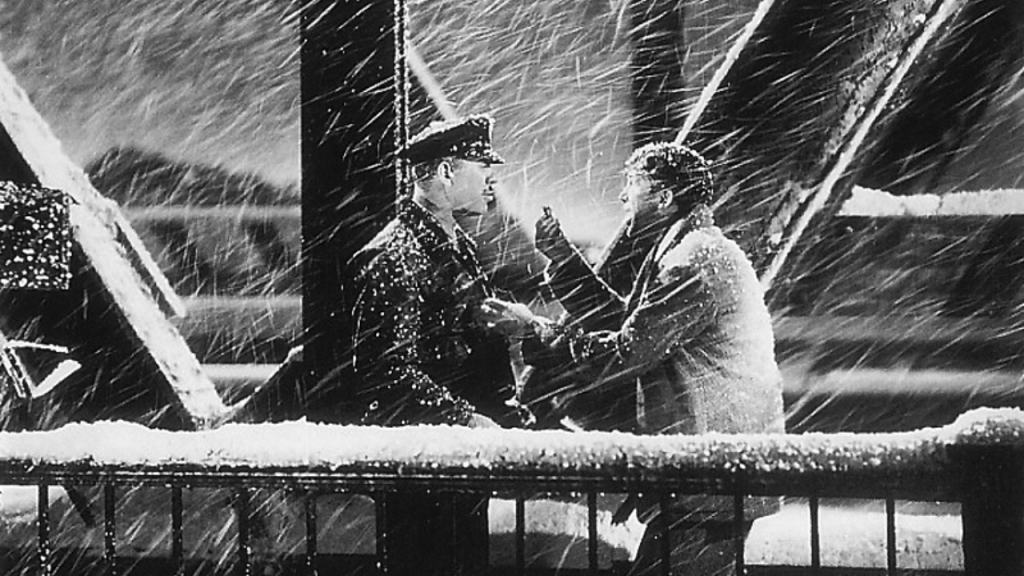
A film that reflects a moment when capitalism absorbed moral tension, before Cold War pressures pushed such ambiguity out of view
It’s a Wonderful Life is not best understood as a radical text, nor even as a political intervention in the conventional sense. It is better read as a symptom of a transitional moment in American capitalism, produced at a time when moral critique still circulated within the system rather than being expelled from it.
Seen this way, the film does not challenge capitalism from the outside but registers internal tensions that were becoming increasingly difficult to manage in the immediate postwar period.
This framing matters because many later interpretations retrofit the film with political intent it did not originally possess. From a historical-materialist perspective, the question is not whether the film is progressive or conservative, but what kind of capitalism required this story to be told in 1946, and why that space for critique would soon close.
The Red Scare and the Policing of Representation
In the late 1940s, the United States entered a phase of ideological consolidation that historians have described as foundational to the Cold War consensus.
This process was not limited to suppressing communists or labor militants. It also involved disciplining how capitalism itself could be represented in mass culture.
It was in this context that It’s a Wonderful Life came under scrutiny.
As later reported, the Federal Bureau of Investigation circulated a 1947 internal memo flagging the film as potentially subversive. Importantly, the memo did not accuse the film of promoting communism.
Instead, it focused on narrative elements: the portrayal of Mr. Potter as a greedy and socially corrosive banker, the sympathetic depiction of debtors and small-town cooperation, and the suggestion that unchecked accumulation undermines community stability.
This response is telling. The FBI’s concern centered on class representation, not political doctrine. By this point, even moral critiques of capital that accepted private property and market relations were beginning to appear ideologically risky. Capital increasingly required affirmation, not ambivalence.
Why the Actor Was Never the Target
A persistent claim has circulated that James Stewart, who played George Bailey, was personally investigated during the second Red Scare of the 1950s.
As historians and journalists have clarified, this is not true. Stewart was never surveilled, interrogated, or blacklisted because of the film.
Structurally, this makes sense. Stewart was a decorated World War II bomber pilot, a public Republican, and a widely recognized symbol of postwar American masculinity and civic virtue.
Investigating Stewart would have meant destabilizing one of the cultural figures through which the state itself derived legitimacy.
Instead, scrutiny gravitated toward the film as an object and toward creative figures like Frank Capra, whose populist tendencies had long attracted suspicion despite his overt patriotism.
Stewart’s role, materially speaking, was not to radicalize the film’s critique but to contain it, rendering moral tension compatible with American identity, military service, and institutional loyalty.
Moral Capitalism and Internal Contradiction
George Bailey is not an anti-capitalist figure. He runs a private financial institution, believes in credit, home ownership, and local enterprise, and never calls for collectivization or state control. What the film dramatizes instead is a conflict within capitalism, not against it.
Bailey embodies a form of petty-bourgeois moral economy, one rooted in social obligation and reciprocity. Mr. Potter, by contrast, represents capital abstracted from community, accumulation divorced from social responsibility.
As writers and film critics have noted in retrospectives on the film, this opposition treats exploitation as a moral failure rather than a systemic necessity.
The film resolves this contradiction ethically rather than structurally. Capitalism itself remains intact; its excesses are personalized and contained. This is not a revolutionary gesture but a stabilizing one, characteristic of a period when capitalism still relied on moral narratives to legitimate itself.
The Contraction of Acceptable Critique
The FBI’s discomfort with It’s a Wonderful Life signals a broader historical shift.
As American capitalism entered the Cold War era, integrating itself more tightly with state power, global markets, and permanent military infrastructure, its tolerance for internal critique narrowed.
Narratives that implied capitalism required moral restraint increasingly appeared incompatible with the demands of ideological certainty.
From this perspective, the Red Scare and McCarthyism functioned not only to suppress overt opposition but to discipline moderation itself. Cultural works that suggested capital could be socially destructive, even without proposing alternatives, risked undermining confidence in the postwar order.
The suspicion directed at It’s a Wonderful Life reflects how these things narrowed the ideological space in which even moral or internal critique could safely circulate.
Militarization and the Reassignment of Cultural Labor
By the time of the Korean War, James Stewart’s position within American ideological production had shifted. Stewart, in fact, became a key figure in Cold War cultural legitimation.
As a Brigadier General in the U.S. Air Force Reserve, he occupied a rare position at the intersection of cinema, military authority, and public trust.
Films such as Strategic Air Command, produced with full cooperation from the Air Force, did not function as wartime propaganda but as normalization.
As Cold War historians have observed, the ideological task had shifted from mobilizing the population for war to reconciling it to permanent readiness.
Managing Contradiction in Postwar Cinema
Stewart’s post-1946 roles consistently stage conflicts between individual conscience and institutional necessity without proposing rupture.
In Winchester ’73, violence is portrayed as corrosive rather than liberatory. In Anatomy of a Murder, the legal system appears compromised but preferable to chaos.
In The Man Who Shot Liberty Valance, law replaces mythic violence, though only through narrative distortion.
Across these films, Stewart repeatedly embodies figures whose function is to mediate contradiction, acknowledging systemic flaws while redirecting conflict back into institutions.
This reflects the broader role of liberal culture during high Cold War capitalism: absorbing tension without allowing it to crystallize into structural critique.
A Displaced Form of Critique
Seen through a historical-materialist lens, It’s a Wonderful Life endures not because it triumphed ideologically, but because it belongs to a moment that no longer exists.
The moral capitalism it gestures toward became increasingly incompatible with a system moving toward financial abstraction, globalized accumulation, and permanent militarization.
What once functioned as internal critique became ideologically inconvenient and was displaced into nostalgia.
In this sense, the film is less a warning or a manifesto than a historical artifact. Its survival as ritual reflects not its political victory, but the disappearance of the material conditions that once made such a critique intelligible within American capitalism.









 Spark Solidarity