
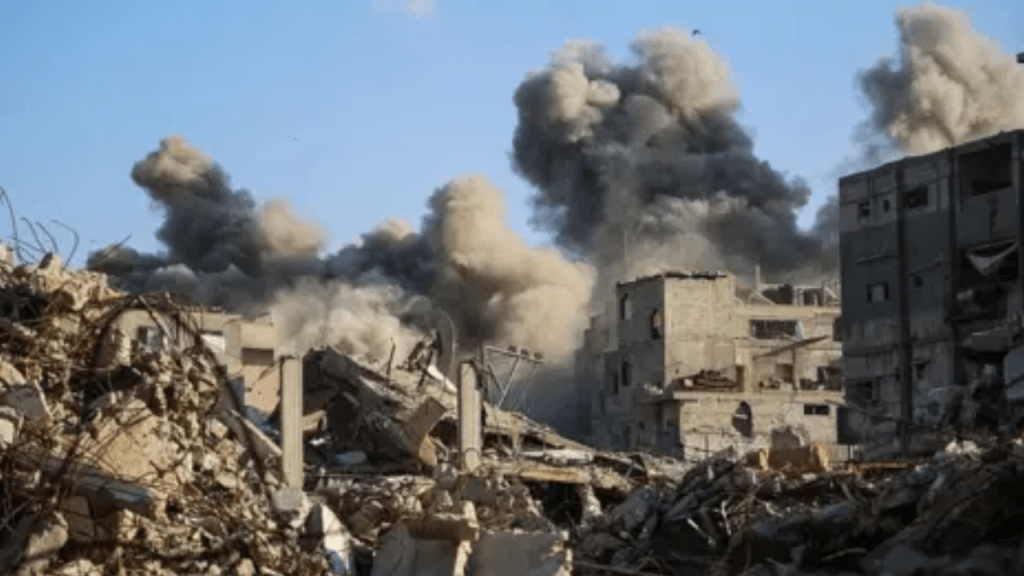
Gaza ceasefire violations — hundreds documented, hundreds killed — expose not a failed truce but a deliberate operational shift: mass bombardment replaced by governance erasure, administered through calibrated strikes and engineered scarcity.
The Label Changed. The Siege Did Not.
Since the ceasefire took effect on October 10, Israeli forces have carried out at least 393 documented violations, killing 339 Palestinians — more than 70 of them children — according to UN human rights experts. The deadliest single night, October 28, killed at least 104 people. Al Jazeera’s correspondent on the ground described the arrangement plainly: the truce deal in Gaza is “a ceasefire in name.” By December 22, the death toll since the ceasefire designation had reached at least 411 killed and 1,112 wounded, with strikes continuing across all five governorates. The Israeli government and Washington maintained the ceasefire was “still in effect.” What they meant is that no single strike was large enough to formally shatter the frame. That is not a defence of the ceasefire. It is a description of the doctrine.
The question the facts demand is not whether violations occurred — they did, at scale, continuously. The question is what kind of logic produces this specific pattern: persistent, distributed, below-spectacle violence that accumulates into mass death while remaining beneath the threshold that triggers coordinated international response. That question has a structural answer, and it begins with calibration.
Low-Intensity Violence Targets the Visibility Threshold
International scrutiny does not activate at cumulative effect. It activates at spectacle. Mass-casualty events in a single strike, images of collapsed hospitals, footage of children pulled from rubble in numbers too large to suppress — these are the inputs that generate pressure on governments, force Security Council sessions, and produce the news cycles that diplomatic actors must respond to. A sustained campaign of smaller strikes does not produce those inputs. It produces a statistical accumulation that is real in its consequences and invisible in its politics. As analysts told Al Jazeera: “as soon as ceasefires go into effect, nobody bothers with details, which gives Israel a free hand to do what it wants.” The reduced scale is not restraint. It is what makes the label politically sustainable while the operational objectives continue to advance.
The same threshold logic governs which targets are selected. Police forces are not symbolically legible civilian infrastructure — they do not photograph as hospitals or schools. Striking them does not generate the visual grammar of atrocity that penetrates Western media. But their destruction produces consequences that are materially equivalent to the destruction of any other administrative system. This is how the visibility gap is exploited: target the infrastructure whose loss is felt in daily life but not seen in a single frame. The international scrutiny mechanism is defeated not by hiding the violence but by distributing it below the threshold at which visibility becomes politically actionable.
Targeting Gaza’s Police Is Governance Destruction
Israel frames its strikes on Gaza’s police as legitimate military action against Hamas-affiliated security forces. The framing is designed to route the analysis into a debate about combatant status. That debate is a distraction. The material question is not whether these officers can be designated targets under Israeli military doctrine. The material question is what their removal does to the social fabric of Gaza as an administered territory. Police forces regulate movement, secure aid convoys, maintain civil order, and constitute the visible presence of administrative continuity under conditions of siege. As The New Arab reported, Israeli airstrikes have directly targeted police units responsible for securing aid convoys, killing officers mid-operation. The result is documented: armed gangs looting warehouses, aid depots, and bakeries; internal instability rising; the infrastructure of civil organization dissolving.
This is not collateral damage. Governance erasure at this scale, sustained across a formal ceasefire period, is the operational objective. A territory whose administrative capacity has been systematically degraded is a territory that cannot organize its own transition. It cannot field a functioning counterpart for negotiations. It cannot demonstrate administrative viability to international observers assessing post-conflict arrangements. It cannot resist the imposition of externally managed structures. The strikes on Gaza’s police are preparation for a dependency condition — and they connect directly to the second instrument of that condition.
Aid Restriction and Governance Destruction Are One Weapon
Only two of six crossings into Gaza have been reopened since the ceasefire designation. The agreed target under the agreement was 600 trucks per day. The actual average is 244 — less than half the committed volume. Out of 43,800 trucks that were supposed to have entered Gaza since the ceasefire began, only 17,819 did, according to Gaza’s Government Media Office. The UN OHCHR confirmed that aid volumes have frequently fallen below half the agreed daily target. The Zikim crossing into northern Gaza was closed by Israel and reopened only under sustained UN pressure — immediately framed as a humanitarian gesture. It was not. It was the minimum required to maintain the narrative of partial compliance while sustaining the scarcity condition.
Police destruction produces lawlessness. Aid restriction produces scarcity. Both produce dependency. A population that cannot secure its food supply and cannot rely on civil order is a population whose political agency is consumed by survival. This is controlled deterioration as strategy — not the chaos of war, but the managed degradation of a social system to a point where it cannot reconstitute itself without external intervention on terms set by the occupying power. The two instruments reinforce each other: absent police, aid that does enter is looted before it reaches civilians; absent adequate aid, the desperation that drives looting intensifies. The system is calibrated to sustain dysfunction just below the threshold of total collapse — because total collapse produces the spectacle that triggers intervention, and that is precisely what the calibration is designed to avoid.
The Word “Ceasefire” Is the Operation’s Political Cover
Declaring a ceasefire produces a narrative of de-escalation. It signals movement toward resolution. It gives diplomatic actors a frame within which to describe their inaction as patience rather than complicity. It gives media organizations a frame within which continued coverage of violence appears as episodic rather than systematic. And crucially, it shifts the burden of proof: under a ceasefire, each strike must be individually justified or individually condemned, rather than understood as part of an ongoing military campaign. The disaggregation of continuous violence into discrete “violations” is not a neutral descriptive act. It is the semantic mechanism through which cumulative governance destruction is rendered invisible as a system. UN Human Rights Commissioner Volker Türk stated in December that Gaza “remains a place of unimaginable suffering, loss and fear” and that “while the bloodshed has reduced, it has not stopped.” The reduction in scale is the point — not because reduced violence is not an improvement, but because reduced scale is what makes the label politically sustainable while the operational objectives continue to advance.
The consequences extend past Gaza. If a documented pattern of hundreds of violations, hundreds of casualties, sub-target aid delivery, and systematic governance infrastructure destruction can be administered under the label of ceasefire without triggering the mechanisms designed to respond to those conditions, then the term has been operationally redefined — not through a formal declaration, but through precedent. Future conflicts will be conducted with this template available: modulate violence to remain below the visibility threshold, deploy partial humanitarian access to deflect blockade characterizations, target administrative rather than symbolically legible infrastructure, and maintain the ceasefire label as diplomatic cover for the duration. The boundary between war and managed collapse does not blur — it is deliberately dissolved, and the language of resolution is preserved precisely to ensure the mechanisms of conflict can continue to operate within it. For the people of Gaza, the distinction between war and this was never available. For the international system that claims to govern armed conflict, the moment to name what is happening is not after the pattern is normalized. It is now.
Sources
- OHCHR — UN experts urge States to act as Israeli violations threaten fragile Gaza ceasefire, November 2025
- Al Jazeera — Israel has violated Gaza truce nearly 500 times in 44 days, killed hundreds, November 2025
- Al Jazeera — Israel kills two Palestinians in Gaza City as ceasefire violations mount, December 2025
- Al Jazeera — Israel’s genocide in Gaza has not stopped, despite the ceasefire: Analysts, December 2025
- The New Arab — Armed gangs rise as Israel strikes target police in Gaza, May 2025
- UN News — Gaza remains a place of unimaginable suffering, December 2025



 Spark Solidarity