
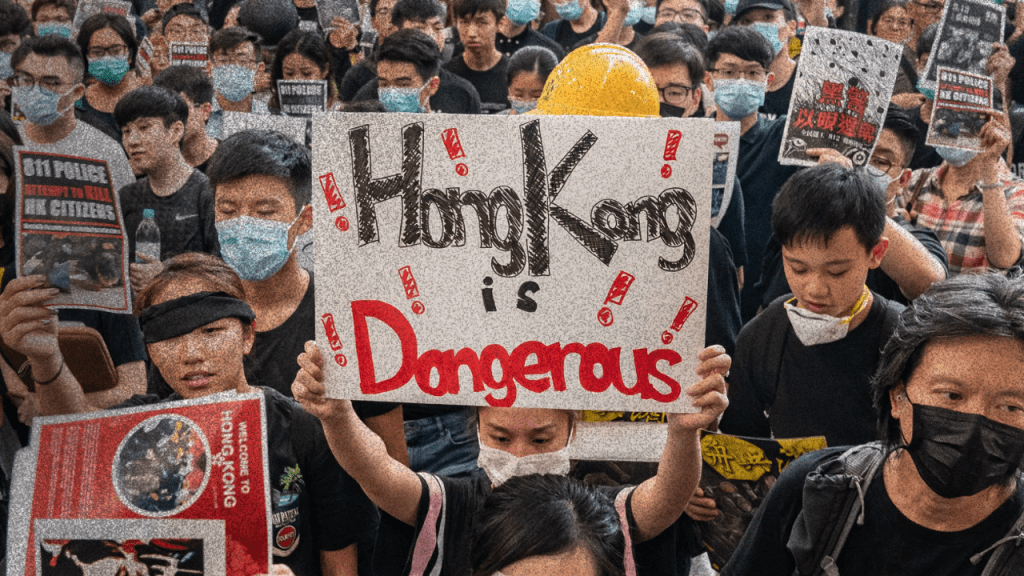
How the largest protest movement in Hong Kong’s history produced the opposite of what it demanded.
On June 9, 2019, between one and two million people — depending on whether you trust the organizers’ count or the police’s — marched through the streets of Hong Kong to demand the withdrawal of a proposed extradition bill. It was, by any measure, one of the largest protest mobilizations relative to population in the world that decade. A week later, an even larger crowd came out. The government suspended the bill. Then withdrew it entirely.
And then, in June 2020, Beijing enacted the Hong Kong National Security Law.
That sequence — mass mobilization, tactical concession, structural crackdown — is the story of Hong Kong in 2019. It is also a case study in a pattern that played out across the entire mass protest decade: the gap between the power of millions in the streets and the difficulty of converting that power into lasting political change. Understanding it requires holding three layers in view simultaneously, which is exactly what the dominant Western framing refused to do.
What Happened
The immediate trigger was the Fugitive Offenders Amendment Bill, introduced by the Hong Kong government in early 2019. The stated rationale was closing a legal loophole: a Hong Kong man had murdered his girlfriend in Taiwan and returned to the city, where he could not be extradited for trial because no extradition agreement existed between Hong Kong and Taiwan. The bill would have allowed case-by-case extradition to any jurisdiction without a pre-existing treaty — which meant, in practice, mainland China.
Critics argued the bill would expose Hong Kong residents to the mainland’s legal system, where the conviction rate exceeds 99 percent and political cases are decided before they reach a courtroom. More than 3,000 lawyers — roughly a quarter of the city’s legal profession — marched in silent protest. The Bar Association, senior business figures, and foreign chambers of commerce all raised objections.
The protests that followed were extraordinary in scale. On June 9, organizers claimed 1.03 million participants; police estimated 270,000. A week later, June 16, organizers claimed nearly two million; police estimated 338,000. Even accepting the police figures, these were among the largest mass demonstrations in Hong Kong’s history. The June 16 figure — on any count — represented more than a quarter of the city’s entire population in the streets on a single day.
Under this pressure, Chief Executive Carrie Lam suspended the bill on June 15. She formally withdrew it in September.
But the protests had already expanded beyond the original trigger. Demonstrators had articulated five demands: full withdrawal of the bill, an independent inquiry into police conduct, retraction of the “riot” characterization of the June 12 confrontations, release of arrested protesters, and genuine universal suffrage. The government gave ground on one demand. The other four remained unmet.
As the months passed, the movement radicalized. Protesters occupied the Legislative Council building and defaced its chamber. Poly U and other university campuses became fortified protest sites. Police deployed tear gas, rubber bullets, and water cannons; protesters built barricades and threw petrol bombs. The confrontations ran through the end of 2019. The slogan that emerged — be water, borrowed from Bruce Lee — described the movement’s tactical approach: fluid, decentralized, capable of flowing around obstacles.
What it could not do was fill a structure.
The Historical Layer
Hong Kong in 2019 was not simply a city experiencing a protest movement. It was a territory with a specific geopolitical history that shaped how both participants and the Chinese state understood what was happening.
That history is documented in detail in Operation Yellowbird and the CIA Network Behind China’s Exiles and The Umbrellas and the Machinery Behind Them. The short version: from 1989 onward, Hong Kong served as the operational base for Western intelligence-assisted extraction of Chinese dissidents, foreign-funded political exile infrastructure, and sustained NGO activity connected to government-funded democracy promotion organizations including the National Endowment for Democracy, which had been operating in Hong Kong for decades before 2019 and confirmed millions in cumulative grants to Hong Kong civil society organizations.
This context does not invalidate the genuine local grievances that brought millions into the streets. It does explain why Beijing’s response was not calibrated to the extradition bill. The bill was the trigger. The NSL was the response to something larger — a decades-long pattern of foreign-backed political organizing operating out of Hong Kong that the Chinese state had been watching since 1989.
The international support the 2019 movement received made this calculus visible. Marco Rubio and James McGovern, chairing the Congressional-Executive Commission on China, wrote to Carrie Lam in May 2019 demanding the bill’s withdrawal — before the mass protests had even reached their peak. US and UK politicians met with protest leaders. The National Endowment for Democracy continued operating in the territory. Jimmy Lai, the Apple Daily owner who funded significant portions of the 2014 movement’s media infrastructure, was a visible presence in 2019 as well.
None of this means the protesters were agents of foreign powers. The vast majority were Hong Kong residents acting on genuine concerns about their legal system and political future. But the infrastructure around the movement — the foreign political support, the media amplification, the funding channels — was not incidental. It shaped how Beijing read what it was watching. And Beijing’s reading produced the NSL.
The Structural Layer
The third layer of the story has nothing specifically to do with Hong Kong or China. It is the structural problem that Vincent Bevins documents across the entire mass protest decade in If We Burn.
The 2019 protests were explicitly and deliberately leaderless. The Civil Human Rights Front — a coalition of more than fifty pro-democracy groups — organized the major marches, but the broader movement had no unified command structure, no designated negotiating body, and no mechanism for making binding strategic decisions. Tactical coordination happened through LIHKG, a Reddit-style forum, and Telegram. The approach was aggressively horizontal: no leaders meant no one to arrest, no one to discredit, no one to compromise.
It also meant no one who could negotiate. When governments make concessions to protest movements, they need a counterpart. The Hong Kong government could withdraw the bill — a unilateral act requiring no interlocutor. It could not grant the remaining four demands — structural changes to policing accountability and electoral systems — to a movement with no one authorized to accept them.
Bevins’ framework is precise here: horizontal movements did a very good job of creating political vacuums, but vacuums are filled by whoever is already organized — and that was not the protest movement. The 2019 movement blew an enormous hole. The vacuum it created was filled by the NSL.
The movement also exhibited the radicalization dynamic Bevins identified across multiple cases. As months passed and the government stopped making concessions, the tactical center of gravity shifted toward more confrontational elements. Moderate participants who had joined the June marches became increasingly peripheral. The cycle Bevins describes — media attention rewarding escalation, escalation drawing a harder state response, moderate participants withdrawing — ran its course through the second half of 2019.
There is a specific irony that applies here: the be water tactical philosophy, derived from Occupy-model horizontal protest that had already failed in Egypt, Brazil, and elsewhere by 2014, was adopted in 2019 after the Umbrella Movement had already demonstrated its limits in the same city five years earlier. The tactic circulated as a success model because Western media coverage of protest movements consistently failed to report on what came after.
What Followed
The National Security Law, enacted June 30, 2020, criminalized secession, subversion, terrorism, and collusion with foreign forces. It applied to acts committed anywhere in the world by anyone, including non-residents. Within months, major protest organizations had dissolved, dozens of opposition politicians had been disqualified or arrested, and prominent activists — including figures from both 2014 and 2019 — had left Hong Kong or faced prosecution.
The extradition bill that triggered the movement was never enacted. On that narrow measure, the protests succeeded. Every structural demand — police accountability, electoral reform, genuine universal suffrage — was not only unmet but rendered moot by the legal transformation that followed.
This is the outcome Bevins documents across the protest decade: movements large enough to destabilize existing arrangements, but not organized enough to replace them. In Egypt, the military filled the vacuum. In Brazil, the right. In Hong Kong, the NSL.
The millions who marched in June 2019 were not wrong about what was at stake. The legal concerns about extradition to mainland China were legitimate and specific. The desire for greater political participation was genuine. What the movement lacked — what the deliberately leaderless, horizontally organized form of protest structurally cannot provide — was the organizational capacity to translate mass mobilization into lasting institutional power. That gap, not the size of the marches, determined the outcome.
Sources
- Wikipedia contributors. “2019–2020 Hong Kong protests.” Wikipedia, accessed March 4, 2026. https://en.wikipedia.org/wiki/2019%E2%80%932020_Hong_Kong_protests
- Wikipedia contributors. “2019 Hong Kong extradition bill.” Wikipedia, accessed March 4, 2026. https://en.wikipedia.org/wiki/2019_Hong_Kong_extradition_bill
- Wikipedia contributors. “Hong Kong National Security Law.” Wikipedia, accessed March 4, 2026. https://en.wikipedia.org/wiki/Hong_Kong_national_security_law
- Bevins, Vincent. If We Burn: The Mass Protest Decade and the Missing Revolution. New York: PublicAffairs, 2023.
- NPR. “Thousands Of Protesters Take To Hong Kong Streets Against Extradition Bill.” June 9, 2019. https://www.npr.org/2019/06/09/731055928/thousands-fill-hong-kongs-streets-to-protest-china-extradition-bill
- Wikipedia contributors. “Timeline of the 2019–2020 Hong Kong protests (March–June 2019).” Wikipedia, accessed March 4, 2026. https://en.wikipedia.org/wiki/Timeline_of_the_2019%E2%80%932020_Hong_Kong_protests_(March%E2%80%93June_2019)
- Cambridge University Press / The China Quarterly. “The Evolution of Protest Repertoires in Hong Kong: Violent Tactics in the Anti-Extradition Bill Protests in 2019.” 2022. https://www.cambridge.org/core/journals/china-quarterly/article/evolution-of-protest-repertoires-in-hong-kong-violent-tactics-in-the-antiextradition-bill-protests-in-2019/E59AC952FD5D818DB65F8043D4824A5F
- National Endowment for Democracy. “The National Endowment for Democracy and Support for Democracy in Hong Kong.” October 14, 2014. https://www.ned.org/the-national-endowment-for-democracy-and-support-for-democracy-in-hong-kong/
- South China Morning Post. “Hongkongers with ties to US-backed group slammed by Beijing report could risk censure, analysts warn.” May 2022. https://www.scmp.com/news/hong-kong/politics/article/3177383/hongkongers-ties-us-backed-group-slammed-beijing-report
- Social Science Matrix / UC Berkeley. Vincent Bevins interview on If We Burn. January 2024. https://matrix.berkeley.edu/research-article/vincent-bevins/
- The Conversation. “‘If we burn… then what?’ A new book asks why a decade of mass protest has done so little to change things.” November 2025. https://theconversation.com/if-we-burn-then-what-a-new-book-asks-why-a-decade-of-mass-protest-has-done-so-little-to-change-things-221116

 Spark Solidarity