
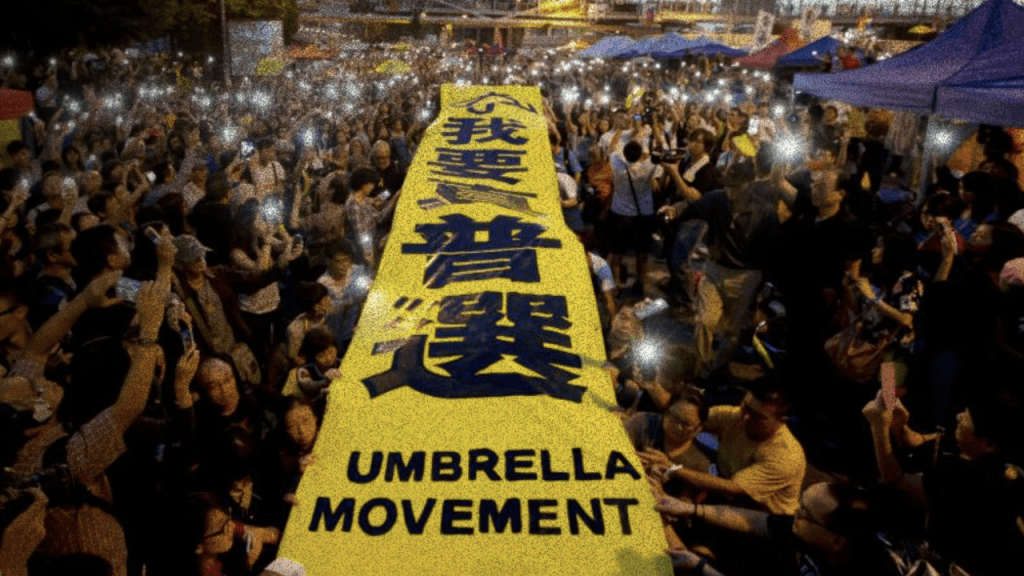
The Umbrella Movement was real. So was the foreign infrastructure operating around it. And so was the structural problem that guaranteed it would fail.
In September 2014, images from Hong Kong spread around the world: students in goggles and masks, crowds occupying major intersections, and thousands of umbrellas raised against clouds of tear gas. The Western media narrative was already written before the tear gas cleared. Young people demanding democracy. A government deploying repression. Peaceful resistance, symbolized by the umbrella.
That narrative contains real elements. Tens of thousands of people did occupy the streets for seventy-nine days, and many participants genuinely believed they were defending political freedoms promised when Hong Kong returned to Chinese sovereignty in 1997. The grievances that brought them out were not fabricated.
But the morality-tale framing does what morality-tale framing always does: it selects the layer of the story that supports a predetermined conclusion and discards the rest. Understanding what actually happened in Hong Kong in 2014 — and what it meant — requires holding three things in view simultaneously: the protest itself and the local grievances behind it; the geopolitical infrastructure that had been operating in Hong Kong for decades before the first umbrella went up; and the structural problem that made the movement’s failure almost inevitable regardless of how many people showed up.
What Happened
The immediate trigger was a decision by Beijing on how Hong Kong’s 2017 Chief Executive election would be structured. Candidates would require approval from a 1,200-member nominating committee before standing — a requirement critics argued would guarantee that only Beijing-acceptable candidates could realistically compete. For activists in Hong Kong, this contradicted the spirit of the One Country, Two Systems framework under which the territory had been administered since the 1997 handover, which promised a “high degree of autonomy” and a separate political and legal system for fifty years.
Student organizations moved first. On September 22, university and secondary school students began class boycotts. Within days the protests spread into the streets around the government district in Admiralty. Then, on September 28, police fired tear gas and pepper spray at crowds attempting to approach government buildings. Demonstrators raised umbrellas against the chemical spray. The images circulated globally within hours.
Encampments formed across three major areas of the city — Admiralty, Causeway Bay, and Mong Kok. For eleven weeks, protesters blocked roads, built makeshift study areas and supply stations, and held nightly assemblies. At its peak the movement brought tens of thousands of people into the streets.
The central demand was never granted. Courts issued injunctions. Authorities cleared the encampments. On December 11, 2014, police dismantled the final protest site in Causeway Bay, ending the seventy-nine-day occupation. The electoral framework Beijing had announced remained in place.
The Infrastructure
Hong Kong was never simply a city where a protest movement emerged. For decades it had been something more specific: a political and intelligence gateway between China and the Western world, shaped by its history as a British colony and its unique position as a jurisdiction where Chinese law did not apply.
The architecture of that gateway was laid down in 1989. After the Chinese government deployed the military to suppress demonstrations in Beijing and dozens of other cities, the network that became Operation Yellowbird used Hong Kong as its operational base — smuggling more than four hundred wanted dissidents out of mainland China over eight years, with logistical support from triad networks, Western intelligence agencies including the CIA and MI6, and foreign consulates that processed asylum claims outside ordinary scrutiny. Hong Kong was the staging ground because it was the only jurisdiction available: British-administered, beyond the reach of Chinese law, and full of the international connections needed to move people, money, and documents.
The extraction was only the first phase. What followed was the construction of a political exile community outside Chinese jurisdiction, funded through instruments like the National Endowment for Democracy, which had been operating in Hong Kong since the early 1990s and confirmed $695,031 in grants to Hong Kong organizations in 2013 alone — the year before the protests. Michael Pillsbury, a former Reagan administration official and Hudson Institute analyst, told Fox News in 2014 that US influence over Hong Kong’s political direction was “not totally false.” The NED’s vice president for Asia programs told Voice of America the same year that the organization had been funding groups in Hong Kong for roughly two decades, with total grants running into the millions.
This context is what Beijing was responding to when it passed the Foreign NGO Law in 2017 and the Hong Kong National Security Law in 2020. Western commentary treated both measures as expressions of authoritarian pathology. What they actually were is predictable state responses to a documented, decades-long history of foreign intelligence operations and foreign-funded political organizing operating out of Hong Kong — including operations that used the territory as a base for constructing political opposition to the Chinese government. The Chinese government was not inventing a threat. It had watched the same territory serve as a staging ground for the exact kind of operation those laws were designed to prevent.
None of this determines what individual Umbrella Movement participants believed or wanted. Most of them had nothing to do with NED grant structures or CIA logistics. But the geopolitical infrastructure did not require the participation of individual protesters to function. It shaped the terrain on which the movement operated, the international media coverage it received, the foreign government support it attracted, and Beijing’s assessment of what the protests represented.
The Structural Problem
The third layer of the story has nothing specifically to do with Hong Kong or China. It is a pattern documented across the entire wave of mass protest movements that defined the decade from 2010 to 2020.
In If We Burn: The Mass Protest Decade and the Missing Revolution, journalist Vincent Bevins spent four years and hundreds of interviews asking a single question: how did so many mass protests — in Egypt, Brazil, Turkey, Ukraine, Chile, South Korea, Hong Kong, and elsewhere — produce outcomes that were, in many cases, the opposite of what the movements demanded? His answer centres on organizational form. The dominant model of protest in the 2010s was what Bevins calls “apparently spontaneous, digitally coordinated, horizontally organized, leaderless mass protest.” This form allowed movements to grow explosively and attract broad participation. It also left them with a structural problem: the ability to destabilize existing arrangements without the organizational capacity to replace them with anything.
As Bevins observes, these movements did a very good job of creating political vacuums — but power vacuums are filled by whoever is already organized, and that was almost never the protest movements themselves. In Egypt, the military. In Brazil, the right. In Ukraine, the nationalist forces that had been building institutional capacity while the protests provided the rupture. The movements that shook governments could not, by their own internal logic, govern.
The Umbrella Movement fits this pattern precisely. It had no centralized organization capable of translating street occupation into concrete political leverage. It had visible faces — Joshua Wong, Nathan Law, Alex Chow Yong-kang — but no unified structure that could negotiate, make binding decisions, or continue applying pressure once the encampments were cleared. When the injunctions came and the sites were dismantled, the movement had no mechanism for persistence. The political demand remained exactly where it had been on September 28.
Bevins notes a further irony that applies directly to Hong Kong: the 2014 protests were themselves a reproduction of a tactic — Occupy-style encampment — that had already failed in its original contexts by the time Hong Kong adopted it. Occupy Wall Street had not produced structural change. The Egyptian Tahrir Square occupation had ended with a military dictatorship worse than Mubarak. The tactic circulated through social media as a successful model precisely because the international media coverage it received was not designed to report on what came after.
What Followed
The Umbrella Movement’s failure did not end Hong Kong’s protest cycle. It energized a generation of young activists and sharpened the territory’s political fractures. Five years later, in 2019, a proposed extradition bill triggered demonstrations even larger and more confrontational than 2014 — at its peak, an estimated two million people in the streets of a city of seven million.
Those protests ended with the passage of the Hong Kong National Security Law in 2020. Several major activist organizations dissolved. Opposition politicians were arrested or disqualified from office. Activists who had been prominent in both 2014 and 2019 left the territory or faced prosecution. The political landscape of Hong Kong was transformed in a way that the 2014 movement, at its height, had not managed to produce — though not in the direction the movement wanted.
The NSL drew particular international condemnation. But Hong Kong had just spent a year as the operational centre of a protest movement that received sustained logistical, financial, and media support from Western governments and NED-linked organizations — as it had in 1989. When a government that has watched foreign intelligence services use a territory as a staging ground for decades decides it will no longer permit that territory to function that way, the decision reflects a causal logic that Western coverage systematically refuses to examine.
The Full Picture
The umbrellas were real. The grievances behind them were real. The desire of hundreds of thousands of Hong Kong residents for meaningful political participation was genuine and not reducible to foreign manipulation.
And the foreign infrastructure operating around and through those protests was also real, documented, and consequential. And the organizational form that guaranteed the movement could mobilize enormous numbers without being able to translate that mobilization into lasting power was also real, and not unique to Hong Kong — it was the defining failure mode of an entire decade of mass protest worldwide.
These layers do not cancel each other out. They exist simultaneously. A materialist analysis does not require choosing one and discarding the others. It requires holding all of them in view and reading the causality correctly.
The umbrellas are still the most striking image of the movement. They were raised against tear gas, and they worked as shields. What they could not do — what no protest tactic, however visually compelling, can do on its own — is substitute for the organizational infrastructure that converts street mobilization into political power. That problem was not solved in Hong Kong in 2014. It was not solved anywhere in the protest decade. It remains unsolved.
For the fuller history of how Tiananmen shaped Hong Kong’s political trajectory, see Rethinking Tiananmen: What Really Happened? Spark Solidarity covered the broader structural mechanics of weaponized diaspora and exile infrastructure here.
Sources
- Wikipedia contributors. “2014 Hong Kong protests.” Wikipedia, accessed March 4, 2026. https://en.wikipedia.org/wiki/2014_Hong_Kong_protests
- Wikipedia contributors. “Operation Yellowbird.” Wikipedia, accessed March 3, 2026. https://en.wikipedia.org/wiki/Operation_Yellowbird
- National Endowment for Democracy. “The National Endowment for Democracy and Support for Democracy in Hong Kong.” October 14, 2014. https://www.ned.org/the-national-endowment-for-democracy-and-support-for-democracy-in-hong-kong/
- Bevins, Vincent. If We Burn: The Mass Protest Decade and the Missing Revolution. New York: PublicAffairs, 2023.
- Wikipedia contributors. “If We Burn.” Wikipedia, accessed March 4, 2026. https://en.wikipedia.org/wiki/If_We_Burn
- Wikipedia contributors. “Hong Kong National Security Law.” Wikipedia, accessed March 4, 2026. https://en.wikipedia.org/wiki/Hong_Kong_national_security_law
- Wikipedia contributors. “Foreign NGO Law of China.” Wikipedia, accessed March 3, 2026. https://en.wikipedia.org/wiki/Law_on_Administration_of_Foreign_NGOs%27_Activities_within_China
- South China Morning Post. “Hongkongers with ties to US-backed group slammed by Beijing report could risk censure, analysts warn.” May 2022. https://www.scmp.com/news/hong-kong/politics/article/3177383/hongkongers-ties-us-backed-group-slammed-beijing-report
- Wikipedia contributors. “2019–2020 Hong Kong protests.” Wikipedia, accessed March 4, 2026. https://en.wikipedia.org/wiki/2019%E2%80%9320_Hong_Kong_protests
- The Conversation. “‘If we burn… then what?’ A new book asks why a decade of mass protest has done so little to change things.” November 2025. https://theconversation.com/if-we-burn-then-what-a-new-book-asks-why-a-decade-of-mass-protest-has-done-so-little-to-change-things-221116
- Social Science Matrix / UC Berkeley. Vincent Bevins interview on If We Burn. January 2024. https://matrix.berkeley.edu/research-article/vincent-bevins/
 Spark Solidarity