
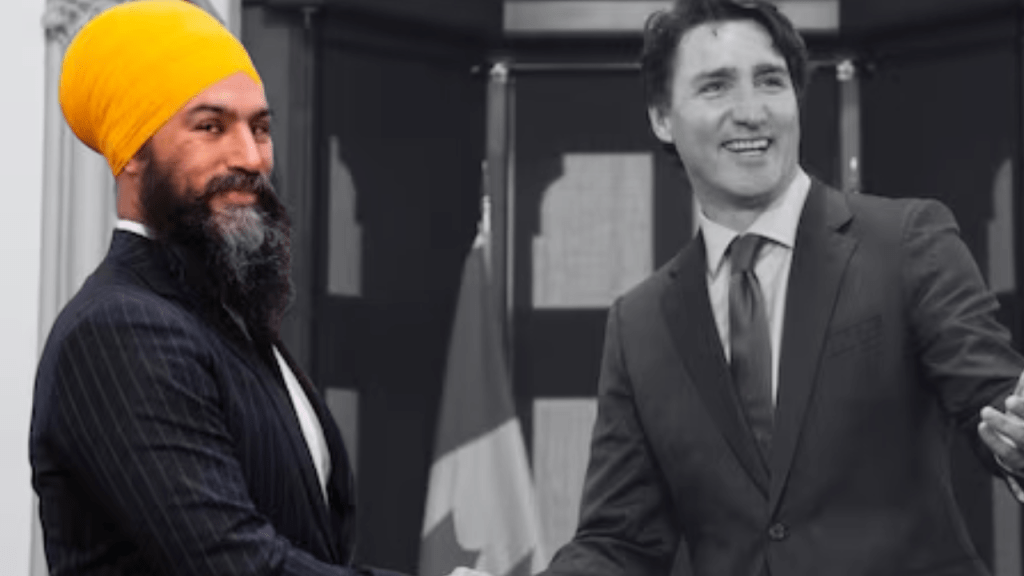
Jagmeet Singh sells himself as a progressive fighter, but his real legacy is propping up the Liberal status quo while delivering nothing for working people.
Jagmeet Singh presents himself as the champion of progressives in Canada — a smiling face promising to fight for a better future.
But behind the image, his leadership of the NDP has been defined not by real opposition, but by empty gestures, strategic cowardice, and a total capitulation to the liberal status quo.
Singh hasn’t built a movement; he’s drained what little remained. Far from challenging the establishment, he has functioned as a loyal junior partner to it, offering Canadians nothing but the illusion of choice.
Pretending to Oppose, Supporting Power
From the beginning, Singh’s run for Prime Minister has been an act of bad faith. Everyone knows — and Singh himself surely knows — that the NDP will not form government. His candidacy is about branding, not building power.
Yet instead of honestly campaigning to be a strong opposition, Singh insists on the fantasy that he’s one breakthrough away from leading the country.
It’s political theater, and not even good theater. In contrast, there’s a perverse honesty to the cynicism of the Liberals and the Bloc Québécois.
The Liberals openly govern for the wealthy and connected, making no serious pretense of serving ordinary people.
The Bloc, at least, makes no bones about putting Quebec first. Singh, by pretending to fight for working people while helping the Liberals maintain power, manages to be even more contemptible.
Performance Over Politics
The NDP’s posturing masks its real record: it was Singh’s party that kept the Trudeau government alive through the pandemic and beyond, voting repeatedly to support a minority Liberal government that protected the rich while leaving workers to fend for themselves.
For four years, Singh and the NDP acted as a crutch, trading leverage for vague promises. Only once Singh’s pension became secure did he finally withdraw support, a move so transparently self-serving it barely registered as news.
Now, in the 2025 election, Singh releases attack ads against the very government he spent half a decade keeping alive. It’s farce piled on top of failure.
If Singh’s political instincts were at least rooted in material struggles, some forgiveness might be possible. But they aren’t. His politics are pure spectacle.
His idea of labor solidarity is showing up on Labour Day to hand out pizza and take selfies. During real moments of worker struggle — strikes, wildcats, fights against anti-labor legislation — Singh has been missing in action, silent or actively complicit.
His presence is performative, his leadership hollow. Even his side hustles betray this unseriousness: when he’s not photo-opping with workers, Singh has shilled products on Instagram, including paid ads for furniture — an elected official behaving like a social media influencer, cashing in on the public’s attention.
The Abandonment of Class Politics
This isn’t just about Singh’s personal flaws; it’s about what his leadership represents. During the George Floyd uprising in 2020, when an opening existed to connect anti-racist politics to a broader struggle against capitalist exploitation, both Singh and the NDP’s influence shrank.
Instead of mobilizing for material demands — defunding police budgets, reinvesting in social goods, protecting workers — Singh retreated into the safe language of identity and representation. He turned systemic injustice into a branding exercise.
The Liberals, experts at this game, outflanked him with ease: Trudeau took a knee at a protest and stole the narrative. Singh and the NDP offered nothing material in response because they had already abandoned the terrain of material politics.
This is the inevitable consequence of building a political project on identity without class. Singh positioned himself as the avatar of minority representation, a figurehead meant to signal progress without delivering it.
But representation without power is meaningless — it’s a placebo offered to the oppressed while the powerful continue to rule.
Canadians already have a party for hollow symbolism. It’s called the Liberal Party. In copying that playbook, Singh made the NDP redundant.
Even worse, Singh has trapped the NDP in the logic of “Pied Piper politics,” where people are urged to support a party not because they believe in its vision, but because they fear the alternative.
It’s the same trap that led leftists in France to vote for Macron just to block Le Pen.
Singh relies on fear of Conservative rule, not hope for anything better. His appeal is less “vote for us” than “vote against them.”
But when opposition is defined purely by negation, it becomes impossible to inspire or mobilize real support. All that remains is fear, inertia, and collapse.
Illusion of Opposition
Jagmeet Singh’s failure is not simply that he has bad politics. It’s that he has no politics — no vision of class struggle, no commitment to material change, no willingness to fight for the people he claims to represent.
His leadership has hollowed out the NDP into a second Liberal Party, indistinguishable except by degree. Without a radical change in direction — away from selfies, identity branding, and negative partisanship, and back toward working-class power — the NDP will continue its slow slide into irrelevance, dragging any remaining progressive energy down with it.
In an age crying out for courage, Jagmeet Singh offers only cowardice. In a time demanding action, he gives us empty gestures. And in a country desperate for a real opposition, he gives us none at all.


 Spark Solidarity