
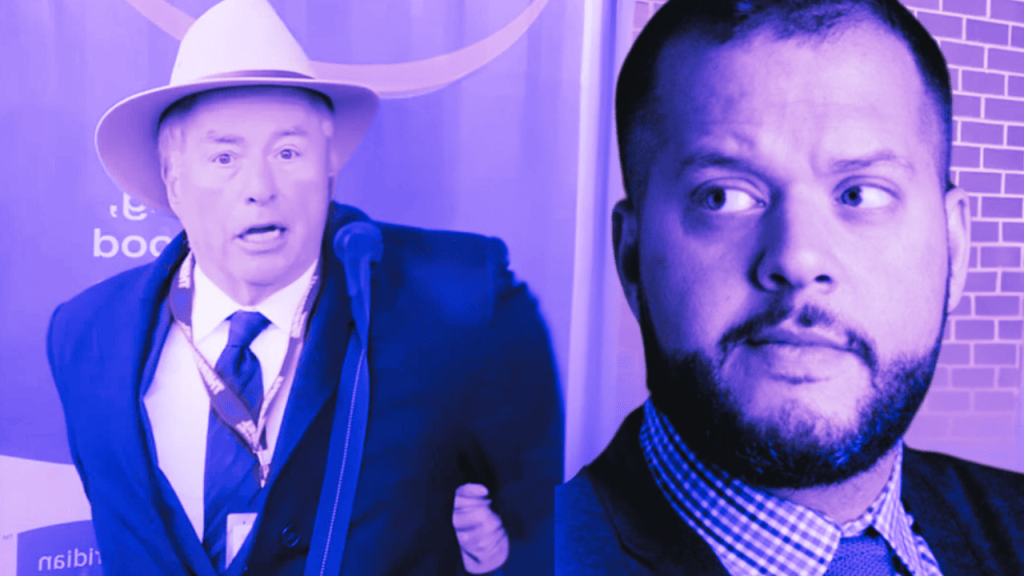
The response to Rebel News at the Canada leaders’ debate reveals how liberal media legitimizes the far right while working to discredit genuine activist dissent.
The 2025 Canadian federal leaders’ debates underscored a disturbing shift in the country’s media landscape. One of the most jarring moments was the inclusion of Rebel News, a far-right outlet often likened to Infowars.
Led by Ezra Levant, Rebel News has built a profitable business on ideological grifting, conspiracy, and disinformation. The decision to allow their participation sparked understandable outrage—not only for platforming extremism, but also for the exclusion of more legitimate political voices, like the Green Party.
Among the voices responding to this decision was Jesse Brown of Canadaland, Canada’s self-styled watchdog of media ethics. In his April 18th episode, titled Ezra Levant’s Debate Night Circus, Brown condemned the debate commission for giving legitimacy to Rebel News.
On the surface, his position seemed straightforward: defending journalistic integrity and calling out the erosion of standards. But beneath that veneer lies a more insidious argument—one that mirrors liberalism’s long history of using “neutrality” as a weapon against dissent.
The Trap of Neutrality
Brown’s key argument rests on a return to what he calls “first principles of journalism”—objective reporting, separated from explicit advocacy. In theory, that sounds noble.
In practice, it’s a position that serves the powerful. This insistence on rigid neutrality draws a moral equivalence between far-right provocateurs and radical leftist journalists, treating both as threats to journalistic order.
But journalism has never been apolitical. Whether it’s cheerleading war efforts or challenging colonialism, reporting is always embedded in power. To pretend otherwise is to ignore the ideological role media plays in shaping public discourse.
By casting activist journalism as inherently unethical, Brown positions himself as a gatekeeper—deciding which critiques are “legitimate” and which are too confrontational, too radical, too inconvenient.
Equating Dissent with Extremism
This isn’t a new tactic. Brown has a history of disingenuously lumping together activists from the left with agitators from the right.
In a 2022 episode of Short Cuts, Canadaland’s Jesse Brown described a verbal confrontation between Chrystia Freeland and a far-right convoy supporter as harassment, and used the moment to broadly critique confrontational protest tactics—collapsing distinctions between right-wing aggression and left-wing activist dissent.
Though he did not name any activist specifically, Brown’s history of critiquing the disruptive actions of activists in similar tones makes clear his tendency to equate principled disruption with reactionary agitation.
What’s at play here is not simply a misguided defense of decorum. It’s a deliberate framing: equating confrontational leftist activism with reactionary extremism.
The result is a false equivalence that allows the state—and its media allies—to criminalize dissent under the guise of maintaining “order.”
This rhetorical maneuver isn’t unique to Brown. It’s a common feature of liberal media ecosystems. It allows centrist voices to feign moral superiority while justifying increased policing and surveillance of the very people most committed to justice.
Canadaland as Controlled Opposition
Canadaland has long positioned itself as a progressive outlet, but its function often aligns with state power. It channels outrage into safe, liberal avenues: identity politics, soft nationalism, and ultimately, liberal Zionism.
This dynamic was sharply illustrated in Jesse Brown’s comparison of a protest at an Indigo store—targeting CEO Heather Reisman’s funding of Israeli soldiers—to acts like Kristallnacht and hanging a noose, as reported by The Maple.
This framing equated anti-Zionist protest with racist violence, reinforcing state-aligned definitions of acceptable dissent. By doing so, it neutralizes more systemic critiques of Canada’s settler colonialism, imperialism, and role in global exploitation.
Brown has also been accused of suppressing more radical content from within his own organization, including edits to a podcast that removed the word “genocide” and references to Canadian arms sales to Israel, actions that led to multiple resignations.
Rather than challenge power, Brown’s platform reinforces it. The critiques Canadaland allows are framed in ways that are digestible to the status quo.
Radical critiques, those that seek to dismantle oppressive structures rather than reform them, are either ignored or discredited as unprofessional or dangerous.
Media critic Davide Mastracci noted this pattern in Canadaland’s coverage of Israel-Palestine, where Palestinian voices were notably absent despite the outlet’s progressive reputation.
This is the role of controlled opposition: to absorb dissent, redirect it, and render it harmless. To give people the illusion of critical media while subtly reinforcing the very systems that need dismantling.
The Political Kayfabe of Canadian Media
What we’re witnessing is a kind of media kayfabe, the professional wrestling-style spectacle of politics where every confrontation is choreographed to serve the status quo.
Far-right agitators borrow tactics from the left, disruption, confrontation, and the media responds with feigned shock and bipartisan condemnation.
Radical centrists like Jesse Brown then use the moment to call for more surveillance, more gatekeeping, more policing of discourse.
Brown’s 2024 talk comparing anti-Zionist protest at Indigo Books to hanging a noose—a racist hate crime—illustrates how he frames leftist disruption as dangerous extremism, echoing state narratives.
In this play-acting, the far right gains legitimacy through exposure. The left loses legitimacy through false equivalence. And the state gains power by casting itself as the rational, stabilizing force amidst the chaos.
As documented in coverage of Brown’s podcast interview with Israel’s ambassador, riddled with uncorrected factual errors, edited to soften critiques of Israel, his editorial decisions often privilege establishment narratives while marginalizing anti-imperialist dissent.
Critics argue that Canadaland plays a role akin to “controlled opposition,” channeling radical outrage into more palatable, liberal forms. Staff resignations in 2024 over editorial interference, and union pushback against Brown’s misrepresentation of Palestine solidarity, reinforce this point.
It’s a soft reboot of Cold War-era “strategy of tension” operations, instability manufactured by the state to justify repression. Only now, instead of secret police and coups, it’s media personalities and podcast episodes paving the way for expanded state authority.
Why This Matters
The consequences of this aren’t theoretical. This framing—of activist journalists as dangerous, biased, or extreme, makes them more vulnerable to repression.
It legitimizes their surveillance, denies them platforms, and ultimately puts them in the same rhetorical category as bad-faith actors like Ezra Levant. And in doing so, it enables a kind of censorship-by-ethics.
Jesse Brown might not frame it as assisting the state’s surveillance apparatus, but by insisting on a false neutrality and rejecting the legitimacy of journalism as activism, that’s exactly what he’s doing.
And if there was any doubt about his awareness of this, consider that he lost 9% of Canadaland’s supporters after amplifying rhetoric that aligns with establishment narratives. He knows the consequences, and he’s doing it anyway.
It’s not enough to critique the CBC or other liberal institutions for letting Rebel News into the room. We have to ask what that room does, who it serves, and how even progressive-sounding figures can be complicit in narrowing the boundaries of political discourse.
If we’re serious about protecting press freedom, about resisting fascism, and about building a more just world, we have to recognize that objectivity is not neutral—and that the people pretending it is may be doing more harm than good.






 Spark Solidarity