
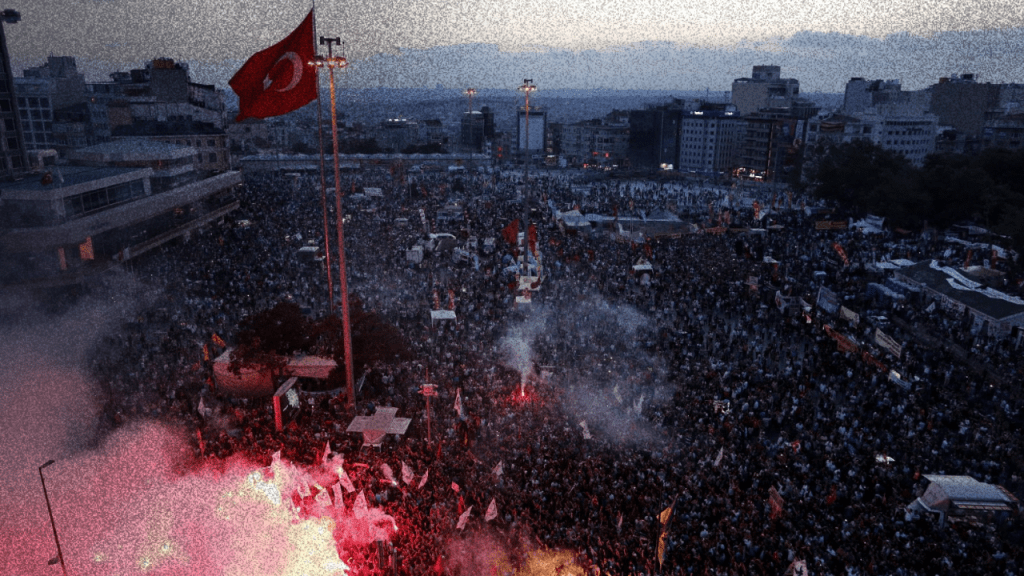
Gezi Park protests began with fifty people and a park — and became the largest spontaneous uprising in Turkish history.
A Park, a Bulldozer, a Photograph
On the morning of May 28, 2013, around fifty environmentalists were camped in Gezi Park — one of the last significant green spaces in central Istanbul, adjacent to Taksim Square — to block its planned demolition. The government of Prime Minister Recep Tayyip Erdoğan and his Justice and Development Party (AKP) had announced plans to replace the park with a replica of Ottoman-era military barracks housing a shopping mall. The protesters had been there since April, filing court challenges, issuing press statements, refusing to leave. That morning, municipal police used tear gas to disperse them and burned their tents to allow bulldozing to continue.
A photograph taken during the police assault captured a young woman in red being sprayed directly in the face with tear gas at close range while she stood her ground. The image circulated globally within hours. The Washington Post reported it “encapsulates Turkey’s protests and the severe police crackdown.” Reuters called it an “iconic leitmotif.” By nightfall, what had been a camp of fifty had grown into thousands. By the following weekend, it had become something Turkey had never seen before.
From a Park to a National Uprising
The protests that swept Turkey from late May 2013 were not organized. There was no central leadership, no coordinating body, no political party directing the movement. What exploded was accumulated social pressure — years of Erdoğan’s tightening grip on the press, erosion of secular protections, crackdowns on Kurdish political expression, and the steady conversion of public space into private profit — detonated by a single act of state violence against a small group of people protecting trees. At least 3.5 million people are estimated to have taken to the streets across Turkey in the weeks that followed.
The coalition that assembled in Gezi Park and in squares across the country was ideologically improbable: secularists, Kurds, feminists, LGBTQ+ activists, soccer ultras, trade unionists, nationalists, and socialists. They had almost nothing in common politically. What united them was the refusal to accept Erdoğan’s model of governance — the conviction that public space, civil liberties, and the right to dissent were not his to dispose of. The Confederation of Revolutionary Trade Unions and the Confederation of Public Workers’ Unions announced a general strike, describing the state response as “state terror.”
Erdoğan’s response was to deepen the provocation. He called the protesters “çapulcu” — looters or marauders — a slur the demonstrators immediately reclaimed, turning “chapulling” into a badge of honor and a verb meaning resistance. At a party rally outside Ankara, he told the crowds: “Nobody can intimidate us. We don’t take orders from anybody except God.” Turkish mainstream media — most of it by then under pressure from or owned by Erdoğan-aligned business interests — largely blacked out coverage of the protests in their early stages. CNN Türk, during some of the largest demonstrations, broadcast a penguin documentary. Social media became the primary nervous system of the movement.
The Crackdown
The state’s response was sustained and brutal. Over the weeks of protest, police repeatedly used tear gas, water cannons, plastic bullets, and baton charges to break up demonstrations in Istanbul, Ankara, and dozens of other cities. Amnesty International documented widespread human rights violations, finding that police used unnecessary and abusive force to prevent and disperse peaceful demonstrations across the country. The death toll reached eight protesters killed, with more than eight thousand wounded and eleven thousand arrested.
On June 15, 2013, police moved into Gezi Park in force to clear it permanently — firing tear gas into a crowd that, by one witness account, had included families and a concert minutes before. Officers attempted to break into the nearby Divan Hotel, which was being used as a first aid center, and fired tear gas inside. The park was cleared. The physical occupation ended. But the protests continued in other forms across the country through the summer, including the quietly defiant “Standing Man” protest initiated on June 17, when activist Erdem Gündüz stood motionless in Taksim Square for hours, staring at the Atatürk Cultural Center. The gesture spread.
Under international pressure, Erdoğan eventually announced that the Gezi Park construction project would be suspended pending a court ruling — and in early July, quietly cancelled. The policeman who had attacked the “woman in red” was convicted and sentenced to community service planting trees. These were concessions extracted by mass resistance. They were also, as it turned out, the last concessions Erdoğan would make to the street.
What Gezi Did to Erdoğan
The standard framing of Gezi is that it failed because it produced no immediate political change. Erdoğan remained in power. The AKP continued winning elections. The assessment is accurate but incomplete. What Gezi did was reveal — to Erdoğan himself — the depth of opposition his rule had produced, and his response to that revelation reshaped Turkish politics for the decade that followed.
Historian Doğan Gürpınar of Istanbul Technical University has argued that the protests paradoxically strengthened Erdoğan, who used them to deepen political polarization and redirect the political agenda toward culture wars — terrain where he had a structural advantage. “This is the battleground where he thrives,” Gürpınar said, “maneuvering with agility — and he emerged politically victorious.” He abandoned what remained of his earlier attempts to broaden his political base and instead deepened it, cultivating an increasingly paranoid nationalism built around conspiracy theories of Western and foreign interference.
In the years after Gezi came the Kurdish conflict’s violent re-escalation, the 2015 elections, repeated terror attacks, the 2016 coup attempt, the state of emergency, the constitutional referendum that converted Turkey from a parliamentary to a presidential system, and wave after wave of purges. Each crisis was used to further consolidate Erdoğan’s authority and shrink the space available to dissent. As Magnum photographer Emin Özmen, who documented the protests, later reflected: “It was the beginning of something, but the events that have taken place in Turkey since then have killed that movement.”
The Prosecutions: Rewriting History
The most revealing dimension of Gezi’s aftermath was not the immediate crackdown but what came later — the slow-motion judicial campaign to retroactively recast a spontaneous mass uprising as a foreign-funded conspiracy to overthrow the government. A judicial investigation into an alleged international conspiracy behind the protests began in the summer of 2013 while people were still in the streets. The indictment, when it finally came in early 2019, ran to 657 pages. It named philanthropist Osman Kavala as the mastermind.
Kavala had been arrested in October 2017 and held without conviction for years. Erdoğan publicly called him the “Soros of Turkey,” embedding the case in an antisemitic conspiracy framework. The European Court of Human Rights ruled in December 2019 that Turkey had violated Kavala’s rights and used his detention for political ends, ordering his immediate release. Turkey ignored the ruling.
On April 25, 2022, an Istanbul court sentenced Kavala to life in prison without parole for “attempting to overthrow the government.” Seven co-defendants — including an architect, a city planner, a documentary filmmaker, and a lawyer — received 18-year sentences for aiding him. Amnesty International called it “a travesty of justice of spectacular proportions.” Human Rights Watch said the conviction was “a gross violation of human rights and ample proof that Turkey’s courts operate under instructions from the Erdoğan presidency.” In September 2023, Turkey’s highest appeals court upheld the sentence, in defiance of multiple binding ECHR rulings.
The Legacy
Ten years after Gezi, the perimeter of the park is ringed with riot police buses. Officers stand guard at its entrance with semi-automatic weapons. That police presence has been a continuous fixture of Taksim Square since 2013, a physical monument to what the movement represented and what the state fears it could still represent.
The chants and images of Gezi did not disappear. When protests erupted again in Turkey in 2025 following the arrest of Istanbul mayor Ekrem İmamoğlu, demonstrators filled squares chanting slogans first heard in 2013: “Everywhere is Taksim, resistance is everywhere.” The imagery of the whirling dervish in a gas mask reappeared. The echoes were unmistakable — and so was Erdoğan’s response, which followed the same playbook of police violence and conspiracy accusations.
Gezi did not overthrow Erdoğan. What it did was demonstrate, at scale and without central leadership, that a different Turkey was possible — that the accumulated dissatisfaction of millions of people could find each other in a square and refuse, together, to leave. The state spent the next decade trying to ensure that could never happen again. The fact that it keeps happening anyway is the actual legacy of the Gezi Park protests.
Sources
- Gezi Park protests — Wikipedia
- timeline of protests — Wikipedia
- Erdoğan and Gezi — Turkey Analyst
- Özmen on Gezi — Magnum Photos
- Amnesty on crackdown — Amnesty International
- Occupy Gezi documentation — Public Space
- HRW on Kavala — Human Rights Watch
- Kavala life sentence — Al Jazeera
- HRW Kavala verdict — Human Rights Watch
- ICJ on appeal — International Commission of Jurists
- ten years later — Turkey Recap
- Gezi then and now — Turkish Minute, March 25, 2025


 Spark Solidarity