
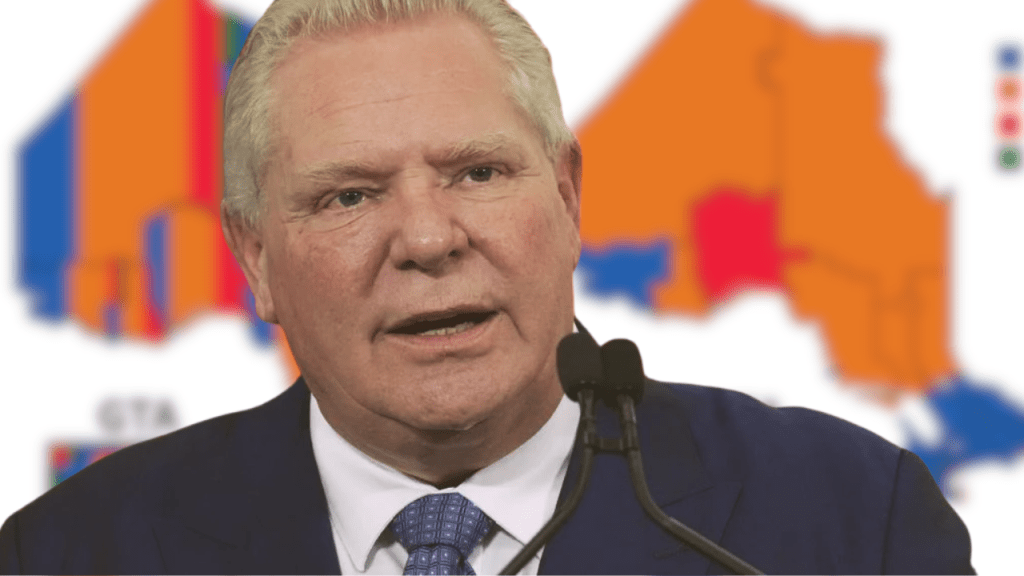
The 2025 Ontario election result exposes how first-past-the-post distorts democracy, handing Ford majority power without majority support—again.
The 2025 Ontario election has once again exposed the harsh reality that electoral politics, as they exist today, are structurally incapable of delivering the transformative change people need.
While political leaders frame elections as opportunities for citizens to shape their futures, the truth is far more cynical — especially under Ontario’s first-past-the-post electoral system, which distorts public will, consolidates power into the hands of a minority, and blocks the structural reforms necessary to address economic inequality, the climate crisis, and the erosion of public services.
This snap election, called by Premier Doug Ford seventeen months ahead of schedule, was not about giving Ontarians a voice.
It was about securing another artificial majority through the manipulative arithmetic of first-past-the-post. Ford justified the snap call by claiming he needed “the largest mandate in history” to lead Ontario through a looming trade war with the United States, spurred by aggressive tariffs imposed by Donald Trump.
In reality, the timing had little to do with governance and everything to do with exploiting the electoral system for partisan gain.
Ontario’s elections, like those across Canada, are governed by first-past-the-post (FPTP) — a winner-take-all system that frequently hands majority power to parties with minority support.
Ford’s 2018 majority government was secured with just 40.5% of the vote, and in 2022, his Progressive Conservatives received an even larger share of seats (67%) despite winning only 40.8% of the popular vote.
This system creates the illusion of a decisive victory when, in reality, the majority of Ontarians did not vote for Ford or his policies. The last time any Ontario leader won a true majority of the vote was in 1937 — nearly nine decades ago.
This electoral distortion does more than simply skew representation — it shapes how governance works (or doesn’t work) in Ontario.
When governments achieve majority status without majority support, they can govern unilaterally, ignoring opposition voices and public input.
The illusion of a broad “mandate” fuels policies that often reflect the interests of party donors, corporate lobbyists, and the premier’s inner circle, rather than the broad, diverse population of Ontario.
By calling a snap election in 2025, Ford was repeating a familiar pattern used by other premiers and prime ministers who weaponize FPTP for political advantage.
In 2020, B.C. Premier John Horgan called an early election during the pandemic, securing a majority government with just 48% of the vote. In New Brunswick, Blaine Higgs did the same, winning a majority with just 39% support.
Federally, Justin Trudeau attempted the same play in 2021, seeking a majority mandate with barely a third of the popular vote, though voters denied him the landslide he wanted. These tactics aren’t about democratic accountability — they’re about exploiting a flawed system to maximize partisan power.
The consequences of this broken system are profound. First-past-the-post doesn’t just distort elections — it distorts policy-making.
It allows governments to pursue unpopular agendas, secure in the knowledge that their power doesn’t actually rest on majority support.
This is how Ford was able to push through controversial changes to environmental protections, public education, and healthcare, despite widespread public opposition.
When voters know their votes won’t translate into fair representation, disillusionment grows, contributing to declining voter turnout and rising cynicism toward electoral politics as a whole.
But the 2025 Ontario election has revealed more than just the flaws of first-past-the-post. It highlights a broader, more fundamental truth: electoral politics alone cannot deliver the kind of transformative change Ontarians need.
Ontario’s housing crisis, crumbling healthcare system, deepening inequality, and ecological destruction are not simply the result of bad policies — they are the product of a political and economic system designed to protect the interests of the wealthy and powerful.
Voting for a different party within this system — even if it’s the so-called “lesser evil” — does not change the underlying structure. It only rearranges who sits at the table.
This point is central to the work of scholar Cedric J. Robinson, who argued in Black Marxism that electoral systems within capitalist states primarily exist to reinforce, not challenge, capitalist power.
Within this framework, even well-intentioned candidates are forced to operate within limits imposed by corporate power, financial markets, and global capital, making bold, redistributive change nearly impossible through the ballot box alone.
As Robinson and other thinkers remind us, real change comes from sustained grassroots organizing and pressure from below, not from electing individual leaders who promise to fix the system from within.
The Ford government’s economic messaging during this election also illustrates how electoral politics prioritize symbolic victories over material improvements for working people.
Ford’s campaign focused heavily on economic resilience in the face of Trump’s tariffs, touting GDP growth, balanced budgets, and investment attraction as markers of success.
But as Mike Davis highlights in Old Gods, New Enigmas, abstract economic metrics often obscure the realities of working-class life — wages remain stagnant, rents keep rising, and public services deteriorate, even as politicians brag about economic indicators that do not reflect people’s lived experiences.
This disconnect is not accidental. As Noam Chomsky has argued, appeals to economic strength and democratic stability are often used to legitimize policies that entrench elite control, while dismissing concerns about inequality, environmental destruction, and systemic racism.
In this context, Ford’s claim to be “protecting Ontario’s future” becomes little more than a rhetorical shield for policies that prioritize corporate profits over public well-being.
What the 2025 election demonstrates most clearly is that Ontario’s political system is not broken — it’s working exactly as intended.
It was built to concentrate power, marginalize dissent, and ensure that real change — change that redistributes wealth, power, and land — remains off the table.
This is why electoral reform campaigns like Fair Vote Canada’s push for proportional representation and a Citizens’ Assembly on Electoral Reform are so crucial.
With over 9,000 signatures gathered ahead of the 2025 vote, and support from Green Party leader Mike Schreiner, the demand for a fairer system is growing.
But even electoral reform, as necessary as it is, won’t be enough on its own. As David Graeber reminds us in The Democracy Project, lasting change comes from people organizing outside electoral institutions — building grassroots power that can disrupt the status quo, challenge corporate control, and reshape political priorities from the ground up.
Arundhati Roy, in her essay The NGO-ization of Resistance, similarly warns that real resistance cannot depend on elite-managed political processes — it must emerge from communities themselves.
The 2025 Ontario election, then, should be seen not as an isolated event, but as a clear illustration of the limits of electoral politics in a capitalist society.
Doug Ford’s victory is not a fluke — it’s the product of a system designed to protect wealth and power, no matter how Ontarians vote.
The real path to change lies not just at the ballot box, but in collective action, worker power, and sustained grassroots mobilization that can build the world we deserve — not just the one we’re told is possible.







 Spark Solidarity