
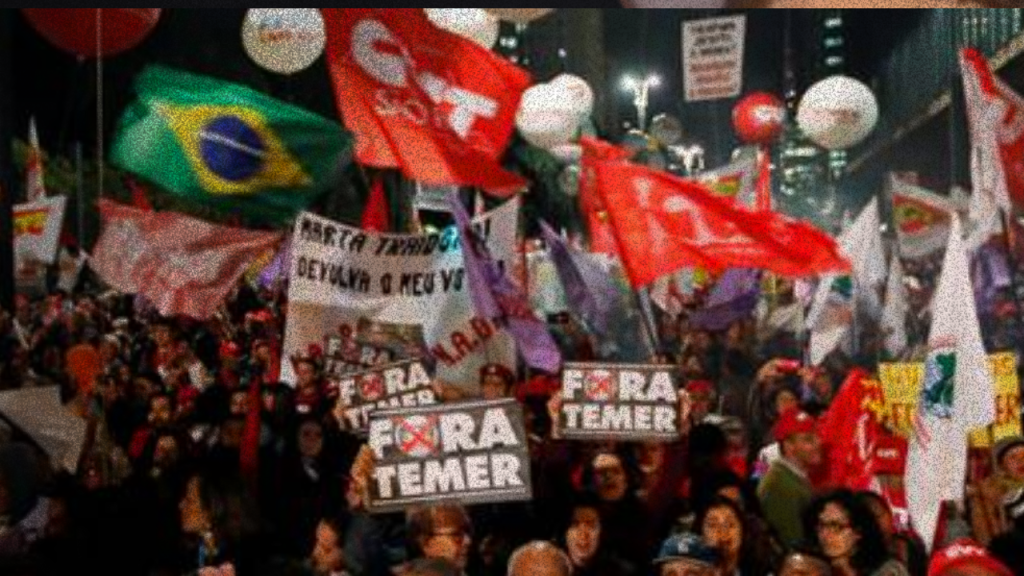
Brazil 2013 protests: the Movimento Passe Livre ignited the largest uprising in decades, reversed a fare hike, and handed the keys to the far right. The left opened a door it had no plan to walk through.
On June 6, 2013, the Movimento Passe Livre — a horizontal, anarchist-influenced collective founded in 2005 at the World Social Forum in Porto Alegre — organized a protest in São Paulo against a 20-cent fare increase on public transit. About 2,000 people attended. The military police responded with rubber bullets and tear gas, injuring over a hundred protesters and journalists. The crackdown was so disproportionate that it shocked Brazilian civil society, including the mainstream media that had called for it. Within two weeks, an estimated two million people were in the streets across hundreds of cities. The MPL had gotten exactly what it wanted: a massive popular revolt. São Paulo and Rio de Janeiro cancelled the fare hike on June 19.
The MPL declared victory and stepped back to regroup. By that point it no longer controlled what it had started.
The Fare Fight Was Won — Then Abandoned
The MPL’s long-term demand was the full decommodification of public transit — free fares for all Brazilian citizens. Its immediate demand in June 2013 was the reversal of the 20-cent increase. That demand was won. The MPL announced it would stay off the streets until it could reorganize around a next step. But the millions who had joined the protests between June 13 and June 20 were not there for free fares. They were there because the police had shot journalists. They were there because Brazil was spending billions on World Cup stadiums while schools lacked teachers and hospitals turned people away. They were there because the mainstream media had spent a week framing small left-wing demonstrators as vandals and then, after the crackdown images spread, reversed course and declared the protests the voice of the Brazilian people.
The demands expanded instantly: punish corrupt officials, improve public services, stop World Cup spending, lower the cost of living. The horizontal structure that had served the MPL as a small militant collective could not govern a mass movement of millions with contradictory agendas. The movement’s meaning was, as Vincent Bevins puts it, fundamentally up for grabs.
The Right Walked Through the Door the Left Opened
A group of young Brazilians connected to the Atlas Network — the Washington-based web of free-market libertarian think tanks — concluded in the heat of June 2013 that the protests’ meaning could be contested. They formed an organization called the Movimento Brasil Livre. In Brazilian Portuguese, “MBL” sounds nearly identical to “MPL.” The name was chosen deliberately to appropriate the original movement’s symbolic capital while replacing its content. Where the MPL demanded free public transit and the decommodification of urban life, the MBL demanded market freedom, anti-corruption prosecutions, and ultimately the removal of the Workers’ Party government.
One MBL founder had trained with Koch brothers-affiliated organizations in the United States. The Atlas Network had been funding libertarian think tanks across Latin America for decades. The infrastructure was already in place. June 2013 provided the opening. Over the following two years, the MBL led a new set of protests against President Dilma Rousseff, calling for her impeachment. The original protesters — anarchists demanding free transit — watched as their revolt was rerouted into a vehicle for the oligarch-owned media’s long-standing project of delegitimizing the PT government.
Horizontalism Blew the Hole. It Couldn’t Fill It.
The structural problem was not bad faith on the MPL’s part. It was the organizational form itself. Horizontal, leaderless, non-partisan, demand-limited movements are effective at one thing: generating disruption. They are poorly equipped to consolidate that disruption into political power, defend against co-optation, or represent themselves coherently to a mass media ecosystem hostile to their actual politics. The MPL had spent eight years building toward exactly the kind of explosion it produced. It had no theory of what to do once the explosion happened.
Bevins documents this directly from the MPL activists themselves. Years later, they said: all we wanted was to cause a massive popular revolt. We succeeded, and it was awful. They had assumed that getting millions of people into the streets would generate bottom-up pressure on the PT government in a direction favorable to the left. It did not. The power vacuum created by a leaderless movement in a country with weak unions, a right-wing media monopoly, and externally funded libertarian organizers was not filled by the anarchist ultraleft. It was filled by those who were ready.
Brazil’s Media Did the Reframing
The role of Brazil’s oligarch-owned media in the 2013 protests is not incidental to what happened — it is the mechanism. The same outlets that called for a police crackdown on the first protests then used images of that crackdown to reframe the movement as a legitimate popular uprising. That reframing expanded the protests’ base by bringing in the middle class. But middle-class Brazilian protesters in 2013 did not share the MPL’s politics. They were angry about corruption, taxes, and government waste — not about the commodification of public space or the legacy of the US-backed military dictatorship whose military police were still shooting rubber bullets at left-wing demonstrators.
When the mainstream media that had attacked the protests reversed course and endorsed them, it simultaneously redefined what the protests meant. The MPL’s anarchist direct action and the demand for free public transit were quietly dropped from the narrative. The protests became about “Brazil” — an empty signifier that the right could fill. This perception management did not require a conspiracy. It required a media ecosystem already structurally hostile to the left and a movement that had deliberately refused to make itself legible enough to resist reinterpretation.
Rousseff Impeached, Lula Jailed, Bolsonaro Elected
The trajectory from June 2013 to Jair Bolsonaro’s 2018 election victory runs through the MPL protests directly. Rousseff’s impeachment in 2016 was not a legal proceeding — it was a parliamentary coup executed by the right-wing congressional majority using technical budget charges as cover. The MBL-led anti-PT protests of 2015–2016 provided the mass mobilization that made the impeachment politically viable. Lula was subsequently jailed on corruption charges under a prosecution widely regarded as politically motivated, barring him from the 2018 election. Bolsonaro won.
The MPL had not wanted any of this. Its activists had opposed the PT from the left — criticizing the Workers’ Party’s moderation and accommodation with capital — but they had never imagined that their revolt would end with the far right in power. They provided the initial spark. They won the immediate demand. Then they watched as the fire consumed everything they had been trying to build.
The Lesson Is What the MPL Itself Learned
This is the case Bevins builds across the mass protest decade: horizontal explosions are very good at blowing holes in social structures and creating political vacuums. They are not equipped to fill those vacuums. In countries with functioning unions and left parties — Brazil, Chile — the horizontal form was an ideological choice, not a structural necessity. It reflected a genuine commitment to participatory democracy and a justified distrust of vanguardist organizations that had betrayed previous movements. But ideological horizontalism in a context where the right has organizational infrastructure, media ownership, and external funding is not prefigurative politics. It is unilateral disarmament.
The MPL activists who participated in June 2013 did not fail because they were wrong about the fare hike, or about the commodification of public transit, or about the class character of the Brazilian state. They failed because they had no answer to the question every successful movement must eventually answer: after the explosion, then what? The fire was real. The revolution was missing. Bolsonaro was the answer that filled the gap.
Sources
- Vincent Bevins. Bevins on mass protests. Jacobin, January 2024.
- Vincent Bevins. Mass protest without revolution. Brave New Europe.
- Participedia. June 2013 free fare protests.
- Global Nonviolent Action Database. MPL fare hike campaign.
- Wikipedia. Movimento Passe Livre.
- Wikipedia. If We Burn overview.
- Social Science Matrix / UC Berkeley. Bevins UC Berkeley talk.






 Spark Solidarity