
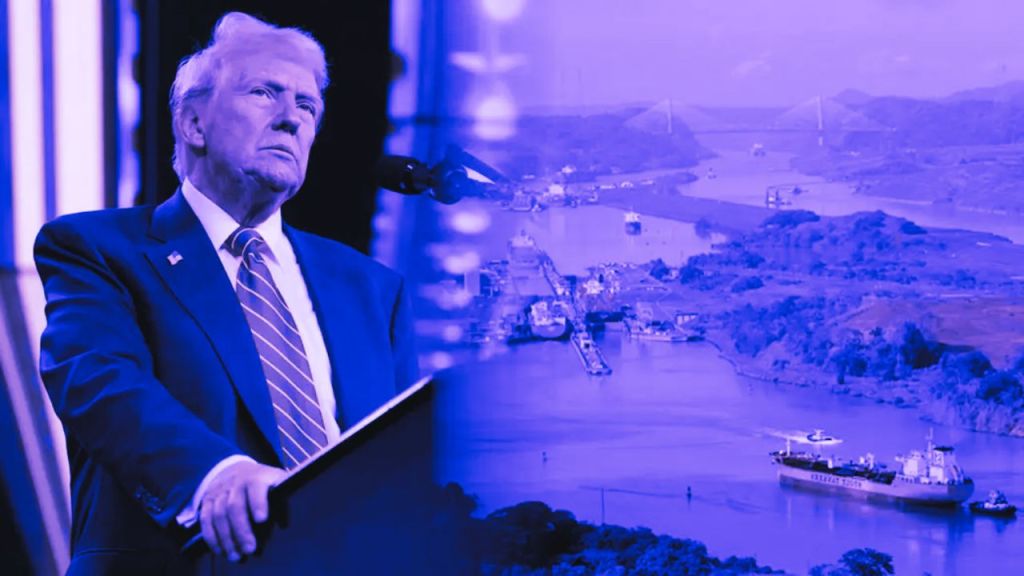
Trump’s false claims about China controlling the Panama Canal fuel fears of global dominance, ignoring Panama’s sovereignty and China’s legitimate investments.
One of the more amusing aspects of Donald Trump’s rhetoric is his tendency to make bombastic claims that blur the line between strategic messaging and outright exaggeration. His recent remarks about China “operating” the Panama Canal are a prime example of this pattern—a mix of Cold War nostalgia, economic fear-mongering, and American imperial insecurity.
The Panama Canal and Trump’s Paranoia
Trump’s fixation on China’s investments around the world often turns routine business dealings into supposed acts of global domination. In his worldview, any foreign investment by China is part of a secretive plot to expand its influence at the expense of the United States. This is particularly evident in his claims about the Panama Canal, which, according to him, has somehow fallen under Chinese control.
The reality, of course, is far less dramatic. Panama has managed the canal since 1999, following the U.S. handover of the waterway. But that fact is too mundane for Trump, who prefers to paint China as a villain in some geopolitical thriller. To him, the idea of Panama making independent economic decisions—especially ones involving Chinese companies—is nothing short of a betrayal.
The American Empire’s Insecurity
For decades, the U.S. treated the Panama Canal as its own toll booth, controlling trade through the region as if it were an extension of American territory. When Panama asserted its sovereignty and took control of the canal, the U.S. reacted with resentment, as if returning stolen infrastructure was an act of charity. Now, Trump’s frustration reflects a broader insecurity: the U.S. is no longer the sole global superpower, and China is making strategic economic moves without resorting to military intervention.
Chinese companies such as Hutchison Ports and Landbridge Group have invested in port operations and infrastructure projects in Panama. But unlike the dramatic narrative Trump pushes, these deals do not equate to control over the canal itself. The canal remains under Panama’s jurisdiction, with no Chinese company managing its locks. Nevertheless, Trump frames these investments as part of a sinister master plan, ignoring the fact that Panama, as a sovereign nation, is simply engaging in global trade.
U.S. Projection and the Fear of a Multipolar World
Trump’s rhetoric about the Panama Canal is less about the waterway itself and more about maintaining the narrative of American supremacy. His claims serve to stoke economic tensions with China, justifying aggressive policies such as tariffs and sanctions. By portraying China as an existential threat, he aims to rally support for American economic interventionism.
Yet, this approach is counterproductive. While Trump yells about China “taking over,” Beijing continues to invest in infrastructure worldwide through its Belt and Road Initiative. Unlike the U.S., which often attaches military presence and exploitative trade deals to its foreign engagements, China offers tangible economic development. As a result, many countries see Chinese investment as a better alternative to American partnerships that come with strings attached.
The U.S. Stuck in the Past
Ultimately, Trump’s alarmist rhetoric about China and the Panama Canal underscores a broader issue: the American establishment’s inability to adapt to a changing world. Rather than accepting a multipolar global system, U.S. leaders continue to recycle outdated Cold War talking points. Meanwhile, China focuses on strengthening economic ties and expanding its influence through strategic development projects.
As Trump rants about the canal, Panama remains unimpressed, China keeps building economic bridges, and the U.S. finds itself stuck in a playbook that no longer works. Instead of confronting the reality of global competition, American leaders cling to the fantasy that they can strong-arm the world into submission. But in a landscape where economic strength increasingly outweighs military force, that strategy is bound to fail.
 Spark Solidarity