
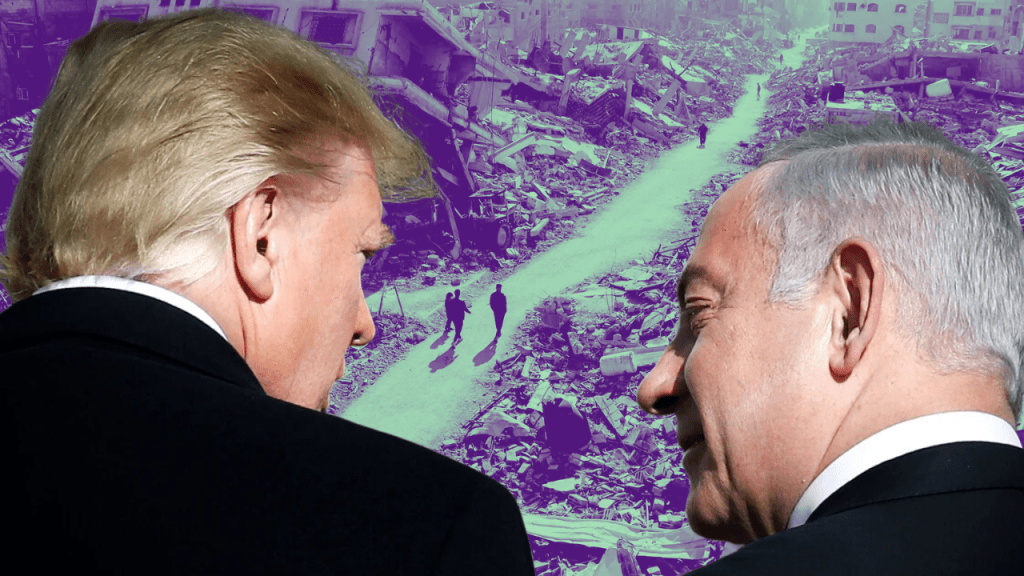
The Trump ceasefire deal is simply a convergence of material interests between powerful actors—an alignment of pressures that demanded resolution. Far from a triumph of morality, this moment underscores the cynical mechanics of imperial global power structures.
President-elect Trump’s brokering of a ceasefire between Israel and Hamas, effectively ending the genocide in Gaza, might appear on the surface as decisive moral leadership to halt mass suffering. In reality, it serves as a stark example of the dialectic of materialism in action.
Trump’s envoy, Steve Witkoff, embodied this pragmatic approach. He reportedly pressured Israeli negotiators relentlessly, even disrupting the Sabbath to force urgency. This was not about a newfound concern for the humanitarian crisis in Gaza but about political calculus.
For Trump, securing a ceasefire bolsters his image as a dealmaker, a key part of his political branding. For Israeli Prime Minister Benjamin Netanyahu, the prospect of Trump’s return to the White House represented a strategic opportunity. Compromising now could secure future support, both militarily and diplomatically, from an administration likely to align more closely with his hardline agenda.
This is historical materialism in action. Decisions by powerful world leaders are rarely, if ever, guided by moral awakenings. Instead, they are shaped by the pressures and material realities of their time. The ceasefire was a practical necessity born out of political survival and strategic self-interest, not a moment of moral reckoning.
Netanyahu’s gratitude to Trump, for example, was not about recognizing some noble humanitarian gesture but about acknowledging a transactional relationship that served his immediate needs, such as securing hostages and maintaining stability.
But while historical materialism provides a clearer framework for understanding these events, it also lays bare the moral bankruptcy of these power structures.
The genocide in Gaza did not end because the powerful suddenly developed compassion for Palestinians or out of a newfound willingness to heed the demands of people protesting in the streets. It ended because the continued violence became increasingly untenable—politically, economically, and strategically. Yet, the protests and public outcry played a significant role in creating that untenability, applying pressure that added to the broader interplay of forces.
This is precisely how the dialectic of materialism operates: progress doesn’t arise from a single cause or moral awakening but from the convergence of material pressures and conditions. Every force matters—public demands, political calculations, and economic realities—all interacting to shape the outcome. If the conditions had been different, the result likely would have been too.
However, while these forces aligned to make continued violence in Gaza untenable, the same materialist structures that enabled the genocide—imperialist interests, settler colonialism, and geopolitical alliances—remain firmly intact.
The ceasefire, while welcome, is no victory for justice or humanity. It is a grim reminder that the mechanisms of power rarely align with the demands of the oppressed except under immense pressure or self-interest.
Understanding the Gaza ceasefire between Israel and Hamas through historical materialism helps demystify the process of progress. It reveals that systemic change does not come from the moral convictions of leaders but from the pressures created by material conditions.
Yet, this understanding also demands a critique of the very systems that produce such outcomes. The same forces that brokered peace today will perpetuate violence tomorrow if they serve the interests of the powerful.
For those who care about justice and humanity, the lesson here is sobering: true progress doesn’t come from waiting for the stars of material interest to align or believing that any individual’s agency alone can change the course of history.
Progress happens when a tip of the spear is formed—when collective action pressures power structures while those same structures strain under their own contradictions. As history repeatedly shows, this sequence of forces is what drives change, not moral appeals or isolated efforts.






 Spark Solidarity