
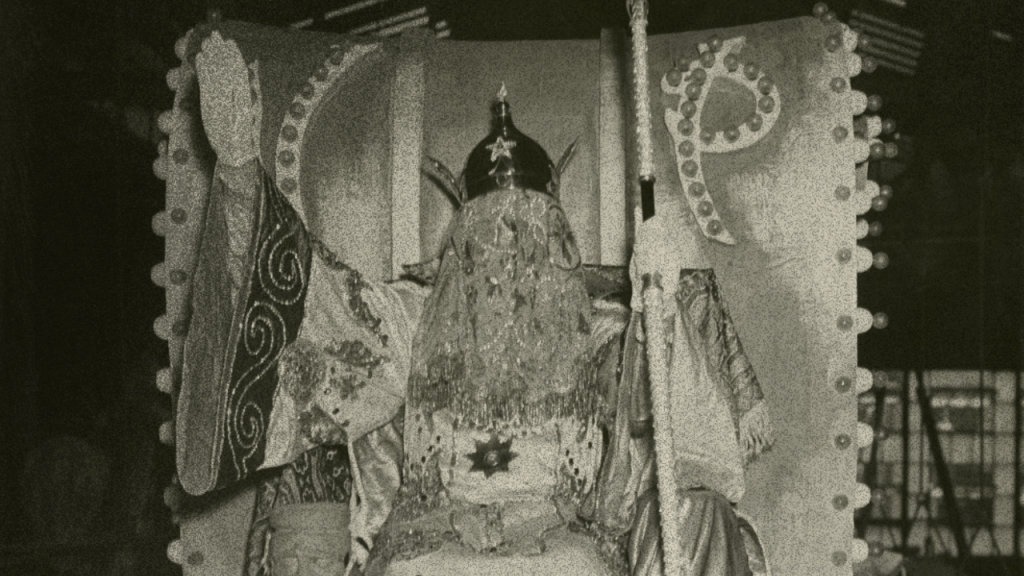
Veiled Prophet Ball history begins in 1877: St. Louis business elites built an annual spectacle to reassert corporate authority after workers shut down the city.
The 1877 Strike Triggered Elite Panic
The Great Railroad Strike of 1877 was the largest labor uprising the United States had yet seen. Railroad companies slashed wages during an economic depression. Workers responded by shutting down rail lines across multiple states.
St. Louis became one of the strike’s most dramatic flashpoints. Local labor leaders organized a general strike that unified railroad workers, factory laborers, and working-class residents across industries. At its peak, strike committees effectively coordinated economic activity across the city, halting rail traffic and openly challenging the authority of corporate managers.
For St. Louis’s business elite, this was not merely a labor dispute — it was a threat to the entire social order. The strike demonstrated that workers could unite across industries, disrupt the city’s economic structure, and govern it themselves, however briefly.
The strike was crushed through military force and police intervention. But the fear it produced among the city’s wealthy did not dissipate. In 1878, prominent businessmen organized the Veiled Prophet Association, launching an annual parade and private ball that celebrated the city’s prosperity while reasserting the authority of its most powerful citizens.
Historian Thomas Spencer documented in The St. Louis Veiled Prophet Celebration that the event functioned as a direct symbolic response to the general strike. Through elaborate ceremonies and exclusive gatherings, many of the businessmen who founded the organization had helped put down the 1877 uprising. The spectacle publicly demonstrated that economic and political power remained firmly in elite hands.
Masked Authority at the Center of the Ritual
Central to the celebration was the mysterious figure of the Veiled Prophet himself. Each year a prominent member of the organization assumed the role, appearing in elaborate robes with his face concealed behind a hood and mask. His identity remained secret throughout the festivities — theatrical intrigue that doubled as a statement about power operating from behind the veil.
The character drew from the “Veiled Prophet of Khorassan,” a villain in the nineteenth-century poem Lalla Rookh by Irish writer Thomas Moore — a figure who rules through deception and hidden authority. The choice of source material was not incidental.
The costume’s design carried additional resonance. The 1878 illustration showed white robes and a pointed cap. The KKK did not standardize white robes and pointed hoods until 1915, but contemporaries in 1878 recognized the hooded imagery through the lens of Klan violence and racial terror that had defined the Reconstruction era. The visual language was legible.
By presiding over the parade and ball, the Prophet embodied an idea: that the city’s social hierarchy was not merely present but natural, permanent, and worthy of celebration.
The Ball Enforced Racial Exclusion for a Century
The Veiled Prophet Ball was a rigidly exclusive social event. Invitations were confined to members of the organization and their guests, drawn almost entirely from the wealthiest families in the region. Its most prominent tradition was the debutante presentation — young women from elite families formally introduced into high society, reinforcing the continuity of class networks across generations.
Racial exclusion was built into the institution from the start. Black residents of St. Louis were barred from participation for nearly a century, while the event was celebrated as a civic tradition. The organization admitted its first Black members in 1979 — three physicians — a full hundred years after its founding.
The event did not exist in isolation. It ran alongside the broader systems of segregation that shaped housing, employment, and political life throughout St. Louis, and it helped legitimize those systems by treating elite social order as something to be annually celebrated rather than questioned.
Corporate Power Ran the Organization
The Veiled Prophet organization was never just a social club. Its membership was drawn directly from the city’s corporate leadership — executives, industrialists, and financiers who shaped St. Louis’s economy and political life. Companies including Monsanto and Anheuser-Busch had long-standing ties to the organization’s membership. Senior corporate figures sometimes served as the Prophet himself.
Membership was a marker of status, but more practically, it was access. The ball brought together the people who ran the city’s businesses, controlled its philanthropy, and influenced its politics. The relationships maintained there reproduced elite power across generations — not through any single decision but through the accumulation of trust, familiarity, and shared interest that exclusive institutions are designed to produce.
Activists Tore the Veil Off in 1972
Opposition to the ball intensified through the civil rights era. Percy Green, founder of the civil rights organization ACTION, had spent years organizing against discriminatory hiring and racial segregation across St. Louis. By the late 1960s, the Veiled Prophet Ball had become a focal point — a visible symbol of elite segregation operating under the banner of civic tradition.
The confrontation peaked in 1972. During the ceremony at Kiel Auditorium, Gena Scott and Jane Sauer from ACTION infiltrated the ball and pulled the veil from the Prophet, exposing him as Tom K. Smith, a Monsanto vice president. The revelation made national headlines. It did exactly what it was designed to do: it named the institution for what it was and identified who was running it.
The organization changed some policies in the years that followed. But the structural relationships that the ball maintained were not dismantled by a single act of exposure.
The 2024 Rebranding Changed Nothing
In September 2024 the organization announced the Veiled Prophet figure would be retired. The group adopted a new name — VP St. Louis — and framed the change as modernization, emphasizing charitable activities and community programs. Leaders described the move as distancing the institution from controversial imagery.
Then a December 2024 investigation found that a “Grand Oracle” character had replaced the Prophet — nearly identical in appearance, swapping veil for mask and beard. The rebranding was cosmetic. The same families and corporate networks remained in control. The name changed; the structure didn’t.
This is a familiar pattern. Symbolic reform is how institutions absorb criticism without surrendering power. A new name, a retired costume, a press release about values — none of it touches who runs the organization, who benefits from it, or what interests it serves.
Elite Traditions Endure Because They Serve Elite Interests
The Veiled Prophet Ball was not a civic tradition that became controversial. It was a class project dressed in civic clothing from the beginning. It emerged from a specific moment of class conflict, was designed to reassert elite authority after workers demonstrated their collective power, and has been maintained ever since by the people who benefit from that authority.
Activists exposed it. Courts and demographics forced partial changes. Organizers reframed it as philanthropy. None of that altered the underlying structure, because the underlying structure is the point.
Cultural traditions, civic rituals, and social clubs reflect the power relations that produced them. The Veiled Prophet Ball is an unusually transparent example — its origin is documented, its class character was visible from the first parade, and its response to every challenge has been to change the aesthetics while protecting the core. The spectacle was never about St. Louis. It was about who owns St. Louis.
Sources
- Washington Post — The Great Railroad Strike of 1877
- Washington University Common Reader — The Veiled Prophet
- Thomas Spencer — The St. Louis Veiled Prophet Celebration: Power on Parade, 1877–1995
- St. Louis Post-Dispatch — Twitter Uproar Descends on St. Louis Actress Ellie Kemper
- Snopes — Was the Veiled Prophet Organization Connected to the KKK?
- The Nation — The Veiled Prophet of St. Louis
- NBC News — Unmasking the St. Louis Veiled Prophet Organization
- St. Louis Public Radio — VP St. Louis Ousts Its Own Figurehead
- St. Louis Public Radio — Masked “Grand Oracle” Replaces St. Louis’ “Veiled Prophet”





 Spark Solidarity