
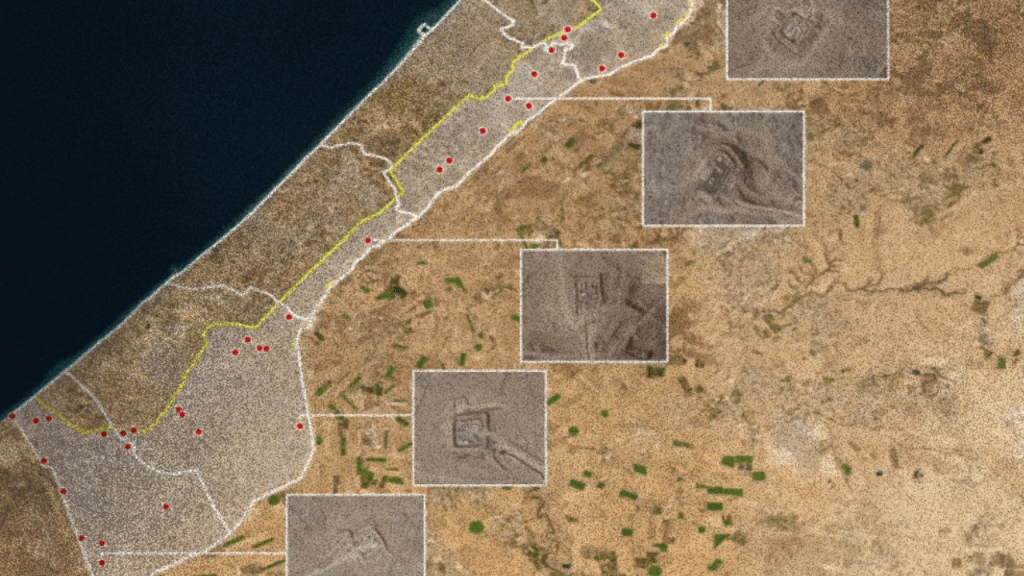
Gaza Strip history begins in 1948. The expulsion of 700,000 Palestinians created the sealed enclave whose conditions made October 7 possible.
Where Western Coverage Starts the Story
When Hamas launched its attack on Israel on October 7, 2023, much of Western media coverage began with that morning. The attack appeared as a rupture — an explosion of violence from a hostile territory, disconnected from any prior cause. Israeli communities near Gaza were presented as ordinary towns beside an inexplicably aggressive neighbor.
This framing has a function. Beginning the story on October 7 removes the historical processes that produced Gaza itself — its population density, its political structure, its militarized border, and the refugee communities whose origins lie only a few kilometers from where they are now confined.
Understanding October 7 does not require justifying it. But it does require understanding how Gaza became what it is. That story does not begin in 2023, or 2007, or 1967. It begins in 1948.
Gaza Before 1948
Before 1948, the Gaza Strip was a small coastal district within British Mandatory Palestine — roughly 80,000 residents, agricultural, commercially connected to the broader region. It was not a refugee camp. It was not a sealed enclave. It was not one of the most densely populated territories on earth.
All of that changed with the 1948 Arab-Israeli war and the events Palestinians call the Nakba — the catastrophe.
During the war that accompanied Israel’s establishment, approximately 700,000 to 750,000 Palestinians were expelled or fled from their homes across what became Israeli territory. More than 500 Palestinian villages were destroyed. The population that had comprised the majority of historic Palestine was scattered across neighboring countries and confined to two remaining territories: the West Bank and the Gaza Strip.
Gaza absorbed a massive influx of the displaced. According to UNRWA registration data from 1951, nearly 200,000 Palestinian refugees were registered in Gaza alone — more than doubling the territory’s pre-war population almost overnight. They had come from towns and villages across southern Palestine, many located only a few kilometers from Gaza’s borders.
What had been a modest administrative district became, within months, one of the most densely populated territories in the world — not through natural growth, but through forced displacement.
The Border as the Edge of Home
The geography of this displacement is not incidental. It is the central political fact of Gaza.
Many of the people crowded into refugee camps had been farmers and villagers whose land lay a short distance away — on the other side of what was now a militarized border. They had not emigrated. They had not chosen to relocate. They had been expelled from nearby places and confined to a narrow strip under Egyptian administration, expecting — as UN Resolution 194 affirmed in December 1948 — that they had the right to return.
That return was never permitted.
In the years after 1948, many displaced Palestinians attempted to cross back into what had become Israel. Israeli military documents described these crossings as “infiltration” — language implying organized hostile incursion. Israeli historian Benny Morris’s research on Israel’s border wars documented the reality more precisely: most crossings involved people attempting to harvest crops from abandoned fields, retrieve belongings left during flight, visit relatives, or return to see their former homes.
As Morris documented, Israeli forces consistently misread these crossings as military threats, responding with disproportionate force. Border patrols were authorized to shoot people attempting to cross. Between the late 1940s and mid-1950s, thousands of Palestinians attempting to return were killed along the frontier.
The border was not a line between two nations with long-standing parallel claims. It was the edge of places these people had recently lived, enforced by lethal violence against those who tried to go back.
Settlement and Structural Permanence
While displaced Palestinians were being shot attempting to return, Israel was establishing new communities along the areas adjacent to Gaza.
These settlements were not randomly positioned. Many were deliberately placed along strategic points near the border — founded by military-linked groups or populated by immigrants arriving under the Zionist settlement project. Their placement served several functions simultaneously: housing new Israeli citizens, reinforcing territorial control near the border, and making refugee return structurally impossible by placing a new civilian population on land from which the previous one had been expelled.
Over decades these communities formed what became known as the “Gaza envelope” — a ring of Israeli towns and agricultural settlements surrounding the strip. Their residents were not personally responsible for the displacement that preceded their founding. But the political function of their placement was inseparable from that history. They were simultaneously civilian communities and instruments of territorial permanence.
Occupation, Withdrawal, Blockade
Following the 1967 Six-Day War, Israel occupied the Gaza Strip directly, imposing military administration over a population that had already spent two decades confined there as refugees. That occupation lasted until 2005, when Prime Minister Ariel Sharon withdrew Israeli settlers and the permanent military presence from inside the strip.
The withdrawal did not end Israeli control. Israel retained authority over Gaza’s airspace, coastline, and most border crossings. When Hamas won Palestinian legislative elections in 2006 and took full control of Gaza in 2007 following a civil conflict with Fatah, Israel imposed a comprehensive blockade.
The blockade severely restricted the movement of people and goods. For the more than two million people living in Gaza, it meant limited access to construction materials, restricted imports and exports, and near-complete inability to travel for work, education, or family reasons. Electricity ran for only a few hours per day. Clean water was chronically scarce. Unemployment rendered normal economic life impossible for large portions of the population.
The security concerns facing Israeli communities near Gaza were real. Rocket attacks struck Israeli towns, causing casualties and disrupting daily life. But the asymmetry in conditions was stark. Israelis near Gaza could leave. Gazans could not. Israeli communities were integrated into a functioning economy. Gaza’s economy had been deliberately throttled. The two populations lived in proximity and in radically different material realities — a difference produced not by individual choices but by decades of accumulated policy.
Gaza as Enclosure
By October 2023, Gaza had been described for years by human rights organizations, UN officials, and independent analysts as an open-air prison — a territory whose population had no meaningful freedom of movement and no ability to exit the conditions imposed on them.
More than 70 percent of Gaza’s population were refugees or descendants of refugees from the 1948 Nakba, as the UN Palestinian Rights Committee documented at its May 2024 panel on the ongoing Nakba. The land their families had lived on lay a short distance away — visible in some cases, inaccessible in all of them.
The conditions that existed on October 6, 2023 were not accidental. They were the accumulated product of specific historical decisions: the 1948 expulsion, the prevention of refugee return, the settlement of the border region, the 1967 occupation, the 2005 partial withdrawal, and the 2007 blockade. Every element of the conflict — the militarized border, the densely packed refugee enclave, the surrounding Israeli communities, the periodic escalations, the rocket attacks, the military operations — becomes legible only against that accumulated history.
Competing Narratives, Shared Facts
Israeli and Palestinian narratives frame this same history in sharply different terms.
In dominant Israeli framing, the state’s actions at each juncture — the 1948 war, border enforcement, settlement, occupation, blockade — were defensive responses to Arab aggression and existential threat. Israel’s establishment is understood as a necessary response to centuries of Jewish persecution culminating in the Holocaust. Security is presented as the primary driver of policy at every stage.
In Palestinian framing, the same sequence represents a continuous process of dispossession that began in 1948 and has not ended. Each phase of Israeli policy — regardless of its stated rationale — produced the same outcome: Palestinian displacement, containment, and denial of rights. The violence of groups like Hamas is understood by many Palestinians as resistance to ongoing occupation, not as an unprovoked assault on a neutral neighbor.
These narratives are not equally supported by the historical record on every point. But the underlying facts — the displacement of 700,000 people in 1948, the prevention of refugee return, the blockade, the conditions in Gaza — are not in serious historical dispute. What is contested is their moral and political interpretation.
Western media coverage that begins on October 7 does not merely take a side in that interpretive dispute. It erases the factual foundation on which the dispute rests — presenting the consequences of a long history as if they were the history itself.
The Story Did Not Start on October 7
The Gaza Strip is not simply a territory governed by Hamas. It is a place created by mass displacement — a refugee enclave that exists because 700,000 people were expelled from nearby land, were never permitted to return, and were eventually sealed inside one of the most controlled borders on earth.
The Israeli communities surrounding Gaza are not simply civilian towns that happened to exist near a hostile territory. They are settlements established on land from which Palestinians were expelled, whose placement made refugee return structurally impossible, and whose residents have lived under genuine security threats produced by the very conflict their communities’ existence helped perpetuate.
Neither population chose the conditions in which they live. Both are products of a historical process that began in 1948 and has not been resolved.
Hamas killed civilians on October 7. That is a fact. But the idea that Hamas emerged from nowhere, that Gaza’s population is hostile by nature, or that the border region was peaceful until militants chose to disrupt it — this is not history. It is the suppression of history in the service of a political position.
Materialist analysis starts from conditions, not events. The conditions in Gaza on October 6, 2023 were the product of seventy-five years of accumulated policy. Any account of what happened on October 7 that does not begin there is not analysis. It is propaganda with a dateline.
Sources
- United Nations — About the Nakba
- UN Press — 1948–2024: The Ongoing Palestinian Nakba (May 17, 2024)
- BADIL Resource Center — From the 1948 Nakba to the 1967 Naksa
- Middle East Forum — Review of Benny Morris, Israel’s Border Wars 1949–1956
- Mohammed Nijim — Gazacide: Palestinians From Refugeehood to Ontological Obliteration (SAGE, 2024)
- Asia Maior — Gaza and the Demographic Question (2024)





 Spark Solidarity