A new Toronto pro-Israel advocacy group used a sold-out Douglas Murray event to launch the Emergency Coalition Against Hate and signal a broader political project.
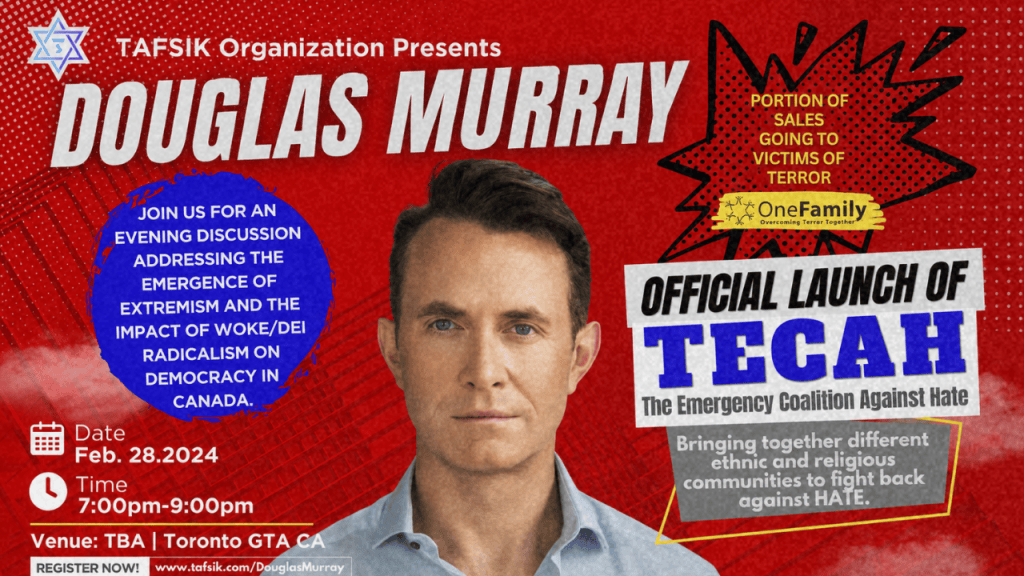
On February 28, 2024, a relatively new Toronto organization called Tafsik staged its biggest public event to date: a ticketed evening with British author and commentator Douglas Murray in the Greater Toronto Area.
The event was not presented as a stand-alone speaking appearance. Promotional material described it as an evening about extremism, democracy and what organizers called the effects of “woke” and DEI politics in Canada. It also served as the official launch of the Emergency Coalition Against Hate, or TECAH.
Tafsik says it was created in Toronto in January 2024 in response to the October 7 attacks in Israel and the political reaction that followed. That means the Murray event came only weeks after the organization says it was founded.
The speed matters. Tafsik was not easing into public life through small policy statements or a long institutional buildup. Its early model was large events, coalition language and a political frame that connected antisemitism to a much wider fight over Islamism, the left, identity politics and what organizers described as threats to Western democracy.
A Launch Built Around Douglas Murray
Tafsik lists 1,400 attendees for the February 28 event. Its own retrospective materials have used figures ranging from more than 1,300 to 1,400. Those are organizer-supplied numbers, but the event was clearly intended as a high-profile public launch rather than a private organizational meeting.
An independent OneFamily Fund event listing confirms the date, a 7 p.m. start time, ticket prices from $118 to $648 and the stated launch of TECAH. The listing said a portion of ticket sales would support victims of terror through OneFamily Fund.
Murray was a deliberate choice for that launch. His public profile is built around arguments about Islam, immigration, national identity and the political left. Tafsik’s event framing placed him inside a Canadian debate that organizers were already defining much more broadly than antisemitism alone.
The language of the event paired “extremism” with opposition to DEI and progressive politics. That combination is important because it shows the coalition’s political architecture at the moment of launch. Tafsik was presenting antisemitism as one part of a larger ideological conflict, with potential allies drawn from communities that organizers believed faced related threats.
The Emergency Coalition Against Hate
TECAH was promoted as a coalition across ethnic and religious lines. The public pitch was that Jewish concerns after October 7 could be connected to the experiences of other communities that opposed Islamist movements, authoritarian governments or left-wing political currents.
That coalition framing gave Tafsik a way to position itself beyond a narrowly communal organization. Rather than presenting its work only as Jewish advocacy, it was already trying to build a wider political bloc around a shared idea of public order, national security and resistance to ideological extremism.
At this stage, however, ambition should not be confused with institutional power. A large event and a coalition launch do not establish durable political influence, common funding or centralized control among participating groups. What they do establish is the model Tafsik wanted to build: public mobilization tied to cross-community political relationships.
A Broader Political Frame From the Start
The February 28 launch also makes clear that Tafsik’s early political identity cannot be reduced to a generic anti-hate campaign. The event material linked antisemitism to debates over Islamism, progressive institutions and the cultural left. The coalition was therefore political in both target and method.
That distinction matters because organizations often acquire legitimacy through universal language such as safety, democracy or opposition to hate while still advancing a specific political analysis underneath it. Tafsik’s launch showed both layers at once.
The universal layer was a coalition against hatred and extremism. The political layer was a defined account of where those threats came from and which ideological movements were responsible for them.
Tafsik has not yet demonstrated the institutional reach that a mature advocacy organization would need to influence courts, legislatures or municipal policy. What it had demonstrated was an ability to convene a substantial audience, attach itself to a nationally relevant political debate and launch a coalition around a broad ideological program only weeks after its self-described founding.