
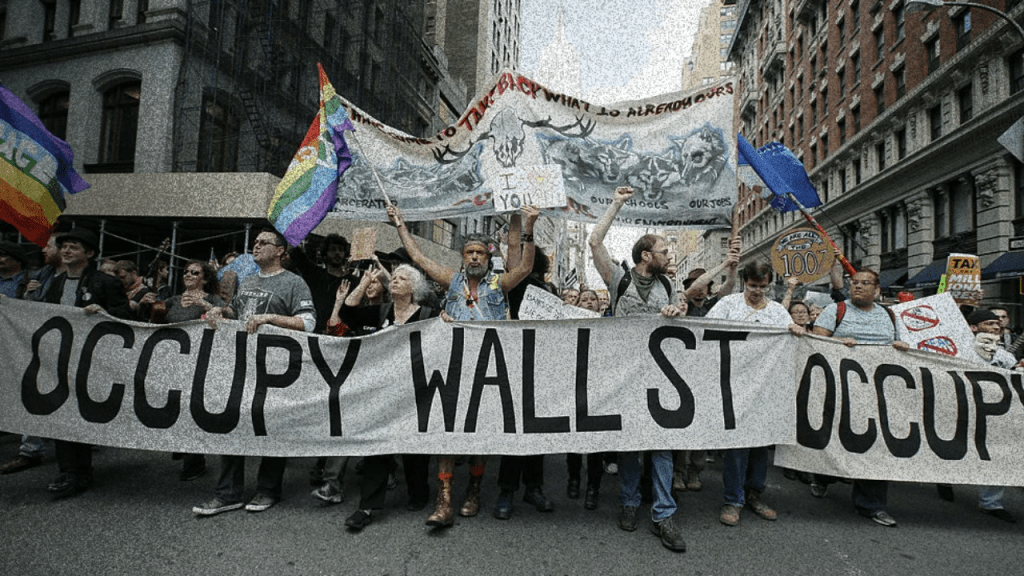
Occupy Wall Street brought inequality talk mainstream but lacked organizational form to threaten capital. Its legacy lies in discourse, not material gains.
The 2008 Crisis Created the Conditions, Not Adbusters
Occupy Wall Street began September 17, 2011 in Zuccotti Park after a call from Adbusters magazine. The encampment lasted 59 days until NYPD cleared the park November 15, 2011. The movement’s “We are the 99%” slogan named wealth concentration in the top percentile as the central antagonism. But OWS did not create political consciousness around inequality — the 2008 financial crisis did. The bank bailouts, the unpunished executives, the foreclosures and unemployment — these material conditions produced the rage OWS channeled. Adbusters provided a date and location. The crisis provided the class composition.
The movement’s timing was structural, not accidental. By 2011, three years into a recovery that enriched bondholders while wages stagnated, the disconnect between financial sector profits and working-class precarity had become undeniable. OWS named this disconnect in language accessible enough to enter mainstream discourse. The slogan worked because it described an empirical reality: income and wealth inequality had reached levels unseen since the 1920s. The Federal Reserve’s monetary policy had reflated asset prices while doing nothing for employment or wages. OWS gave people a way to name their enemy.
Horizontal Organization Prevented Strategic Escalation
The movement’s insistence on leaderless, consensus-based decision-making expressed a legitimate distrust of hierarchy. But it also prevented OWS from moving beyond symbolic occupation to material disruption. Encampments in public parks do not threaten capital accumulation. They create spectacle, which the media amplifies, but spectacle without the capacity to shut down production or finance remains containable. The NYPD cleared Zuccotti Park citing health and safety concerns. The movement had no organizational structure capable of resisting eviction or redirecting its energy into workplace organizing, rent strikes, or other forms of economic leverage.
The rejection of demands was framed as a strength — a refusal to negotiate with a system requiring abolition, not reform. But without demands, OWS could not build the coalitions necessary to win concessions or protect itself from state repression. Horizontalism works for small affinity groups. It does not scale to mass movements that need to coordinate across cities, defend against police violence, or transition from protest to power. The result was predictable: the movement fragmented as soon as the encampments were cleared. No organizational infrastructure survived to continue the fight.
Discourse Shift Does Not Equal Material Gains
OWS succeeded in making inequality a topic of mainstream political conversation. This is the standard defense of the movement — that it “changed the discourse” even if it did not win policy victories. But discourse shifts do not pay rent. They do not raise wages. They do not redistribute wealth. The Fight for $15 campaigns that emerged after 2011 built on OWS energy, but they succeeded where they did because unions like SEIU provided organizational infrastructure and funding. The Bernie Sanders 2016 campaign drew on similar themes, but the claim that OWS caused Sanders’ rise is contested — both were parallel responses to the same crisis conditions.
The problem with celebrating discourse shifts is that capital does not care about discourse. It cares about profit rates, labor costs, and the rate of exploitation. OWS did not threaten any of these. The financial sector continued consolidating. Wealth concentration accelerated. Real wages remained stagnant. The Dodd-Frank regulations passed in 2010, before OWS, were steadily weakened throughout the 2010s with bipartisan support. The revolving door between Wall Street and Treasury continued uninterrupted. If the test of a movement’s success is whether it improves the material conditions of the working class, OWS failed.
Social Media Amplification Is Not Organization
The movement’s reliance on social media for coordination was treated as innovative. Twitter and Facebook allowed rapid mobilization and message spread. But social media presence is not the same as organizational capacity. Digital networks dissolve as quickly as they form. They do not build the trust, discipline, or institutional memory required for sustained struggle. When the encampments ended, the Twitter feeds went quiet. No membership rolls existed. No local chapters remained. The energy dissipated because it had no container.
Contrast this with the labor movement’s organizational model: unions, locals, shop stewards, strike funds, contracts. These structures persist across election cycles and media attention spans. They accumulate knowledge and train new organizers. They can escalate from symbolic action to economic disruption because they have leverage at the point of production. OWS rejected this model as hierarchical and bureaucratic. The result was a movement that burned bright for two months and left almost no institutional trace. The activists who participated went on to other work, but OWS itself built nothing durable.
The State’s Repressive Capacity Remains Unchallenged
The coordinated evictions of Occupy encampments across US cities in fall 2011 demonstrated the state’s willingness to use force to end even symbolic challenges to capital. The November 15 clearing of Zuccotti Park involved riot police, arrests, and the destruction of the movement’s library and infrastructure. Similar operations happened simultaneously in Oakland, Portland, and other cities. This coordination suggests federal involvement, likely through DHS fusion centers. OWS had no strategy to resist this repression because it had rejected the organizational forms that might have allowed coordinated defense or tactical retreat and regrouping.
The movement’s commitment to nonviolence was presented as moral high ground, but it also meant accepting the state’s monopoly on violence as a given. When the police came, OWS could only document the repression and appeal to public sympathy. This worked in the sense that the evictions generated negative press coverage. It did not work in the sense that the movement was destroyed and did not recover. Future movements will face the same repressive apparatus. The question OWS could not answer was: how do you build power sufficient to make the state hesitate before deploying that apparatus?
Class Struggle Requires More Than Moral Clarity
OWS was correct that the financial sector had captured the state and that wealth inequality threatened social cohesion. But being correct about the diagnosis does not generate the organizational capacity to implement treatment. The movement’s moral clarity about the 1% versus the 99% was politically powerful as rhetoric. It did not translate into a program for taking power from the 1% and redistributing it to the 99%. The demand-less protest made a statement. It did not build the working-class organizations necessary to contest capital’s control over the economy.
This is the central failure: mistaking the raising of consciousness for the building of power. Consciousness is necessary but insufficient. Workers need to be organized at the point of production. Tenants need to be organized in their buildings. Communities need institutions capable of meeting material needs outside the market. OWS did none of this. It created temporary autonomous zones in public parks, which is a form of prefigurative politics — showing what a different world might look like. But prefigurative politics without a strategy for getting from here to there remains a performance, not a transformation.
The Legacy Is Ambiguous, Not Inspirational
Defenders of OWS point to its influence on subsequent movements and electoral campaigns. This influence exists but should not be overstated. As Fong and Offenbacher argue in Catalyst, OWS was “not the beginning of a new political era for the Left but the last, carnivalesque expression of a period of defeat” — the endpoint of decades of nonstrategic activism and self-defeating horizontalism, not the seedbed of what followed. The Sanders campaigns, the growth of DSA, the teacher strikes of 2018–2019 — these built on the same material base of inequality and precarity that OWS identified. Whether OWS accelerated or shaped these developments is debatable. What is certain is that OWS itself did not survive to participate in them as an organization.
The useful lesson from OWS is negative: this approach does not work. Horizontal organization, demand-less protest, and reliance on moral suasion cannot challenge entrenched power. The movement succeeded in changing what people talk about. It failed to change what people can do, what resources they control, or what power they can exercise. Future movements need to study this failure not to replicate OWS’s mistakes. The fight against the 1% requires building organizations capable of wielding the collective power of the 99% — and that requires exactly the structures OWS rejected.
Sources
- Wikipedia. Occupy Wall Street overview.
- History.com. OWS protest history.
- Britannica. OWS facts overview.
- NPR. OWS roots analysis. October 2011.
- Catalyst Journal. Occupy in retrospect. Winter 2022.
- Wikipedia. Fight for $15 overview.
- National Employment Law Project. Fight for $15 legacy. November 2022.






 Spark Solidarity