
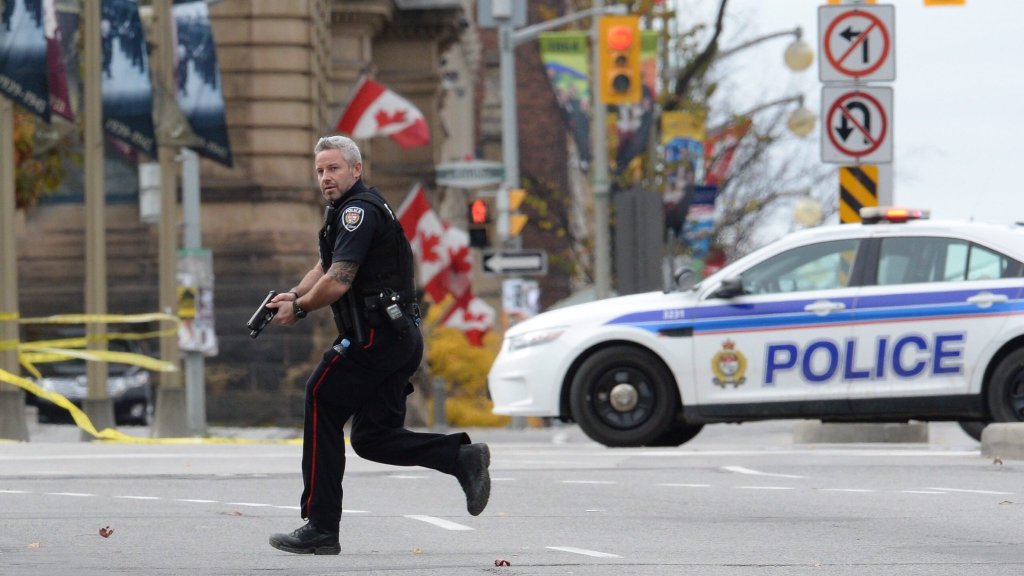
In the wake of the attack on Parliament, authorities are reexamining security protocols amid rising questions of possible insider orchestration.
Recent so-called “terrorist attacks” in both Montreal and Ottawa have sparked intense scrutiny of Canada’s law enforcement and intelligence practices. While the official narrative paints a picture of a government swiftly responding to unforeseen terrorist threats, a closer look raises unsettling questions about the police’s role and motivations in these incidents.
Over the past 18 months, authorities revoked the passports of suspects linked to both the Montreal and Ottawa incidents. On the surface, this may appear as a necessary precaution, yet it also hints at a deeper, more troubling narrative.
These measures suggest that law enforcement was already monitoring these individuals closely—a fact that raises the question: if the police had been so vigilant, why did these incidents occur in the first place? Could it be that, through either negligence or a calculated strategy, police actions have inadvertently—or perhaps even deliberately—created conditions ripe for these events?
The government’s response has been notably swift, with Prime Minister Harper announcing an expedited introduction of a new CSIS Act designed to tighten counter-terrorism measures. Public Safety Minister Steven Blaney emphasized that while overreacting isn’t the aim, under-reacting to significant threats is simply unacceptable. However, it’s peculiar that this very legislation was being proposed both in the lead-up to—and even during—the time of the shooting at the Parliament buildings.
This raises a critical question: how could the system be failing so drastically when the remedy it now champions was supposedly the safeguard that would have prevented such an attack?
The narrative suggests that the existing security framework was so inadequate in protecting citizens that radical reform was necessary. Yet, the timing of the CSIS Act’s proposal implies a certain irony: the very tool they claim would have stopped the attack was under discussion as the tragedy unfolded. This discrepancy forces us to scrutinize not just the legislation, but also the motivations and methods of the agencies tasked with ensuring our safety.
The juxtaposition of a proposed law that ostensibly should have prevented the incident, with the incident itself occurring during its creation, casts a long shadow over the official narrative. It suggests that the shortcomings of the current system might not be solely due to unforeseeable events or external threats, but could also stem from deeper, systemic issues within the agencies responsible for national security.
As these measures are fast-tracked, the underlying question remains: is the CSIS Act truly a forward-thinking solution, or is it simply a band-aid applied in the midst of a crisis to obscure more troubling failures within the system?
This scenario highlights the urgent need for a critical reassessment of the methods and motivations of those in power. When the remedy is introduced at the same moment as the crisis, it not only undermines confidence in the existing framework but also raises doubts about whether the proposed changes are genuinely aimed at enhancing security or merely designed to mitigate political fallout.
Historically, Canada is often celebrated for its success in thwarting terrorist plots, with the famous Toronto 18 case frequently cited as a prime example. In that instance, the RCMP’s undercover operations, led by agent Mubin Shaikh, infiltrated and dismantled what appeared to be a terrorist cell.
However, this so-called triumph of law enforcement also raises a critical question: are these “terror plots” genuinely spontaneous threats, or do they sometimes owe their very existence to the orchestration by police and their covert informants?
Investigative journalists have been reporting since the post-9/11 era that elements within law enforcement may, at times, manufacture or manipulate such plots as a pretext for expanding surveillance, tightening security measures, and gaining political leverage.
If operations like the one against the Toronto 18 can be justified on the grounds of preventing imminent threats, then one must wonder whether similar tactics are deployed to justify future political or security measures. Essentially, one could argue that these terror plots might never occur if they weren’t, at least in part, being engineered by the very agencies tasked with protecting the public.
This perspective invites a deeper interrogation of the broader strategy behind counter-terrorism operations in Canada. Rather than being solely about national security, could these maneuvers be part of a calculated effort to maintain or expand state control? The consistent narratives presented in the media often obscure the possibility that some of these threats are not entirely external but are, in some cases, a product of covert operations designed to bolster the powers of law enforcement agencies.
Further complicating the official narrative are conflicting reports of events surrounding recent incidents. Eyewitnesses have described a chaotic police chase at the Rideau Center, details that the RCMP has categorically denied.
The discrepancy between public accounts and official statements is alarming and suggests that there may be more to the story than what is being presented to the public. It begs the question: Are these inconsistencies simply the result of poor police coordination, or is there an underlying motive to obscure the truth?
Some observers argue that the system may have been compromised by a blend of incompetence, complacency, and even collusion. The notion that events of this magnitude would occur if the police themselves weren’t partly to blame is hard to ignore.
When law enforcement agencies are caught in a web of bureaucratic inefficiency or, worse, deliberate manipulation, it casts a long shadow over their ability to act impartially. This situation is further complicated by suggestions of political exploitation—where intelligence operations are used not only for national security but also as tools for political leverage.
One particularly provocative theory involves the background of Michael Zehaf-Bibeau, the perpetrator of the Parliament Hill shooting. Rumors from both questionable and mainstream media outlets suggest that his father was involved as a Libyan rebel in 2011 add an international dimension to the narrative.
If the radicalization process was indeed influenced by external forces, it raises further doubts about the efficacy and transparency of domestic intelligence operations. How much of this can be attributed to genuine security threats, and how much is the result of a system that has, perhaps inadvertently, contributed to its own vulnerabilities?
Ultimately, these incidents force us to question whether the official narrative of a vigilant, proactive police force holds up under scrutiny. If law enforcement agencies are compromised—whether by complacency, incompetence, or a desire to manipulate events for political gain—then such catastrophic https://sparksolidarity.wordpress.com/acab/events might indeed be, at least in part, a product of their own actions.
As Canada moves to strengthen its counter-terrorism measures, a critical reassessment of police practices and motivations is not just necessary; it is imperative for ensuring that the pursuit of national security does not come at the cost of truth and accountability.


 Spark Solidarity