
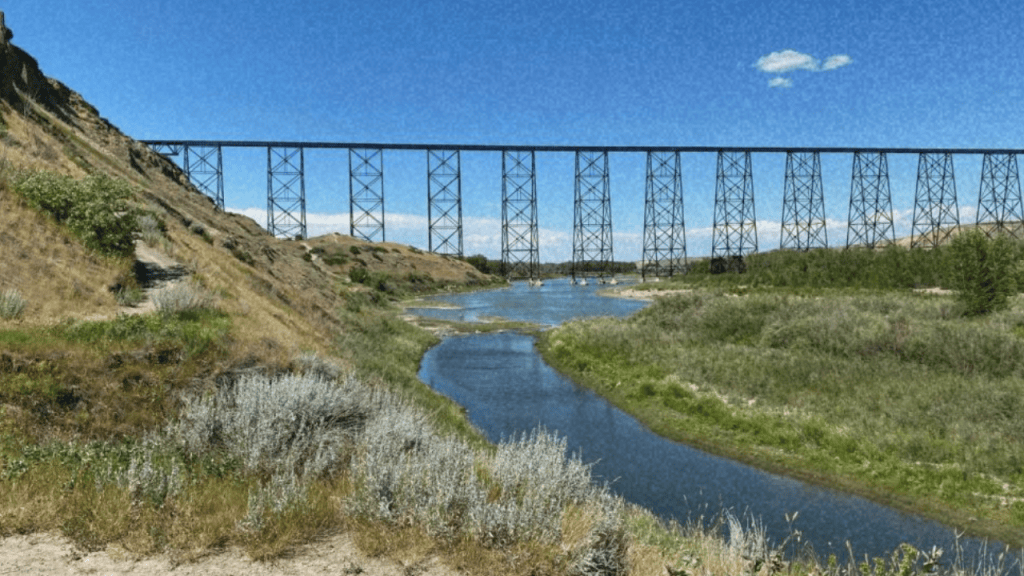
Lethbridge High Level Bridge Death: ASIRT has not explained the officer’s interaction with the 22-year-old man immediately before he went over.
As reported first by Killer Cops Canada, a 22-year-old man died after going over the side of Lethbridge’s High Level Bridge during an interaction with a Lethbridge Police Service officer.
Nine days after Lethbridge Police first called the case an “in-custody death,” the Alberta Serious Incident Response Team released the most detailed official account currently available. ASIRT says three officers responded to reports of a man walking on the railway bridge, but only one officer entered the span and approached him near the middle.
After roughly thirty minutes of conversation, ASIRT says an undisclosed “interaction” occurred and the man went over the side. The agency has not explained what the officer did, whether there was physical contact or what immediately changed before the man fell.
ASIRT’s July 23 Account Is the Latest Version
According to ASIRT’s preliminary account, Lethbridge police received multiple 911 calls at approximately 7:30 p.m. reporting a man walking west along the Lethbridge Viaduct, commonly called the High Level Bridge. The railway trestle is not open to pedestrians.
Three officers responded. ASIRT says one officer entered the bridge alone and approached the man near the middle of the span. The officer spoke with him and directed him to leave, but the man remained and the conversation continued.
At approximately 8 p.m., ASIRT says there was an “interaction” between the officer and the man. The man then went over the side of the bridge. Paramedics pronounced him dead at the scene.
The word “interaction” conceals the central event. ASIRT has not said whether the officer touched the man, attempted to restrain him, moved toward him, blocked his path or issued a command immediately before he went over. It has not described the man’s movements or explained whether he moved deliberately, lost his footing or reacted to police action.
The agency says its investigation will examine the officer’s actions and what occurred immediately before the man went over the bridge. Until that evidence is released, ASIRT’s chronology remains a preliminary state account, not an independently tested finding.
Police and ASIRT Published Different Dates
The public record contains a basic contradiction about when the death occurred.
Lethbridge Police said officers responded on July 12 and that ASIRT investigators arrived in the city on July 13. ASIRT’s later account says police received the calls and the man died on July 13.
Killer Cops Canada identified the contradiction in its initial report. Neither Lethbridge Police nor ASIRT has publicly reconciled it.
The difference may be a clerical error, but agencies investigating a death during police contact should be able to establish the date before asking the public to trust their reconstruction. A basic timeline discrepancy matters because each official release is presented as authoritative while neither explains why its date differs from the other.
Police Called Him in Custody Without Explaining Why
Lethbridge Police classified the case as an “in-custody death.” Its release does not explain when the man supposedly entered custody, whether the officer told him he was detained, whether he was under arrest or whether police had made physical contact with him.
The police account says an interaction resulted in the man “moving away” from the officer before he went over the bridge. That wording makes the man’s movement the active event and leaves the officer’s conduct undefined.
The release also emphasizes that no officers were injured. The statement offers reassurance about police safety while providing no equivalent account of the decisions made around a civilian standing near the middle of a lethal structure.
ASIRT uses narrower language, describing a death following an interaction with an officer. That formulation avoids the unexplained custody claim but still withholds the content of the encounter.
The Lone-Officer Approach Requires Scrutiny
The public record says three officers attended but only one entered the bridge. No release explains why that officer approached alone or what plan police had for managing a person on a narrow railway trestle where a sudden movement could be fatal.
There is no public indication that police requested a crisis negotiator, mental-health worker or other specialized responder. The releases do not say whether officers considered preserving distance, limiting movement on the bridge or continuing communication from a safer position.
The absence of that information does not prove that a different tactic would have prevented the death. It does show how little the agencies have disclosed about the tactical decision that placed an officer close to the man near the centre of the bridge.
Police institutions routinely frame intervention as an unquestioned good. On a structure where proximity itself can increase danger, the necessary question is not only whether the officer committed a criminal offence. It is whether police intervention made the situation safer or introduced another source of pressure and risk.
The Evidence Needed to Explain the Death Is Missing
Neither agency has publicly identified the man. The releases do not disclose what the officer said, what warnings or instructions were given or whether the man responded verbally.
The public record does not say whether the officer touched or attempted to restrain him. It does not establish whether body-camera, railway, surveillance or civilian video exists. No witness accounts have been released.
The medical cause and formal manner of death are also not public. Those findings may confirm injuries caused by the fall, but they will not independently establish what the officer did immediately before it.
The fact that the death occurred during a police interaction does not by itself prove that the officer caused it. It requires a complete account of the contact because police were the only state actors present and Lethbridge Police itself classified the man as being in custody.
Lethbridge Had Two Other Custody-Death Findings in July
The bridge death arrived during the same month that ASIRT closed two other investigations involving people who died after contact with Lethbridge police. The circumstances differ, but together the files show how repeatedly the oversight system narrows accountability to possible individual criminal offences.
In the first case, a woman died in a Lethbridge Police holding cell in September 2023 after being returned from hospital. Reporting on ASIRT’s findings says required checks were missed. A supervising officer entered the cell, nudged the unresponsive woman with a foot and clipboard, recorded that she “refused to awake” and left.
She was later found without a pulse. ASIRT described the missed checks as deficiencies but concluded there were no reasonable grounds to believe police staff committed a criminal offence.
In the second case, a 59-year-old man died after a March 2025 arrest. Police restrained him during an arrest for mischief, placed him in a police vehicle and later found him unresponsive. He died in hospital days later.
ASIRT’s completed review attributed the death primarily to methamphetamine toxicity and concluded the police use of force was reasonable and authorized by law.
Those conclusions do not determine what happened on the bridge. They show the local institutional pattern: people die during custody or police contact, ASIRT asks whether an individual offence can be established, and broader questions about intervention, supervision, restraint and preventability remain outside the decisive legal test.
Criminal Clearance Is Not Institutional Accountability
ASIRT investigates incidents that may involve criminal conduct by police. That mandate can establish evidence, interview witnesses and assess whether an officer may have committed an offence. It is not a general inquiry into whether police contact was necessary, whether institutional policy increased danger or whether another response could have prevented a death.
The same structural limit appeared in the Abbotsford police shooting, where individual criminal-liability review did not answer the larger question of how police create escalation, control the first public narrative and preserve institutional authority after lethal encounters.
A finding that evidence does not support prosecution is not proof that police acted wisely, safely or without contributing to the danger. It means only that investigators did not identify reasonable grounds for a criminal charge under the available evidence and legal standard.
That narrow frame is especially inadequate when the official record still cannot agree on the date and refuses to describe the “interaction” immediately before a young man went over a bridge.
The Initial Read
Lethbridge Police called the man “in custody” without explaining when custody began. ASIRT says an “interaction” occurred without explaining what the officer did. Those two phrases conceal the central event.
A police officer approached a 22-year-old man alone near the middle of a lethal structure, and minutes later the man was dead. The state has classified the death without accounting for the police action immediately before it.
Until the officer’s movements, words, physical contact and tactical decisions are public, the agencies have supplied institutional labels instead of the evidence required to understand what happened on the bridge.
Sources
- Killer Cops Canada, “Man (22) Killed in Fall from High Level Bridge During Lethbridge Police Deployment (July 13, 2026),” July 23, 2026.
- Police Review Commission and Alberta Serious Incident Response Team, “ASIRT Investigating Death at High Level Bridge in Lethbridge,” July 23, 2026.
- Lethbridge Police Service, “Alberta Serious Incident Response Team Investigating In-Custody Death,” July 14, 2026.
- Brook Wagner, “Lethbridge Police Cleared in Death,” Lethbridge Herald, July 4, 2026.
- Dave Lueneberg, “ASIRT Completes Investigation Into In-Custody Death of Lethbridge Man in Spring 2025,” Lethbridge News Now, July 8, 2026.
- Police Review Commission, “Alberta Serious Incident Response Team,” accessed July 30, 2026.



 Spark Solidarity