
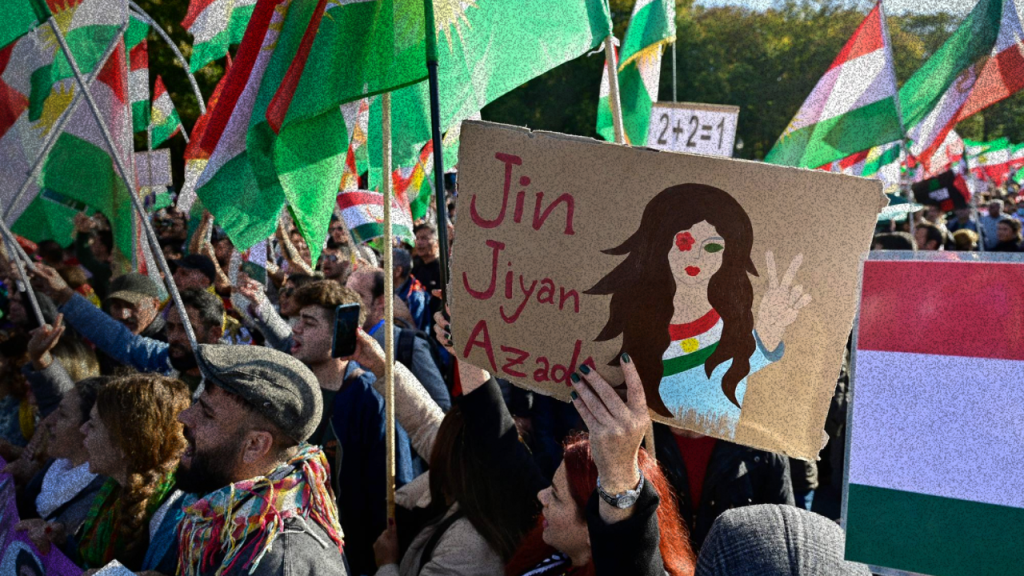
Western left Iran solidarity is failing a basic test — demanding ideological purity from resistance movements that the United States is never asked to pass.
On April 7, 2026 — six weeks into the U.S.-Israeli bombing of Iran, with ceasefire negotiations underway in Islamabad and over a thousand Iranian civilians already dead — Feminists for Jina held simultaneous rallies across multiple cities. In New York, a silent protest flyer outside Trump Tower carried the line: “No State Flags Please.” In Toronto, the same network co-organized a rally with the Iranian Collective for Peace and Justice — Canada, circulating a code of conduct banning the flags of the United States, Israel, the Islamic Republic, and the lion-and-sun flag. In Ottawa, a Feminists for Jina Toronto poster for an April 12 rally printed the position directly onto the artwork: “NO TO WAR — NO TO ISLAMIC REPUBLIC.”
Same network, same week, multiple countries, same policy. This is not a local organizer making a bad call. It is a coordinated international position, which means it deserves to be analyzed as one.
Feminists for Jina is an international network with roots in the Iranian diaspora, founded in the wake of the 2022 Woman, Life, Freedom uprising that followed the death of Jina Mahsa Amini — the Kurdish-Iranian woman killed in police custody for allegedly violating the Islamic Republic’s mandatory hijab law. Their politics emerge from that movement: feminist, anti-authoritarian, opposed to the Islamic Republic’s gendered repression. That is a coherent and serious political position.
It is also, applied to an active military assault on Iran, the position that Calla Walsh — an American leftist organizer, internationally known for her direct confrontations with AIPAC lobbyists — named the absurdity of this request with precision:
“No to the US! No to Iran! No to war! No to resisting war! No to Israel! No to the only state forces resisting Israel! No to everything!”
This is not mocking the network’s feminism. It is describing what their position produces when you read it straight through in the context of a war. The rallies were organized to oppose a U.S.-Israeli assault on Iran. The organizing framework told Iranians they could not bring either flag representing their actual political options.
The Method Behind the Position
To understand why anti-war organizers end up running a policy that excludes the people the war is happening to, you have to look at the analytical method the Western left applies to political situations — and where it stops. When the United States moves troops, the materialist analysis arrives immediately: empire, capital, resource extraction, regional control. Nobody requires the U.S. to earn structural analysis through ideological alignment. The structural position determines the behavior, and the analysis follows automatically. That is the correct method.
Point it at Iran and the method breaks down. Suddenly the IRGC needs a socialist program. Suddenly the Islamic Republic must conform to Western left political frameworks before its military resistance to a U.S.-backed assault qualifies as resistance. The structural position — a country under attack, defending itself with the military capacity it has — stops being sufficient. Ideological credentials are required first. That asymmetry is not a principled refinement. It is the operating condition of a politics that has already conceded the civilizational hierarchy it claims to oppose.
The Iranian writer Jalal Al-e Ahmad named this condition in 1962. He called it gharbzadegi — westoxification — the internalization of Western epistemological categories so complete that one can no longer perceive non-Western social reality on its own terms. Al-e Ahmad was writing about Iranian intellectuals who had absorbed European frameworks so thoroughly they could only evaluate Iranian political life by asking whether it conformed to European models of liberation. The Western left has produced its own version sixty years later.
The question worth sitting with before reading further is this: if you would never require the United States to pass an ideological test before analyzing its behavior structurally, why are you requiring Iran to? The Feminists for Jina code of conduct is the organizational answer to that question. The rest of this article is the explanation for how that answer gets produced.
What the Double Standard Erases
The withholding of structural analysis from Iran erases something specific — a revolutionary tradition that the Western left’s categories do not have room for. Ali Shariati was an Iranian sociologist who trained at the Sorbonne, worked alongside the Algerian National Liberation Front, translated Fanon into Persian, and delivered lectures in Tehran that became the ideological foundation of the 1979 revolution. He was not a Marxist and not a cleric. He synthesized anti-colonial theory with a living religious tradition to build a mass revolutionary politics that was internally generated rather than imported from Europe.
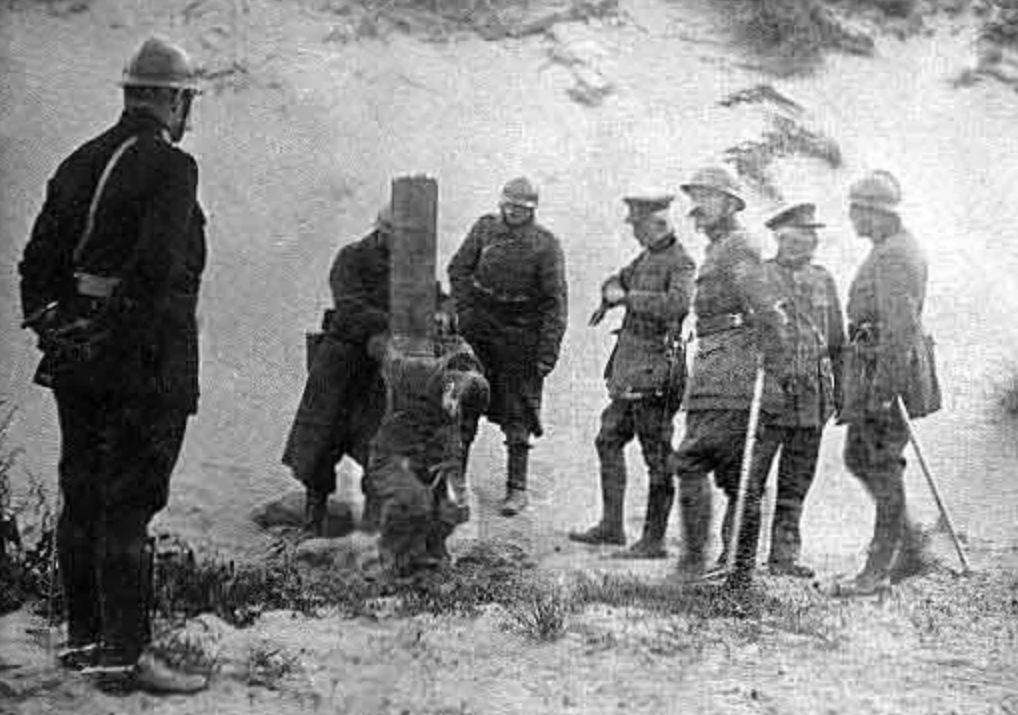
His central contribution was the distinction between Red Shiism and Black Shiism. Red Shiism — the tradition of Imam Hussein’s stand at Karbala in 680 CE — is the tradition of treating resistance to unjust power as a permanent this-worldly obligation, not a spiritual reward deferred to the afterlife. Black Shiism — the Safavid clerical tradition — makes peace with power, reduces Islam to ritual mourning, and leaves the political order untouched. Shariati’s project was the recovery of Red Shiism as a living revolutionary ideology — one that overthrew a U.S.-backed monarchy without a Leninist vanguard party and without a European secular program.
This tradition runs continuously from Karbala through 1979 through the IRGC’s asymmetric military doctrine through the human chains that formed around power plants in Kazerun and Ahvaz and Bushehr in the days after the assault began. When Tehran metro stations fill with mourning posters forty days after the Supreme Leader’s assassination, that is not state-manufactured compliance. It is Red Shiism operating exactly as Shariati described — grief and resistance as inseparable expressions of the same political tradition.
The Western left’s framework does not have a category for this. A revolutionary tradition that is religious rather than secular, state-adjacent rather than state-opposed, drawing its legitimacy from Karbala rather than the Paris Commune — this falls outside the recognizable. And what falls outside the recognizable gets absorbed into the framework anyway, recast as theocratic repression, as false consciousness, as something requiring correction before solidarity can be extended. The demand that Iran conform to a European framework before its resistance merits analysis is not universalism. It is provincialism with better branding.
CrimethInc’s Equivalence Is the Theoretical License
The Feminists for Jina position did not emerge without theoretical infrastructure. Two weeks after the assault on Iran began, CrimethInc — an anarchist collective with genuine reach in Western left spaces — published an analysis arguing that the Islamic Republic’s violent repression of the January 2026 uprising and the U.S.-Israeli military assault “are neither two separate events nor two opposing forms of violence” — that they must instead be understood as “part of a single counterrevolutionary process.”
The piece is historically grounded, takes the January massacre seriously, and is genuinely concerned with emancipatory politics inside Iran. It is also, at its analytical core, the move that makes “no to everything” feel principled rather than incoherent. If Iranian resistance and the assault on Iran are phases of the same counterrevolutionary process, then opposing both simultaneously is consistency rather than contradiction. The equivalence is doing enormous political work.
What the equivalence erases is asymmetry — the only thing that makes resistance legible as resistance rather than mere violence. One actor is managing real internal contradictions while operating under decades of sanctions and an active military assault that has killed over a thousand civilians. The other is conducting that assault with U.S. weapons, carrier groups in the Gulf, and the full force projection of the most powerful military alliance in history.
Treating these as equivalent phases of a single counterrevolutionary process is the same structural operation that liberal jus in bello framing performs at the diplomatic level — it absorbs the asymmetry between aggressor and defender and produces the conditions under which solidarity becomes impossible because resistance has been made indistinguishable from what it resists. The refusal to apply consistent definitions of imperialism across actors is not theoretical precision. It is imperial convenience dressed as rigor.
Who Benefits From a Left That Won’t Commit
There is a constant drive for control in Western left solidarity spaces — solidarity extended conditionally, withheld pending ideological alignment, offered alongside demands about which flags are acceptable. This is not solidarity. It is supervision, reproducing the same paternalistic logic that has structured every other Western relationship with the Global South, dressed in the language of feminist intersectionality or anarchist prefiguration or whatever framework is ascendant in the space doing the supervising.
Part of believing in resistance is trusting those conducting it to make the best decisions available under the circumstances they actually face — not the circumstances that would make their politics more legible to a solidarity network in Toronto. That trust does not require agreement with every decision. It requires recognizing that people facing an existential military assault are not obligated to pass a political theory exam before their presence is welcomed without conditions.
The organizational infrastructure behind these codes of conduct does not operate in a vacuum. The NGO and activist networks circulating them in Canadian left spaces have operated through state-adjacent funding structures where Liberal and Conservative MPs regularly take the stage at organized events, and where structural solidarity with non-Western resistance movements consistently loses to the kind of opposition that looks radical but produces no material challenge to imperial order. This is what weaponized diaspora politics looks like organizationally.
The manufacturing of a left that opposes the war in language while refusing to support the forces fighting it is not a failure of this apparatus. It is the function the apparatus performs. Gharbzadegi has institutional infrastructure, funding networks, and the accumulated social credibility of feminism and human rights attached to it. That combination is precisely what makes it effective and what makes naming it feel uncomfortable — because the people inside these organizations are not bad actors. They are people who have internalized a framework so completely that its demands feel like their own principled commitments.
What Is Actually Happening in Iran Right Now
While solidarity networks debated acceptable flags, Iran was doing several things simultaneously that the Western left’s framework cannot hold at once. The Supreme Leader was killed on the first day of the war. The forty-day mourning period — Arba’een, one of the most significant observances in Shia practice — was being marked during the ceasefire pause, with Tehran metro stations covered in mourning posters and public rituals staged at scale across the country.
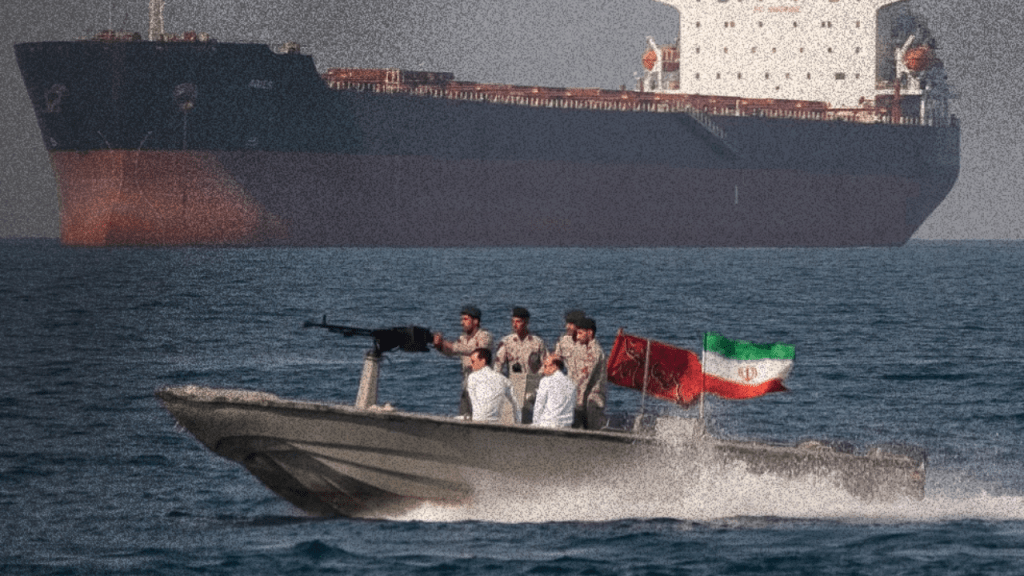
The IRGC had closed the Strait of Hormuz, sent oil prices above $100 a barrel, and produced what the IEA described as the most acute supply disruption in global energy market history — not through conventional dominance but through the asymmetric doctrine Shariati’s tradition informed. Iran was simultaneously mourning, fighting, and negotiating, all as expressions of the same political culture that does not separate grief from resistance, because the tradition of Karbala is precisely the tradition of carrying both forward at existential cost.
The Western left’s conditional solidarity cannot perceive any of this because it has already decided what resistance is supposed to look like before arriving at the situation. A movement that is also a state, drawing its legitimacy from religious tradition rather than secular Marxism, carrying flags a solidarity network has banned from its own rallies — this does not fit the template. So it gets recast: theocratic repression, false consciousness, the same counterrevolutionary process as the assault it is resisting.
The double standard at the level of method, the absent trust at the level of practice, the NGO infrastructure at the level of organization, and the CrimethInc equivalence at the level of theory are not four separate problems. They are one problem operating at four registers, and its name is gharbzadegi. The moment Shariati spent his life theorizing has arrived. The Western left can analyze it on its own terms or disappear into the framework it inherited. The flags debate suggests it has already made its choice.
Sources
- Calla Walsh (@CallaWalsh) — on the Feminists for Jina Toronto rally code of conduct, April 7, 2026
- CrimethInc — Iran: Between Repression, Co-optation, and War: Three Waves of Counterrevolution, March 19, 2026
- MERIP — Ali Shariati: Ideologue of the Iranian Revolution
- Al Jazeera — Three scenarios for the Strait of Hormuz, March 31, 2026
- Spark Solidarity — Weaponized Diaspora and the Witnesses Empire Needs, February 2026
- Spark Solidarity — Perception Management: How States Control the Narrative, November 2025
- Spark Solidarity — China Is Not Imperialist, August 2024
- Spark Solidarity — Iran Breaks Dollar Hegemony. Western Left Isn’t Watching., April 2026

 Spark Solidarity