
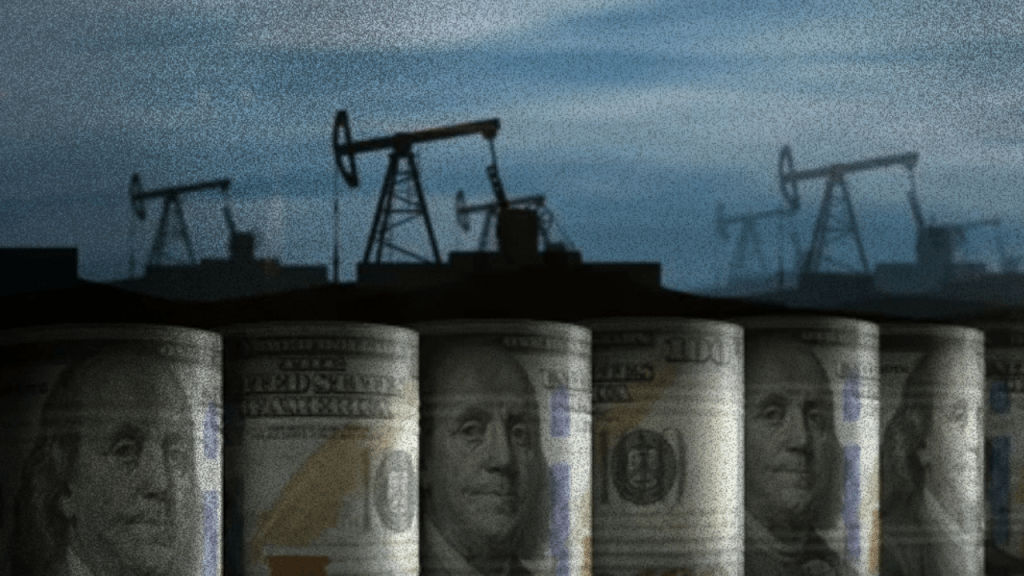
Petrodollar manufactured scarcity — not American productivity — is the foundation of dollar hegemony, and the system has always required permanent instability to survive. The Iran war is not a disruption to that system. It is the system running.
The postwar monetary order was not designed to last. It was designed to serve U.S. interests at a specific historical moment — the immediate aftermath of World War II, when the United States held the majority of the world’s gold reserves and could plausibly position the dollar as the anchor of global finance. What emerged from the Bretton Woods Conference in 1944 was a dollar-centered system in which every other major currency pegged to the dollar, and the dollar pegged to gold at $35 per ounce. The United States gained structural dominance over global trade and finance in a single institutional arrangement.
The contradiction was built in from the start. John Maynard Keynes, who attended Bretton Woods as Britain’s lead negotiator, had argued for a genuinely international reserve currency — what he called the Bancor — precisely because he understood what the dollar-anchored alternative would produce. Any country whose currency serves as the global reserve must supply that currency to the world. Supplying it means running persistent balance-of-payments deficits. But persistent deficits eventually undermine confidence in the currency’s value. The issuing country is structurally required to do the thing that destroys the system’s foundation. This tension was later formalized as the Triffin dilemma, named for the Belgian-American economist Robert Triffin, who identified it in congressional testimony in 1960. The dilemma was not a theoretical curiosity. It was a timer.
The timer ran out on schedule. By the late 1960s, the United States had financed both Lyndon Johnson’s Great Society domestic programs and the Vietnam War through deficit spending. Foreign central banks — particularly France under de Gaulle — had accumulated dollar surpluses and began demanding gold redemption at the agreed rate. The United States did not have enough gold to honor those claims. On August 15, 1971, Richard Nixon ended dollar-gold convertibility unilaterally. This was not a policy failure or an act of recklessness. It was the system’s structural contradiction arriving at its logical terminus. Nixon Shock did not destroy the dollar’s global role — but it eliminated the mechanism that had justified that role. Without gold, the question became immediate and unanswered: what now obligates the world to hold dollars?
The answer did not come from monetary reform. The United States did not return to gold, did not adopt Keynes’s Bancor proposal, and did not accept a multilateral reserve system. Instead, it found a new external anchor — one that did not depend on reserves the U.S. actually held, but on a commodity the entire industrial world was structurally dependent on consuming. The Bretton Woods era ended. The petrodollar era began. The contradiction was not resolved. It was relocated.
The Petrodollar Substituted Oil for Gold and Called It Stability
The mechanism that replaced gold convertibility was not formally announced, not codified in a treaty, and not subject to democratic deliberation in any of the countries it affected. It emerged from bilateral agreements between the United States and Saudi Arabia in the early 1970s — agreements that produced what became the operative rule of global energy markets: oil would be priced in dollars, and dollar-denominated oil revenues would be recycled back into U.S. financial assets. Through back-channel negotiations kept classified for four decades, the Nixon and Ford administrations structured an arrangement in which Saudi Arabia agreed to invest its surplus oil revenues in U.S. Treasury bonds. In exchange, the United States provided military protection, arms transfers, and political backing for the Saudi monarchy. The arrangement was kept secret at King Faisal’s insistence and was not revealed until Bloomberg News filed a Freedom of Information Act request in 2016.
The structural consequences were immediate and total. Because oil is the energy input into virtually every industrial process — manufacturing, agriculture, transport, electricity generation — every economy that needed to industrialize needed oil. Every economy that needed oil needed dollars to buy it. The dollar’s global role, which had previously rested on gold reserves the U.S. was running out of, now rested on energy dependence that was genuinely universal and structurally embedded in production itself. Demand for dollars was no longer a function of U.S. productive capacity or fiscal discipline. It was a function of the physical requirements of industrial civilization, rerouted through a currency pricing arrangement.
The recycling loop completed the architecture. Oil-exporting states accumulated dollar surpluses they could not spend domestically at the scale they were earning. Those surpluses flowed into U.S. Treasury bonds, dollar-denominated financial instruments, and American arms purchases. Capital that left the United States to pay for oil returned as investment in U.S. debt. The United States could now run persistent deficits — the same deficits that had collapsed Bretton Woods — because those deficits were being externally financed by the very countries that had benefited from the oil-dollar arrangement. The Triffin dilemma had not been solved. A mechanism had been found to defer its consequences indefinitely, as long as oil remained central to global production.
This is the core of everything that follows. Oil did not need to be scarce. It needed to be necessary. A system built on scarcity can be disrupted by discovery — find enough oil, and the foundation crumbles. A system built on necessity is disrupted only if the thing that necessitates oil is replaced. As long as industrial civilization ran on oil, the dollar ran on oil. The threat to the system was never running out of oil. The threat was oil becoming optional.
The Gulf Became a Military-Financial System, Not an Energy Region
Once oil became the monetary foundation of American power, leaving its production and distribution to market forces was structurally intolerable. Markets are indifferent to the political requirements of currency hegemony. The Persian Gulf required enforcement. The Carter Doctrine, announced in 1980, formalized what was already structurally true — the United States would treat any attempt by an outside force to gain control of the Persian Gulf as an attack on vital national interests, to be repelled by any means necessary, including military force. This was not an energy policy. It was a monetary policy enforced through military doctrine.
The architecture that emerged had three interlocking components. Saudi Arabia managed price stability through its control of spare production capacity — the kingdom maintained enough idle capacity to flood the market or tighten it, giving it unmatched pricing leverage within OPEC. The United States maintained military presence through the Fifth Fleet, bases across the Gulf, and security guarantees to every major producer. Israel functioned as a regional security partner — a highly armed state outside the Arab political framework that could project force, provide intelligence integration, and act as a deterrent against any regional power that might challenge the arrangement. Energy, finance, and military coercion became a single operating system. This system did not require peace. It required managed tension. An entirely pacified Gulf with stable, cooperative governments and freely flowing oil under internationally neutral pricing arrangements would be structurally dangerous to dollar hegemony — because it would allow oil to become a genuinely competitive commodity, divorced from political risk and therefore from the dollar’s monopoly on its pricing. Tension was not a failure mode. It was an operating condition.
The Real Crisis of the 1990s Was Oil Becoming Irrelevant, Not Running Out
The post-Cold War decade introduced a structural threat to the petrodollar system that had nothing to do with reserves, OPEC pricing, or regional conflict. The threat was optionality. Throughout the 1990s, energy efficiency was improving across industrial sectors. Renewable energy technologies — solar, wind, early hybrid vehicles — were developing along cost curves that pointed toward eventual competitiveness. Climate science was consolidating, producing institutional pressure for fossil fuel displacement. The Kyoto Protocol was negotiated in 1997, representing the first serious multilateral framework for carbon emissions reduction. None of this meant the immediate end of oil. But it introduced long-term uncertainty about oil’s structural centrality — and therefore about the dollar’s structural foundation.
The 1990s also produced a specific threat through low prices. The oil price collapse of the late 1990s, which saw crude fall below $12 per barrel in 1998, reduced the geopolitical stakes of oil supply. Cheap, abundant, politically low-intensity oil is not a foundation for currency hegemony. It is a commodity. The system required oil to remain expensive, contested, and strategically irreplaceable. The conditions of the late 1990s pointed in exactly the wrong direction. A structural response was required — not necessarily a planned conspiracy, but a system-level adjustment that would reassert oil’s centrality at the moment it was most at risk.
The Iraq War Preserved Oil’s Indispensability — It Didn’t Extract It
The conventional debate about the Iraq War circles between two positions: it was about stealing Iraqi oil, or it was a catastrophic strategic miscalculation driven by ideology and false intelligence. Both framings are wrong because both are focused on outcomes rather than mechanisms. The Iraq War did not need to succeed as a conventional military or political project to achieve its structural function. Its function was not to extract Iraqi oil. Its function was to ensure that oil could not become politically neutral.
The planning infrastructure for the Iraq invasion predates September 11, 2001. The Project for the New American Century — whose signatories included Dick Cheney, Donald Rumsfeld, and Paul Wolfowitz — had called for removing Saddam Hussein from power in a 1998 letter to President Clinton, framed explicitly around Gulf stability and U.S. strategic dominance of the region. September 11 removed the political constraints on executing what had already been structurally planned. The manufactured intelligence around weapons of mass destruction provided public justification. What followed was not the orderly extraction of Iraqi oil wealth — Iraqi production remained disrupted, infrastructure was destroyed, and the country descended into sustained conflict. By the logic of resource extraction, the war was a failure. By the logic of value preservation, it was a success.
There is also the matter of what Iraq had done in the years before the invasion. In 2000, Saddam Hussein formally switched Iraq’s oil sales from dollars to euros under the UN Oil-for-Food program. Following regime change, Iraqi oil sales reverted immediately to dollar denomination. Between 2003 and 2008, global oil prices rose from approximately $25 per barrel to a peak above $140 per barrel. EIA price data shows the sustained nature of the increase — not a spike and correction but a persistent upward trajectory maintained over five years. The Iraq War and the regional instability it generated embedded a sustained risk premium into oil markets that could not be separated from the price level. Oil remained indispensable, contested, and expensive at precisely the moment when efficiency gains, renewable development, and climate politics were threatening to make it optional. The war did not need to produce stable Iraqi oil exports. It needed to produce instability. The system bought time.
After Iraq, the System Learned to Manage Rather Than Generate Instability
The Iraq War’s costs made direct large-scale military intervention politically unsustainable as a routine system-maintenance tool. The financial cost exceeded two trillion dollars by the most conservative estimates, with Brown University’s Costs of War Project putting the full figure considerably higher when veteran care and debt financing are included. The political cost was the collapse of public support for military adventurism across the Western imperial core. The system had to evolve. It could not keep generating instability through full-spectrum invasion. It needed cheaper, more durable mechanisms.
What emerged was managed instability — a set of interlocking instruments that could sustain oil’s political volatility without requiring direct military occupation. Sanctions regimes against Iran, Venezuela, and other producers introduced supply uncertainty without requiring boots on the ground. Proxy conflicts in Libya, Syria, and Yemen kept the regional risk premium elevated without U.S. forces bearing the full cost. Oil markets simultaneously underwent deep financialization. The volume of oil traded through futures contracts, options, and derivatives far exceeded the volume of physical oil actually changing hands. Prices were now shaped by expectations — of future supply, future demand, future political conditions. Political signals could move prices directly, because prices already reflected anticipated futures rather than present realities. This structural shift set the conditions for the system’s most advanced iteration: threat as a direct financial instrument.
Libya is the clearest post-Iraq demonstration of the pattern. Muammar Gaddafi had proposed a pan-African gold-backed dinar for oil trade — a project that, if realized, would have provided an alternative pricing currency for African and Middle Eastern energy exports and directly challenged the dollar’s monopoly on commodity denomination. NATO intervention followed in 2011, Gaddafi was killed, and the gold dinar project died with him. Libya’s oil exports reverted to dollar pricing. The official humanitarian justification — protection of civilians in Benghazi — served the same function as WMDs in Iraq: a legal and moral frame that made the structural motivation invisible in public discourse while the structural outcome was delivered precisely.
Venezuela Proved That Oil Scarcity Is Political, Not Physical
The U.S.-backed campaign to remove Nicolás Maduro from power — combining recognition of an opposition “interim president,” sweeping financial and oil sanctions, and explicit public support for military defection — constitutes one of the most intensive regime-change operations in recent Latin American history. Venezuela holds 303 billion barrels of proven oil reserves according to OPEC figures, the largest in the world. By any logic in which oil scarcity drives oil prices, a major intervention destabilizing the country with the world’s largest reserves should have produced a significant and sustained price spike. It did not. Global oil markets remained relatively stable through the escalation of Venezuela-related pressures in 2018 and 2019.
The reason is structural. Global oil markets do not price Venezuelan barrels primarily on their physical availability. They price them on perceived access within the political hierarchy that governs oil trade. When the United States signals that Venezuelan oil is politically off-limits — through sanctions, through designation of Maduro as illegitimate, through threats of secondary sanctions against anyone purchasing Venezuelan crude — the market adjusts its perception of that oil’s accessibility without expecting a physical supply shock. Sanctioned oil does not disappear. It reroutes through alternative buyers, often at a discount. But it exits the pricing hierarchy that sustains dollar demand. Venezuela had been actively building that exit — accepting yuan, euros, and rubles for oil sales, building payment channels with China that bypassed SWIFT, petitioning to join BRICS. As Modern Diplomacy documented, efforts by resource-rich states to hedge against dollar dependence have consistently coincided with intensified U.S. pressure — from Iraq to Libya to Iran to Venezuela. Maduro was captured by U.S. special operations forces in January 2026. Venezuelan oil is expected to return to dollar-denominated markets under U.S.-aligned management. The sequence is familiar. The outcome was structurally predictable.
The Venezuela episode demonstrates a critical structural evolution: physical supply and price are no longer tightly coupled. What drives price is not how many barrels exist or even how many are being produced, but the political conditions under which those barrels can be accessed through dollar-denominated markets. Scarcity is a political assignment, not a geological fact. And if scarcity is political, the instrument that manufactures it is not the drill. It is the threat.
Hormuz Proved That Threat Alone Is Now the Pricing Instrument
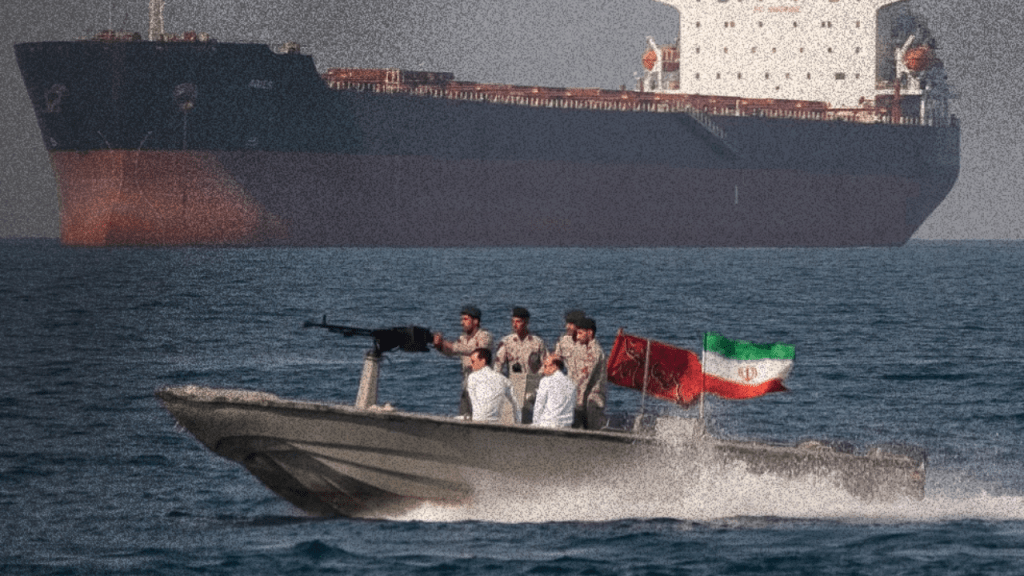
The Strait of Hormuz is approximately 33 kilometers wide at its narrowest point. Through it flows roughly 21 million barrels of oil per day — approximately one-fifth of global petroleum liquids consumption. It is the physical chokepoint through which the Gulf’s energy exits into the global economy, and it has been the implicit backdrop to every U.S. military posture in the region since the Carter Doctrine was announced. What the current Iran conflict has demonstrated with unusual clarity is that the United States does not need to close or open the Strait to extract value from it. It needs only to threaten.
When U.S. and Israeli forces launched Operation Epic Fury on February 28, 2026, oil prices immediately surged — U.S. crude jumping 7.5% and Brent spiking 6.2% in the opening hours of the conflict. That was just the beginning. By the end of the first week, U.S. crude had posted its biggest weekly gain in the history of the futures contract dating back to 1983 — surging 35.63%. Qatar’s energy minister told the Financial Times that Gulf exporters would halt production within days if tankers could not pass Hormuz, warning prices could reach $150 per barrel and “bring down the economies of the world.” The IEA characterized the disruption as the largest supply disruption in the history of the global oil market. By March, Gulf states had shut in an estimated 7.5 million barrels per day of crude production.
On April 7, Trump issued his ultimatum publicly: “A whole civilization will die tonight, never to be brought back again.” The statement was timed to an 8 p.m. ET deadline paired with a specific operational demand — Iran must reopen the Strait or face total destruction. Oil markets had already surged past $100 per barrel. The movement was not solely a response to physical disruption. It was a response to perceived hierarchy — to the signal that the world’s dominant military power was actively willing to destroy the infrastructure through which a fifth of global oil supply transits. That signal, independent of whether any barrel was actually disrupted, moved the market. The threat was the instrument. When a ceasefire was announced on April 8, oil prices plunged below $100 per barrel, stocks surged globally, and markets swung into relief rally mode — only for analysts to immediately note that prices would remain structurally elevated above pre-war levels regardless of the ceasefire’s durability. The energy shock was already filtering through the global economy. The damage to supply chains, insurance markets, fertilizer costs, and industrial inputs was already done. A two-week ceasefire does not unwind six weeks of the largest supply disruption in oil market history.
Trump’s April 1st address to the nation made the energy dominance logic explicit. “The United States imports almost no oil through the Hormuz Strait and won’t be taking any in the future. We don’t need it,” he said. The United States, as the world’s largest oil producer, does not need Hormuz to remain open for its own supply. It needs other economies to need it open. The shift from guarantor to gatekeeper — from providing security as a public good in exchange for systemic influence to providing it conditionally in exchange for direct payment or political compliance — is not a departure from the petrodollar architecture. It is its logical endpoint. As the Panama Canal episode demonstrated, Trump’s instinct is to convert every structural position into an explicit coercive lever. Hormuz is the largest structural position in the global energy system. The lever is now explicit.
The Speculation Economy Completes the Circuit
The most revealing feature of the current conflict is not the military escalation. It is the trading patterns that have accompanied Trump’s market-moving statements about it. A Financial Times investigation found that $580 million in oil futures flooded the market in a sudden spike roughly 16 minutes before Trump announced a pause in strikes on Iranian power plants on March 23 — with no public news to explain the movement. The trades were structured as bets on falling oil prices, perfectly positioned to profit from the de-escalation announcement that followed minutes later. The same pattern had appeared before the war began: an unusual surge of Polymarket accounts placed bets predicting a U.S. strike on Iran the day before it was publicly announced. On January 2, a trader turned $32,000 into more than $400,000 by betting on the capture of Venezuela’s Nicolás Maduro before it was announced the next morning. The pattern is consistent across every major market-moving decision of the Trump administration — Liberation Day tariffs, the Iran war, Venezuela, and now Hormuz.
As Nobel Prize-winning economist Paul Krugman observed, if a foreign adversary were receiving advance signals of U.S. national security decisions, it would be called treason. The same information flow routed through financial markets is called speculation. The distinction is institutional, not moral. What the trading patterns reveal is the system’s terminal logic: the financialization of oil markets that began as a mechanism for managing political risk has evolved into a mechanism for extracting private profit from public military decisions. The manufactured scarcity that sustains dollar hegemony now generates a secondary extraction layer — a class of actors positioned close enough to state power to front-run its market-moving announcements, converting the gap between public information and insider knowledge into financial returns. As the perception management architecture we have documented elsewhere makes clear, the information environment surrounding state decisions is not a neutral channel. It is a resource. And like oil, it flows to those with the infrastructure to capture it.
Crisis Is Not a Failure of the System — It Is How It Reproduces Itself
The through-line from Bretton Woods to the petrodollar arrangement to the Iraq War to Venezuela to Hormuz is not a sequence of separate crises managed by a single hegemonic power. It is a single system moving through successive phases of the same fundamental logic: the dollar’s global dominance cannot be maintained by American productive superiority alone, because that superiority no longer exists in the form it took in 1944. It must be maintained by manufactured necessity — by ensuring that the commodity that prices in dollars remains indispensable, contested, and politically volatile enough that global demand for dollar reserves cannot safely decline.
Each phase has required active intervention to sustain. The original gold anchor required increasingly unsustainable deficit financing until it collapsed. The petrodollar arrangement required the military architecture of the Carter Doctrine and the Gulf security guarantee to enforce oil’s dollar denomination. The threat from oil’s potential irrelevance in the 1990s required the Iraq War to re-embed a risk premium at the moment renewable alternatives were beginning to look credible. The post-Iraq phase required sanctions regimes, proxy conflicts, and financialization to maintain volatility without direct occupation. The Venezuela intervention removed the world’s largest reserve holder from the dollar-alternative pricing hierarchy. And the Hormuz ultimatum demonstrated that threat alone — without execution — is now sufficient to move global energy prices by 35 percent in a single week. What looks like instability from the outside is infrastructure from the inside. The wars, the sanctions, the regime changes, the ultimatums, the insider trades — these are not failures of American foreign policy. They are its operating mechanism.
A stable, multipolar world with diversified energy pricing, accessible renewable alternatives, and sovereign control over natural resources would be catastrophic for dollar hegemony — because it would eliminate the manufactured necessity that makes everyone hold dollars. The system does not malfunction when it produces war. It malfunctions when it produces peace. This is what the structural distinction between China’s development model and U.S. imperial capitalism ultimately indexes. China’s Belt and Road Initiative, its CIPS payment infrastructure, its yuan-denominated energy contracts with Gulf producers, its investment in Venezuelan oil infrastructure — these are not mirror images of American power. They are attempts to build a parallel architecture that does not require manufactured scarcity to function. Whether that project succeeds or is absorbed into the existing system is the central geopolitical question of the coming decades. What is not in question is what the existing system requires to survive. It requires that the world remain dependent. It requires that dependence be enforced. And it requires that the enforcement be invisible enough that the enforced continue to mistake their subordination for the natural order of things. The petrodollar system has always been that invisibility project. The Iran war is what it looks like when the project stops bothering to hide.
Sources
- IMF — History of the International Monetary Fund: The Bretton Woods System
- Britannica — Triffin Dilemma
- Federal Reserve History — The End of the Bretton Woods System (1972–81)
- Bloomberg — The Untold Story Behind Saudi Arabia’s 41-Year U.S. Debt Secret, May 2016
- UNFCCC — Kyoto Protocol to the UN Framework Convention on Climate Change, 1997
- EIA — Crude Oil Spot Prices: WTI Cushing Oklahoma
- Brown University Costs of War Project
- OPEC — Venezuela: Proven Oil Reserves
- Modern Diplomacy — Venezuela and the Petrodollar Question, January 25, 2026
- Kashmir Reader — The Real Stakes in Venezuela: It’s Not Just About Oil, It’s About the Dollar, January 2026
- CNN Business — Oil surges and stock futures sink as war in Iran threatens crude supply, March 1, 2026
- CNBC — Oil surges 35% this week for biggest gain in futures trading history dating back to 1983, March 6, 2026
- Axios — Mysterious trading patterns follow Trump into war, March 25, 2026
- PBS NewsHour / AP — Trump warns “a whole civilization will die tonight,” April 7, 2026
- Miller Center — Trump Address to the Nation on Iran, April 1, 2026 (full transcript)
- NPR — Oil prices plunge and stocks soar after U.S. and Iran agree on a ceasefire, April 8, 2026
- Spark Solidarity — Perception Management: How States Control the Narrative
- Spark Solidarity — China Is Not Imperialist
- Spark Solidarity — Trump on China and the Panama Canal




 Spark Solidarity