
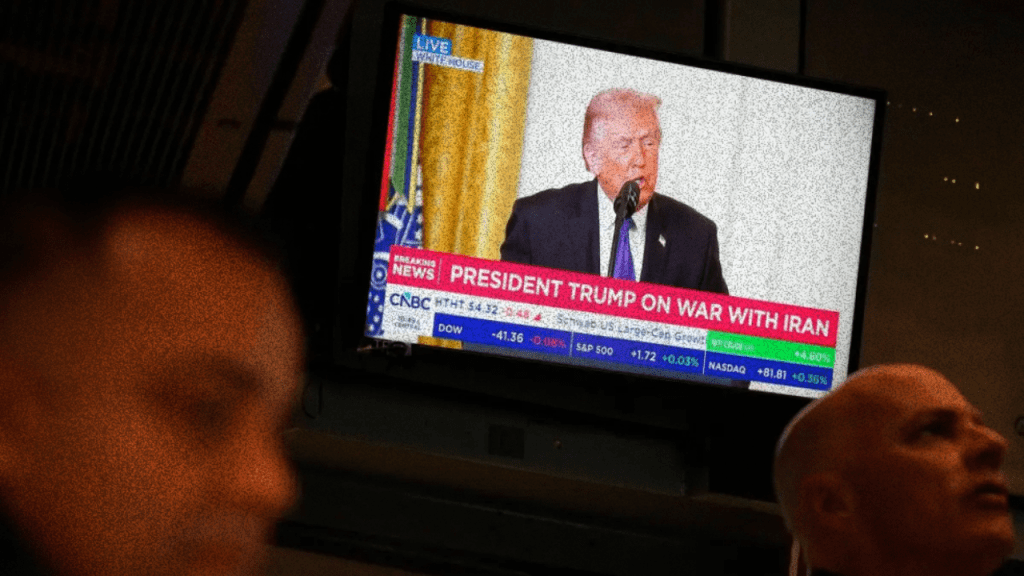
Trump Iran oil markets: the April 2026 deadline cycle exposed how war threats function as direct commodity price instruments — oil above $110, tanker traffic collapsed, and no missiles required to produce the disruption.
One Strait Controls the Equation, and Washington Knows It
Before the ultimatums, before any of the specific moves in the April 2026 crisis, the structural condition was already in place. The Strait of Hormuz carries roughly twenty million barrels of crude oil and refined product per day — approximately a fifth of global petroleum consumption and closer to a quarter of all seaborne oil trade. That single chokepoint is not a vulnerability in the system. It is the system. Every actor with exposure to energy prices, which is every actor in the global economy, holds a structural stake in what happens inside that waterway. That condition precedes Trump. It precedes the current Iranian government. It is the geography that makes the threat credible before a single word is spoken, and it is the reason a political statement in Washington can move commodity prices in Singapore within the hour. The architecture of leverage was already built. What the April 2026 sequence demonstrated is that the Trump administration understood how to deploy it.
The Deadline Cycle Was Not Erratic — It Was the Method
The sequence runs as follows. On March 21, Trump first threatened to blow up Iran’s electricity plants and energy facilities if the Strait was not reopened. That deadline passed. The threat was sharpened, not executed. A new window was issued. On April 5, Trump threatened to attack Iran’s power plants and bridges within two days. That deadline approached. Trump deferred it, citing ongoing negotiations. On April 7, the sharpest statement yet: “Tuesday will be Power Plant Day, and Bridge Day, all wrapped up in one, in Iran. There will be nothing like it.” Then: “A whole civilization will die tonight, never to be brought back again.” As the 8 p.m. ET deadline approached, Pakistan’s army chief Field Marshal Asim Munir was on the phone through the night with U.S. Vice President JD Vance, Special Envoy Steve Witkoff, and Iranian Foreign Minister Abbas Araghchi. Al Jazeera confirmed the “Islamabad Accord” proposal — an immediate ceasefire with 15 to 20 days to finalize a broader settlement. Iran rejected it, demanding a permanent solution and refusing to reopen Hormuz under a temporary arrangement.
The IRGC characterized Trump as going back and forth between talks and threats. That characterization describes the surface behavior accurately and misses the logic entirely. The oscillation is not inconsistency. Each extension keeps maximum pressure live while deferring the costs of actual conflict. Each sharpened threat raises the perceived price of non-compliance. The deadline is not a countdown to war. It is the instrument of negotiation — and the fact that Iran is refusing to accept a temporary deal confirms it understands this too. Hormuz is Iran’s counter-instrument, and it will not surrender it for a ceasefire that could collapse like Gaza or Lebanon.
Anticipation of Disruption Became Actual Disruption
The raw price data confirms the mechanism and sharpens it beyond what the original framing anticipated. Brent crude surpassed $100 per barrel in early March 2026 and hit $126 at its peak. U.S. crude topped $110. Al Jazeera’s analysis of war costs confirmed that tanker traffic through the Strait fell dramatically within days of the conflict’s outbreak, restricting millions of barrels per day. The EIA confirmed that Gulf states collectively shut in an estimated 7.5 million barrels per day of crude production in March alone, with the disruption expected to worsen. The distinction between expectation and reality had collapsed: the threat of closure produced actual closure. The signal became the event.
This is not a complication of the thesis — it is its sharpest expression. A credible enough threat, aimed at a structurally irreplaceable chokepoint, does not need to be executed to produce real economic consequences. The anticipation of disruption is sufficient to generate the disruption. When ceasefire signals emerged over the April 6 to 7 window, oil futures moved sharply in response — markets absorbed the diplomatic signal at the speed of a statement, not the speed of a tanker convoy. That symmetry is the proof of concept: up on threat, down on negotiation, indifferent to whether the underlying military situation has actually changed.
This Is Not Manipulation — It Is Power Making Itself Legible
The accusation of market manipulation is the wrong frame, and it matters that it is wrong because the correct frame is more damning. Manipulation implies a covert operation — insider knowledge, coordinated trades, a hidden hand moving prices while concealing the mechanism. None of that was required here. The connection between political authority and commodity pricing is not hidden. It is the normal operating condition of a global economy organized around U.S. hegemony and dollar-denominated energy markets. When a sitting U.S. president signals that twenty million barrels per day of global oil flow are at risk, markets price that risk. When the same president signals relief, markets price that too. No covert action is required because the system is built to translate geopolitical statements into financial movement in real time. Statements are not commentary on events. They are events. This is the architecture of perception management operating at its most structurally naked — the mechanism is visible, the connection between power and price is immediate and measurable, and the system does not hide it because it does not need to. What the April 2026 sequence exposed is not a malfunction. It is the system functioning as designed, with the design suddenly rendered legible to anyone paying attention.
Pakistan’s Mediation Confirms the Crisis Went Systemic
Pakistan’s emergence as the primary mediator is not a diplomatic footnote. It is the political confirmation of what the Hormuz geography already implied. Axios confirmed that four sources with knowledge of the diplomatic efforts described negotiations taking place through Pakistani, Egyptian, and Turkish mediators and also through direct text messages between Witkoff and Araghchi. Pakistan’s position in this architecture is not accidental. It is a state with direct economic exposure to Gulf energy flows, with established back-channel access to Tehran, and with enough U.S. dependency to carry Washington’s requirements credibly. The fact that a bilateral U.S.-Iran confrontation required third-state intermediaries with those specific characteristics is structural, not circumstantial.
When a chokepoint controls a fifth of global oil consumption, the conflict stops being bilateral the moment the threat is credible. Every state tied to that supply chain acquires a stake in the outcome. That systemic expansion of the crisis is not a side effect of the escalation — it is what made the threat maximally coercive. The more actors pulled into the orbit of disruption, the more pressure on Iran to accept terms, and the more pressure on Washington to offer a face-saving off-ramp. Iran’s counter-reading is equally structural: the IRGC said the Strait will “never return” to what it was before the war, especially for the U.S. and Israel. Both sides are operating from the same geographic logic, in opposite directions. That standoff is the current condition of global energy markets.
No Ceasefire — The Leverage Remains Intact and Active
As of April 7, 2026, no ceasefire has been concluded. Iran rejected the Islamabad Accord, calling for a permanent solution and refusing to reopen Hormuz under a temporary arrangement it fears could collapse like Gaza or Lebanon. Trump described Iran’s counter-proposal as “significant but not good enough.” The deadline passed or was extended — the specific resolution remained unclear as this article was filed. What is not unclear is the structural condition: the entire mechanism documented above remains live. The leverage has not been dissolved. It has been demonstrated.
The April 2026 sequence has already established its operational record: deadlines were set, markets moved, primary mediators emerged, proposals were exchanged, and escalation was repeatedly deferred through the credible threat of execution. That demonstration is now part of the permanent record of what this instrument can do. The underlying condition — Iranian control of Hormuz access, U.S. economic and military dominance of the Gulf, the structural dependency of global energy markets on that chokepoint — remains identical to what it was before the first deadline was issued. The ceasefire that has not yet arrived does not change that. When it comes, it will produce a temporary re-pricing of risk. The moment either side signals non-compliance, the entire mechanism reactivates from a now-credibilized baseline. War, diplomacy, and commodity markets are operating on the same timeline, driven by the same signals. That convergence was not created by the April 2026 crisis. It was made visible by it.
Sources
- U.S. Energy Information Administration — Hormuz oil flow data
- Al Jazeera — Trump’s “Bridge Day” threat: can a last-ditch ceasefire plan work?, April 2026
- Al Jazeera — Pakistan offers two-phased truce deal; Iran won’t open Hormuz under temporary ceasefire, April 2026
- Al Jazeera — How much could the Iran war cost the US?, March 2026
- Axios — US, Iran mediators discuss potential 45-day ceasefire, April 2026



 Spark Solidarity