
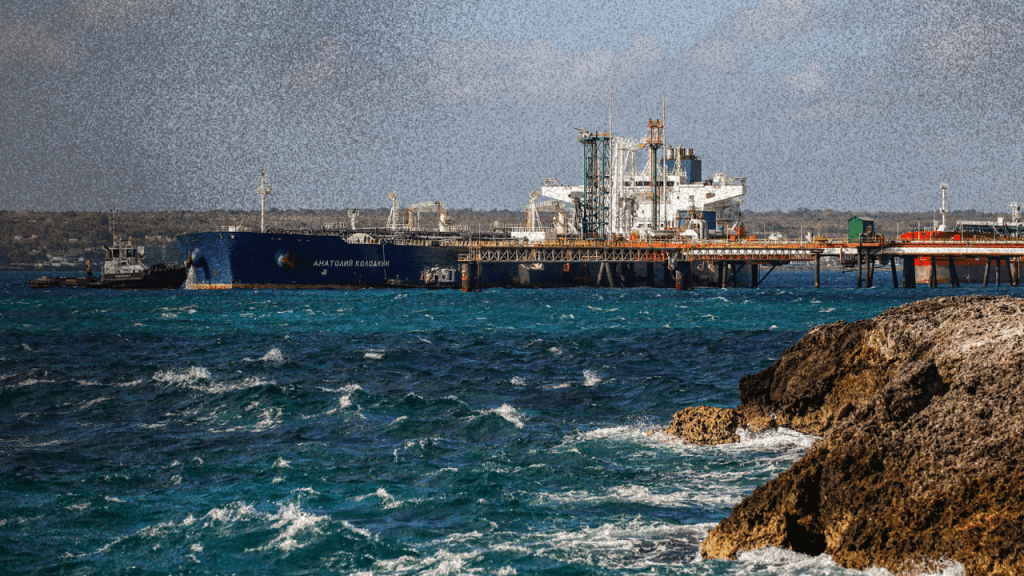
Russia Cuba oil: a sanctioned tanker docked at Matanzas with 730,000 barrels — and Washington stood aside, revealing more about the blockade’s condition than any act of evasion could.
A Sanctioned Russian Tanker Docked in Cuba. The U.S. Let It.
On March 31, 2026, the Anatoly Kolodkin — a Russian tanker sanctioned by the United States, the European Union, and the United Kingdom — docked at the Cuban port of Matanzas and offloaded 730,000 barrels of crude oil. It was the first significant oil delivery to reach Cuba in three months. The island has been living through a severe energy crisis: blackouts running over 30 hours daily, transportation disrupted, hospitals operating on reduced capacity. The U.S. had not only sanctioned the vessel — it had positioned two Coast Guard cutters off Cuba’s northeast coast, issued an OFAC directive explicitly barring Cuban receipt of Russian oil, and coerced Mexico into halting Pemex shipments under tariff threats. Every piece of the blockade architecture was in place. Then Washington stood down.
Asked whether the vessel should be permitted to dock, Trump told reporters: “If someone wants to send oil to Cuba right now, I don’t have a problem with that, whether it’s Russia or not.” He added: “Cuba’s finished. They have a bad regime. Whether or not they get a boat of oil, it’s not going to matter.” The administration confirmed it had allowed the Anatoly Kolodkin to proceed despite the ongoing energy blockade. The sanctions regime was not outmaneuvered. It was suspended — deliberately, by the state that built it. That is the story.
A Blockade That Bends Is Not a Blockade
The logic of sanctions as a foreign policy instrument depends entirely on credibility. States comply with U.S. financial pressure not because they are physically incapable of doing otherwise but because the cost of non-compliance — secondary sanctions, dollar-clearing exclusion, asset freezes — is calculated to exceed the benefit of defiance. That calculation works only when the enforcing state enforces. The moment it introduces exceptions, it does not just soften one transaction. It broadcasts to every state under analogous pressure that the calculus is negotiable. The question stops being “can we afford to defy this?” and becomes “what is the price of an exception?”
That reframing is more corrosive to the sanctions architecture than any shadow fleet routing or yuan-denominated workaround. Evasion can be addressed through enforcement. Voluntary suspension cannot — because the enforcer has already modeled the behavior it is supposed to deter. Washington’s case-by-case discretion does not contain the damage; it institutionalizes discretion as a feature of the system. Every state the U.S. currently sanctions is now watching to learn the price of its own exception. This is the management of perception as a substitute for consistent enforcement — and its cost is the credibility that makes enforcement worth anything in the first place.
The Infrastructure Being Built in the Space Erosion Creates
The authorized exception does not exist in isolation. It lands inside a structural environment that is already being reshaped by states that read U.S. sanctions as a threat to route around rather than a rule to comply with. Russia’s SPFS — its domestic interbank messaging system — has been expanding steadily since 2022. China’s CIPS payment system processed over 175 trillion yuan in 2024, up 43 percent year-on-year, and has since expanded its rules to handle multi-currency transactions — building a non-U.S.-dollar payment rail that routes transactions entirely within China’s financial system, bypassing the U.S. correspondent banking network through which sanctions are enforced. The yuan accounted for 42 percent of trades on the Moscow Exchange by 2025, up from 4 percent in 2022. Shadow fleet vessels now routinely reflag, rename, and transfer through shell companies to move sanctioned crude — not as emergency measures but as standard operating procedure across global energy markets.
This is what China’s state-directed capital is doing at the structural level: building ports, pipelines, payment rails, and currency swap agreements that collectively reduce the surface area available for U.S. coercion. Each piece of that infrastructure makes the next sanctioned transaction cheaper, faster, and more normalized. The shadow fleet is not a workaround to the system. It is becoming a parallel system — and the Anatoly Kolodkin is a vessel in it.
Each Delivery Lowers the Threshold for the Next
The compounding logic matters here. Ruble-yuan trade surged eighty-fold since 2022. That number does not represent eighty individual acts of defiance — it represents the normalization of an alternative pathway through repetition. The first transaction in any new infrastructure carries the highest cost and risk. The hundred-thousandth carries neither. What is happening across sanctioned energy markets, alternative payment systems, and shadow shipping networks is not a series of discrete evasions — it is the construction of a new normal through accumulated precedent. The Anatoly Kolodkin‘s delivery in Matanzas is one data point in a series building toward a threshold: the point at which non-dollar, non-Western-controlled trade is routine enough that the U.S. sanctions threat loses its deterrent gravity entirely.
Washington understands this, which is why Chinese state-owned oil companies curtailed Russian oil purchases in 2025 under threat of secondary sanctions. The tool still has teeth. But teeth that must be bared repeatedly — against allies as much as adversaries — to maintain deterrence are teeth that are being worn down. The Chinese developmental state has a twenty-five-year planning horizon for restructuring its international economic relationships. U.S. sanctions policy operates on electoral cycles. The structural advantage belongs to the side playing the longer game.
Cuba Is Where the Enforcer Blinked First
Cuba has been the most durable test case for U.S. coercive economic policy precisely because the blockade there is the longest, the most legally embedded, and the most politically entrenched. Over sixty years of continuous sanctions — the Helms-Burton Act, the Trading with the Enemy Act, successive executive orders — and Washington still permitted a sanctioned Russian tanker to complete a 730,000-barrel delivery because full enforcement proved politically inconvenient. If the political cost of enforcement is too high in the case where U.S. commitment is supposed to be most unambiguous, then every state under U.S. sanctions pressure has just received a very clear signal: the blockade is not a wall. It is a variable.
Trump’s “Cuba’s finished” framing does not limit this reading to Cuba — it amplifies it. The dismissal reveals that the exception was granted not from principle but from indifference, which is structurally worse for the sanctions regime than a principled humanitarian carve-out would be. Indifference is harder to argue with than principle, and it is easier for the next targeted state to exploit. Iran has watched this. Venezuela has watched this. Every state in the emerging multipolar order is now recalibrating what U.S. sanctions actually cost and what conditions might produce its own exception. Cuba is not the story. Cuba is the proof of concept.
Coercion That Is Sometimes Enforced Is Not Coercion — It Is Negotiation
The sanctions regime does not need to collapse for the global power structure to shift. It needs only to become unreliable. A tool that is sometimes enforced, sometimes suspended, and sometimes selectively applied against competitors rather than rule-breakers is not a rules-based order. It is a power-based order with rules-based branding — and the distance between those two things is exactly what the BRICS institutional architecture, the SPFS-CIPS integration, and the shadow fleet normalization are exploiting. The NDB is extending credit in local currencies. Bilateral currency swap agreements are expanding the yuan’s settlement reach. Non-alignment is being rebuilt not as an ideology but as a hedging strategy — one that becomes more viable every time Washington demonstrates that its coercive tools are subject to political exception.
The global economic order is not fragmenting because adversaries are strong enough to break U.S. power. It is fragmenting because U.S. power is being administered in ways that require ever-larger amounts of political capital to sustain, and that capital is finite. What Cuba exposes about liberal democratic statecraft applies here directly: a system built on the premise of universal enforcement cannot survive the accumulation of self-granted exceptions without revealing that universality was always a performance. The Anatoly Kolodkin docked in Matanzas because Washington let it. That sentence is the entire argument.
Sources
- PBS NewsHour / AP — Sanctioned Russian tanker docks in Cuba after U.S. allows passage, March 2026
- Euronews — Russian oil tanker docks in Cuba after U.S. allows passage despite energy blockade, March 2026
- Telesur — Cuba’s energy crisis: blackouts, fuel scarcity, and daily life, 2026
- China Daily — MNCs drive expansion of China’s CIPS, March 2026
- U.S.-China Economic and Security Review Commission — Chinese firms curtail Russian oil purchases under secondary sanctions threat, 2025






 Spark Solidarity