
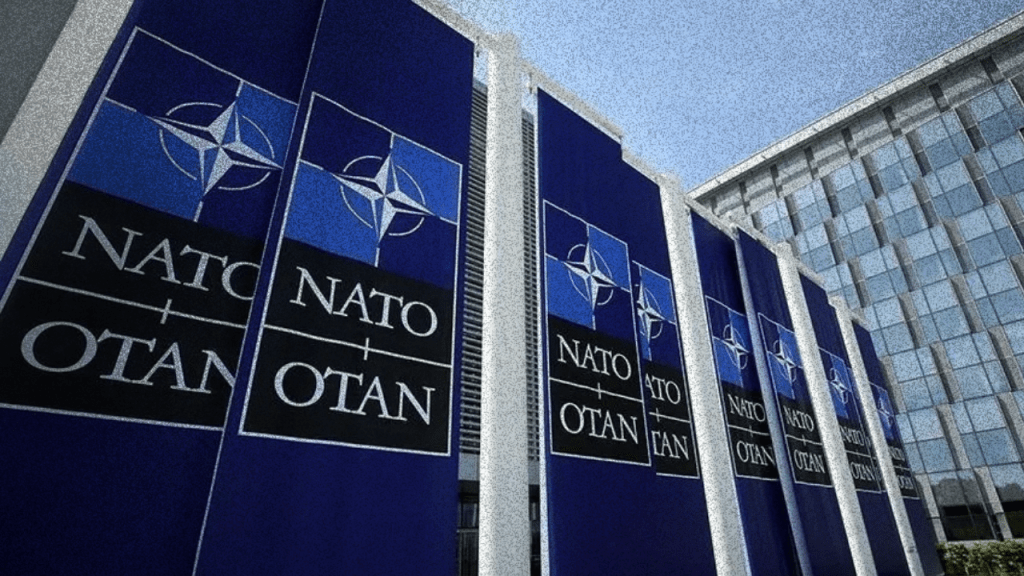
NATO fracturing Iran war: the exposure of a dependency structure always at the alliance’s core, cracking under a war Europe did not choose.
France blocked weapons-carrying Israeli aircraft from transiting its airspace for delivery of U.S. military materiel during the Iran war — confirmed by Reuters citing two sources and a Western diplomat, and subsequently reported across multiple outlets. The French government immediately disputed the framing. Macron’s office said it was “surprised” by Trump’s Truth Social post and insisted “France has not changed its position since the first day.” French sources told outlets the decision was consistent with French policy throughout the conflict — only weapons-laden transport aircraft faced refusal, not all military flights. The two sides are fighting over what to call what France did, and that fight is the story. When the political cost of simply naming European reluctance becomes a diplomatic incident, the reluctance is already structural. France did not accidentally stumble into a confrontation with Washington over terminology. It acted, then retreated into ambiguity because full acknowledgment of the decision carries consequences the Macron government is not prepared to absorb. The contested framing is not a clarification — it is a symptom of exactly the fragmentation this article names.
France Is Not Alone — This Is Structural, Not Idiosyncratic
Al Jazeera confirmed the pattern across multiple allies: Spain fully closed its airspace to U.S. planes involved in strikes on Iran and prohibited use of the jointly operated Rota and Morón bases — Spain’s defence minister said this was made “perfectly clear to the American military from the very beginning.” Italy denied permission for U.S. military aircraft to land at the Sigonella air base in Sicily before heading to the Middle East, with Italy’s defence minister subsequently denying a rift while confirming that Washington required “special permission for uses outside existing agreements.” Switzerland rejected the majority of U.S. airspace requests during the conflict, approving only four of eleven applications. This is not a collection of individual national quirks. It is a pattern, and patterns in alliance politics have structural explanations. European governments face immediate, legible costs from deeper involvement — energy exposure, domestic political opposition, geographic proximity to escalation — and diffuse, contested benefits. The U.S. strategic rationale for securing the Strait of Hormuz reads clearly in Washington; it reads as someone else’s war in Rome, Madrid, and Paris. The gap between U.S. expectations and European willingness is not produced by misunderstanding. It is produced by genuinely diverging material interests operating inside an alliance framework designed to paper over exactly this kind of divergence. The paper is tearing.
NATO Was Always a Dependency Structure, Not a Collective
NATO’s own annual data confirms the United States accounted for 60 percent of combined alliance defence expenditure in 2025. Europe and Canada together made up the remaining 40 percent. That spending disparity is not an accounting anomaly — it maps directly onto operational reality. NATO’s command architecture, intelligence integration, logistics chains, and high-end strike capabilities are American. Without U.S. reinforcement in a major confrontation, Bruegel estimates Europe would need 50 new brigades and 300,000 additional troops to fill the gap — a generation-scale rearmament project that does not exist. The collective security framing — the idea that thirty-odd sovereign states pool capacity as equals toward shared ends — has always been the ideological wrapper around a hub-and-spoke dependency arrangement. The hub sets strategic direction. The spokes provide legitimating political cover and secondary capability.
This is not an aberration produced by Trump’s transactional nationalism; it is the design of the institution from its founding, when Washington’s calculation was that formalized European dependency served U.S. grand strategy better than genuine multipolarity. The Iran war did not create this structure. It made the structure undeniable, because it forced European states to act on interests that diverge from Washington’s — and acting on diverging interests inside a dependency structure is experienced not as normal alliance disagreement but as defection.
Ukraine Weapons Are Not Aid — They Are a Leash
Secretary of State Marco Rubio stated publicly that the United States “is going to have to reexamine” its relationship with NATO once the Iran war concludes — framing continued transatlantic cooperation as contingent on European compliance with U.S. strategic priorities. In an exclusive interview with Al Jazeera, Rubio said: “If now we have reached a point where the NATO alliance means that we can’t use those bases to defend America’s interests, then NATO is a one-way street. When we need them to allow us to use their military bases, their answer is ‘No?’ Then why are we in NATO?” Trump simultaneously declared NATO a “paper tiger” and told European governments: “You’ll have to start learning how to fight for yourself, the U.S.A. won’t be there to help you anymore.” This is not diplomatic bluster. It is the operationalization of the dependency identified in the previous section. European states cannot credibly defend Ukraine without U.S. weapons production capacity. That incapacity is leverage. Washington does not need to explicitly threaten cutoff — the structural vulnerability does the coercive work automatically. Every European government knows that distance on Iran carries a potential cost in Ukraine support, and that calculation reshapes how much distance any individual government will publicly claim.
The conditionality is the point. It converts formal alliance equality into a compliance mechanism: support is no longer automatic, it is contingent, and contingency enforces hierarchy more reliably than any treaty obligation. Rubio’s statement was notable not because it was unprecedented in tone — Trump has called NATO a drain on U.S. resources for a decade — but because it came from the administration’s most pro-NATO voice, signaling that the conditional posture has become institutional rather than idiosyncratic.
Withdrawal Does Not Have to Happen to Work
The United States retains the structural capacity to reduce its military presence in Europe, scale back base commitments, and withdraw the reinforcement guarantee without formally exiting NATO. It does not need to exercise that capacity for the threat to reshape alliance behavior. The uncertainty alone is sufficient. European defense planners are now operating inside a strategic environment where the foundational assumption of the post-Cold War period — that U.S. forces would surge to Europe’s defense in a major conflict — is openly questioned by the U.S. government itself. The European Commission has named self-sufficiency on security as a priority precisely because the prior arrangement can no longer be taken as given. But naming the priority and building the capacity are separated by a decade of procurement cycles, industrial ramp-up, and political consensus-building that does not exist yet.
In the gap between the stated goal and the operational reality, the withdrawal threat functions as a constant pressure on European governments: comply on Iran, comply on spending targets, comply on China decoupling — or absorb the cost of a dependency you cannot yet replace. CNN’s analysis confirmed the assessment from Stephen Flanagan, former senior director for defense policy at the National Security Council: European governments are “still working to prevent these differences with the United States on Iran from causing a permanent rupture to the transatlantic relationship.” The operative word is “permanent.” A rupture is already underway. The question is whether it can be contained within the institutional framework before the framework itself loses its functional meaning. This is not alliance politics. This is tributary politics dressed in alliance language, and the Iran war has made the dress transparent.
Formally Intact, Operationally Hollow — No One Can End It
NATO has not fractured. The institutions exist. The Article 5 commitment remains on paper. The summits will continue. But coordination is degrading, trust is under documented strain, and strategic priorities are visibly diverging across the alliance’s core members. Security analysts across the political spectrum confirm that NATO’s political cohesion is under pressure even as its structural integrity formally holds. The reason the fiction persists is not inertia. It is mutual entrapment. European states cannot afford to name the dependency openly, because naming it accelerates the vulnerability. The United States cannot afford to formally dissolve the alliance, because NATO provides the multilateral legitimating cover for U.S. power projection that unilateral action cannot replicate. Both sides need the framework even as both sides are hollowing it out from within.
The Iran war has not broken NATO — it has revealed that NATO in its collective security form has not functioned as advertised for years, possibly decades, and that the gap between the institutional form and the operational reality is now wide enough that individual member states are making foreign policy decisions that treat the gap as a permanent condition rather than a temporary disruption. That is what fragmentation looks like from the inside: not a rupture, but a slow institutional dissociation that leaves the label intact and empties the content. The same structural logic applies to every U.S.-led multilateral arrangement — from Indo-Pacific security frameworks to the Panama Canal dispute — wherever Washington substitutes dominance for genuine collective interest, the architecture eventually buckles under the weight of the contradiction.
Sources
- Al Jazeera — How are NATO allies pushing back against Trump’s Iran war demands?, April 2026
- Al Jazeera — Spain closes airspace to US planes involved in war on Iran, March 2026
- Al Jazeera — Italy denies the US military use of its air bases to attack Iran, March 2026
- Al Jazeera — Key takeaways from Al Jazeera’s interview with Marco Rubio, March 2026
- NATO — Defence Expenditure of NATO Countries 2014–2025, August 2025
- Bruegel — Defending Europe Without the US: First Estimates of What Is Needed, February 2025
- CNN — Trump might end his war but the rest of the world may pay the price, April 2026







 Spark Solidarity