
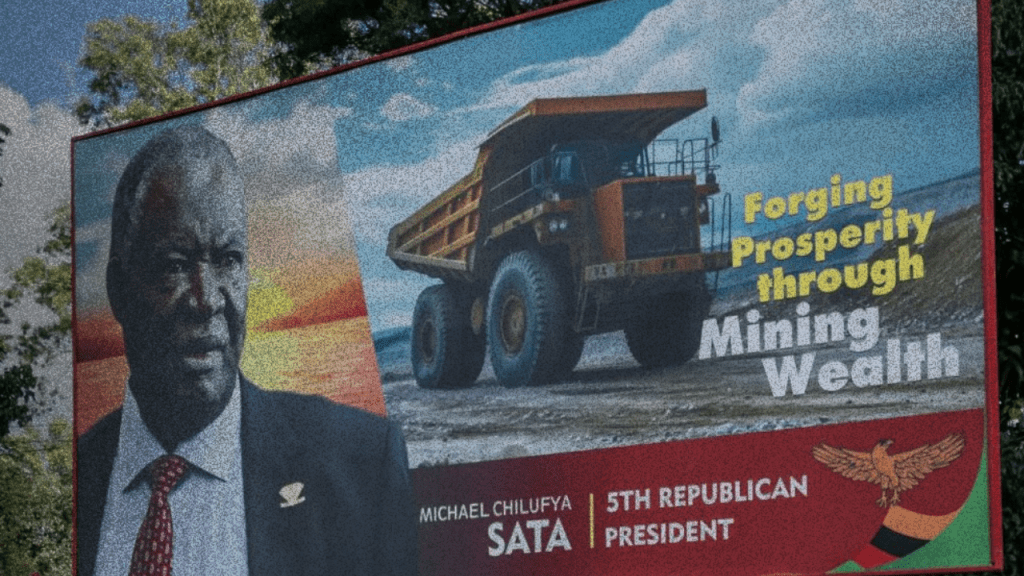
PEPFAR Zambia minerals: Washington has made HIV treatment a bargaining chip for mineral rights — a structural crossing that changes what U.S. aid is.
A Leaked Memo Exposes What U.S. Diplomacy Has Become
This is not a rumour circulating in diplomatic corridors. A draft State Department memo prepared for Secretary of State Marco Rubio spelled it out in writing: the United States would “demonstrate willingness to publicly take support away from Zambia on a massive scale” unless Zambian officials agreed to concessions on critical mineral access. Washington’s ask was specific — preferential access to Zambia’s mineral sector in exchange for $1 billion in PEPFAR funding over five years, contingent on Zambia co-financing $340 million in new health spending and signing a decade-long data-sharing agreement. The proposed deal is less than half the health assistance Zambia received before the Trump administration took office. When Zambian officials did not immediately sign, the memo made the threat explicit. The conditionality was not implied or inferred. It was drafted, formatted, and submitted for a cabinet-level briefing.
The significance of that document is not just its content. It is that it exists at all. State Department planning memos do not get written for hypotheticals. They get written when a course of action has enough institutional support to require formal coordination. The memo was prepared by the Zambia desk in the Africa Bureau, circulated among, and approved by, a number of officials informing the U.S. side of the negotiations. That is the baseline from which analysis must proceed — not whether this represents a departure from American values, but what institutional structure produced it and what it tells us about where U.S. foreign policy is materially headed.
PEPFAR Always Had Conditions — None Were About Mining
The United States has attached conditions to PEPFAR funding since the program’s original authorization. Recipient governments have been required to meet domestic co-financing thresholds, share epidemiological data, submit to program audits, and comply with treatment spending directives. More recently, governments have been asked to provide biological samples and pathogen data for U.S. research purposes. Across the African continent, more than a dozen countries have signed memorandums of understanding with Washington since late 2025 under this framework. In most cases the main requirement is that recipient governments commit to increasing their own health spending. These demands were controversial, and in several cases coercive in their own right. But they shared a structural feature: every condition operated within the health domain.
The Zambia case eliminates that categorical alignment. The condition attached to HIV treatment funding has nothing to do with HIV treatment. It is a demand for preferential access to copper and critical mineral supply chains. That is not a tightening of existing conditionality — it is a structural crossing of categories that changes what PEPFAR is. As Al Jazeera reported: “Data or mineral demands in return for health aid are unprecedented in the history of the US, which is Africa’s largest health assistance provider.” A program framed for two decades as a humanitarian commitment becomes, through this move, a cross-sector instrument of economic coercion. The rupture is not in the degree of pressure applied. It is in the architecture of the instrument itself.
Why Washington Reached for PEPFAR to Fight China in Zambia
Washington did not develop an interest in Zambian copper in a vacuum. Over 600 Chinese firms have invested more than $3.5 billion in Zambia’s Copperbelt Province, and Chinese state enterprise China Nonferrous Metal Mining Group has operated there since 1998 — making it China’s oldest African mining operation. Copper accounts for approximately 70 percent of Zambia’s total export earnings. Chinese infrastructure financing, processing facilities, and long-term offtake agreements have given Beijing an entrenched structural position in a sector Washington now considers strategically essential for electric vehicles, semiconductors, and defense technology. As the Observer Research Foundation documented, the U.S. cannot displace that position through conventional investment competition in the short term — it lacks the state-directed capital deployment capacity, the bilateral relationships, and the infrastructure presence to match what China has already built on the ground.
What Washington does have is PEPFAR. And so it used it. The logic is not irrational from within a great-power competition framework — it is the application of available leverage in a sector where conventional tools have failed. Understanding this dynamic is precisely why the distinction between Chinese and U.S. capital export in Africa matters analytically. China’s Copperbelt presence is state-directed investment building productive capacity; the U.S. response is to threaten to cut 1.3 million people’s HIV treatment if Zambia does not redirect that capacity toward Washington’s supply chain priorities. Those are not equivalent strategies. One is development financing. The other is coercion backed by a mortality threat.
The Mineral Wealth and the PEPFAR Dependence Are One Trap
Zambia’s exposure here is not a coincidence of geography and disease burden. It is the mechanism of the coercion. The country’s mineral wealth is what made it a target. Its population’s dependence on PEPFAR funding — over 80 percent of Zambia’s HIV program financing flows through the program, sustaining free treatment for 1.3 million people, approximately six percent of the population — is what made that pressure applicable. Strip either variable and the coercive logic collapses. A country without strategic mineral assets would not receive this kind of attention. A country with mineral assets but no PEPFAR dependence would have no vulnerability to exploit. Zambia has both, which is why it sits at the precise intersection where the new architecture of U.S. aid weaponization becomes operational.
The human stakes of that architecture are not abstract. PEPFAR interruptions do not simply reduce service levels. They produce treatment gaps that drive viral rebound, increase transmission, and generate preventable mortality. The people most exposed to those outcomes are not Zambian government officials weighing mineral concession agreements. They are patients on antiretroviral regimens whose continued suppression depends on uninterrupted supply. Washington’s leverage is real precisely because the consequences of exercising it fall on a population with no agency in the negotiation. The threat works because the people who die when PEPFAR is cut are not the people making decisions about copper contracts. That is not a side effect of the coercive strategy. It is the coercive strategy.
The Precedent Is the Point and Every Country Now Knows It
Whether Zambia ultimately signs a mineral access agreement with Washington is, at this level of analysis, secondary. The template has been activated. A State Department memo has formally connected health aid to mineral extraction, and as Health GAP confirmed, Zambia’s MOU text is “the first we know of that explicitly ties exploitation of mineral wealth” with PEPFAR conditionality. The memo warned explicitly that Zambia “could not be allowed to backtrack because other countries are watching.” That framing is the point — the coercion is designed to be observed. No future U.S. administration conducting aid negotiations with a resource-rich African government will be unaware that this instrument exists and was deployed. No recipient government will be able to treat its PEPFAR funding as categorically insulated from resource policy demands.
This is the structural endpoint of a longer trajectory. U.S. foreign aid has never been purely humanitarian — the historical record of the IMF and World Bank attaching structural adjustment conditions to development financing establishes the baseline clearly. But PEPFAR occupied a specific institutional position as a bipartisan humanitarian success story, insulated from the cruder instruments of U.S. economic statecraft. That insulation has now been formally breached. The broader global reorientation away from U.S.-dominated multilateral institutions accelerates precisely as Washington demonstrates that its humanitarian commitments are conditional on geopolitical compliance. Every country now evaluating its relationship to U.S. aid programs is doing so in the light of what the Zambia memo revealed: the humanitarian commitment lasts exactly as long as Washington has no better leverage available.








 Spark Solidarity