US Iran uranium raid planning reveals not military capability but its absence — the search for a breakthrough dressed as bold action.
The Plan Is Not a Strike — It Is a Temporary Occupation
The proposal circulating in U.S. military and political circles calls for special operations forces to infiltrate Iranian territory, secure hardened underground nuclear sites, excavate highly enriched uranium stockpiles, construct a runway capable of handling cargo aircraft, and extract the material before Iranian forces can mount a decisive response. The Washington Post confirmed the operation was briefed to Trump at his request — and that it would require flying in excavation equipment and building out extraction infrastructure, a logistics profile that has nothing in common with a surgical strike and everything in common with a temporary military occupation. Foreign Policy confirmed that military analysts estimate the operation could require more than 1,000 special forces personnel, supported by engineering units tasked with navigating debris, mines, and potential booby traps inside damaged but structurally intact tunnel systems. Defense planners estimate the operation could take weeks to months on the ground. The framing of precision and speed is not a description of what the plan involves. It is a marketing decision. What the plan actually involves is sustained site control in one of the most heavily surveilled and defended operational environments in the region, with no margin for the compounding failures that multi-stage operations inside hostile territory reliably produce.
Fordow Was Built Specifically to Defeat This Operation
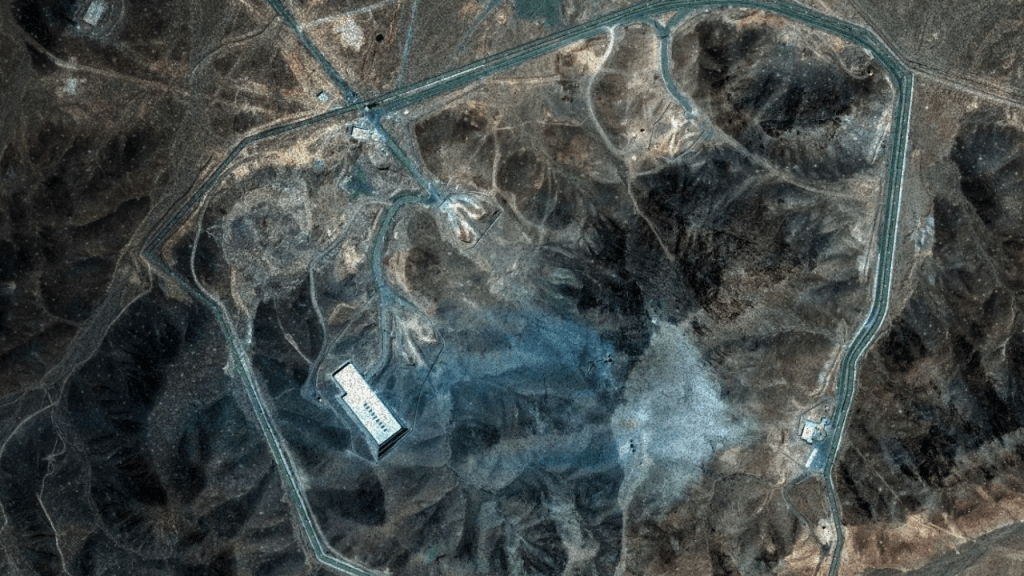
The Fordow Fuel Enrichment Plant near Qom sits beneath approximately 80 to 90 metres of hard rock inside a mountainous formation, protected by reinforced blast doors. CNN confirmed the main halls are believed to be 80 to 90 metres below ground — and that even after June 2025 U.S. strikes using 12 Massive Ordnance Penetrators, the uranium stockpile was not destroyed. The material is now believed to be buried under layers of rubble and reinforced underground infrastructure, in some areas more than 90 metres deep. Former nuclear weapons inspector David Albright confirmed to PBS NewsHour that anyone entering the tunnels to retrieve canisters would need hazmat suits and would have to maintain precise distances between canisters to prevent a self-sustaining critical nuclear reaction. The physical environment does not merely complicate the operational concept — it renders it incoherent. The excavation required is not a secondary logistical challenge. It is the mission. And the mission requires weeks of exposed presence inside a fortified site that was engineered, from its inception, to deny exactly this scenario. Prior strikes hardened the problem rather than solving it.
Iran Has Already Watched This Movie — the U.S. Has Too
On April 24, 1980, the U.S. military launched Operation Eagle Claw — a special operations mission to rescue 53 embassy staff held inside Iran. No hostages were rescued. Eight Americans died. Iran broadcast images of burned and abandoned U.S. helicopters to the world. The mission’s failure exposed structural deficiencies in U.S. special operations command so severe that it directly produced the creation of SOCOM. Analysts covering the current uranium raid proposal are already invoking that precedent explicitly — former U.S. defense officials told the BBC that removing the uranium stockpile would be one of the “most complicated special operations in history,” with “a million things” that could go wrong. This is not a speculative warning about what could go wrong. It is a documented pattern of what does go wrong when U.S. special operations enter Iranian territory under conditions of strategic pressure and political urgency. Iran has spent the four decades since Eagle Claw building a defensive architecture calibrated to this exact threat vector. The assumption of operational ease is not contradicted by the possibility of failure. It is contradicted by the historical record of failure already on file.
Successful Extraction Leaves Iran’s Nuclear Capacity Intact
The operational logic of the raid assumes that removing the stockpile removes the threat. IAEA Director-General Grossi disposed of that assumption directly, stating that Iran has “the capabilities, the knowledge, the industrial ability” to reconstitute — and that “a lot still has survived.” The Bulletin of the Atomic Scientists confirmed the structural limitation: “knowledge is a permanent asset.” Iran maintained advanced centrifuges in dispersed facilities, and thousands of scientists whose accumulated expertise is not stored in canisters. The Arms Control Association concluded that Iran “will retain the knowledge — and likely some of the key materials — necessary to develop and build nuclear weapons” regardless of what extraction achieves. Removing a stockpile disrupts a program temporarily. It does not end the knowledge base, decommission the centrifuges, or dissolve the institutional capacity that produced the enrichment in the first place. The raid’s best-case outcome is a temporary setback to a program that reconstitutes. Its worst-case outcome is escalation without resolution. Neither outcome changes the underlying strategic equation. That is not a secondary limitation of the plan. It is the plan’s fundamental incoherence stated in technical terms.
The Raid Is Built to Look Decisive, Not to Be Decisive
When conventional strategic options are exhausted, the political pressure to produce visible action does not disappear — it intensifies. The uranium raid offers something that a negotiated settlement, a sustained siege, or an acknowledgment of strategic limits cannot: a defined objective, a dramatic image, a narrative of control. The operation would look like victory in a way that a grinding, unresolved conflict does not. That appearance is the point. The production of visible decisive action is a core instrument of imperial statecraft — not a supplement to strategy but, at the point of strategic failure, a substitute for it. The raid is not being seriously considered because planners believe it will resolve the conflict. It is being seriously considered because the conflict cannot be resolved by other means, and the domestic and international political cost of visible inaction has become unsustainable. The operation is built for the coverage of its execution, not for the durability of its outcome. It would look decisive. It would not be decisive.
Tactical Fantasy Is the Product of Strategic Failure
The uranium raid does not exist in isolation. It exists as a symptom. Wars without clear objectives and viable paths to conclusion reliably produce proposals of this kind — singular acts designed to change everything, offered as substitutes for the coherent endgame that political leadership cannot construct. The same dynamic that produced the manufactured pretexts around the Panama Canal is operating here: when imperial power cannot achieve its stated objectives through conventional means, it reaches for spectacular action that performs capability while concealing its absence. Tactical ingenuity cannot compensate for strategic absence. A successful extraction — operationally, against all evidence — does not create an exit from the conflict. It does not resolve the underlying dynamics that produced the conflict. It does not answer the question of what comes next. It produces a moment. The war continues. Iran’s centrifuges continue. Iran’s scientists continue. The search for the next singular act that changes everything begins again. That cycle is not a failure of imagination or execution. It is the structural condition of a power that has reached the limits of what force can accomplish but retains both the capacity and the political compulsion to keep using it anyway.
Sources
- Washington Post — Risky commando plan to seize Iran’s uranium came at Trump’s request, April 2026
- Washington Post — Securing Iran’s enriched uranium by force would be risky and complex, April 2026
- Foreign Policy — What a U.S. operation to get Iran’s uranium would look like, April 2026
- PBS NewsHour — Securing Iran’s enriched uranium by force would be risky and complex, April 2026
- Bulletin of the Atomic Scientists — Trump may send US troops to neutralize Iran’s HEU; there are no good options, March 2026
- Arms Control Association — Did Iran’s Nuclear and Missile Programs Pose an Imminent Threat? No., March 2026
- Axios — U.S. weighs sending special forces to seize Iran’s nuclear stockpile, March 2026
- CNN — How badly have US strikes damaged Iran’s nuclear facilities?, June 2025
- Britannica — Operation Eagle Claw