
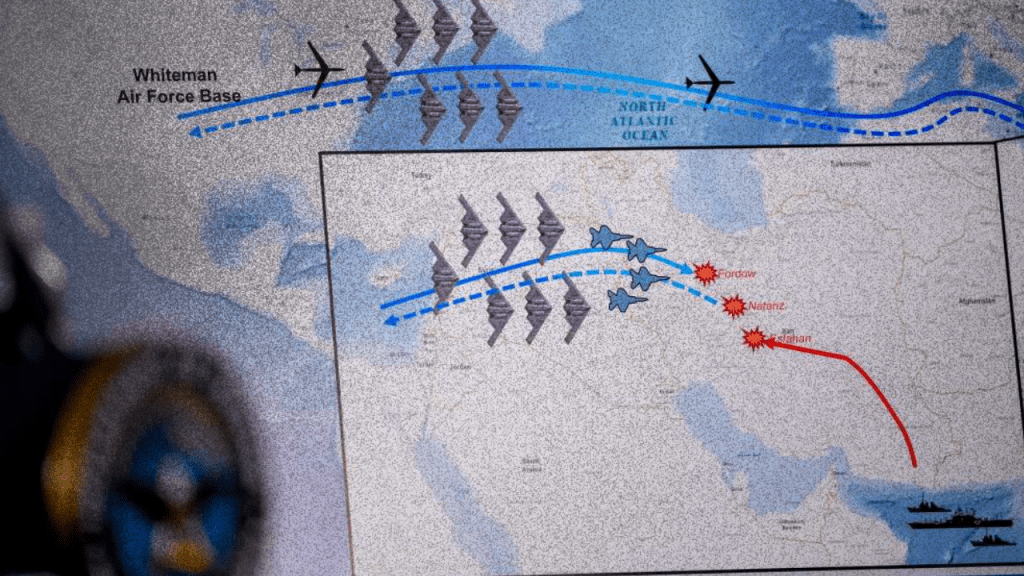
US Iran nuclear escalation is not a policy choice — four weeks of Operation Epic Fury have eliminated every off-ramp below the catastrophic threshold.
Four Weeks of Strikes Have Confirmed the Stalemate
The most alarming development in the US-Iran war is not what has been done. It is what is now being openly discussed. Nuclear weapons have migrated from the unthinkable column into the plausible one — not because decision-makers are uniquely reckless, but because the structural conditions of this conflict have closed off every other terminus. The piece that follows is not about a single decision, a miscalculation, or an impulsive executive. It is about what happens when a war is launched without a diplomatic framework, without a clear and achievable objective, and without a conventional military instrument capable of producing the outcome demanded. Under those conditions, escalation is not a risk to be managed. It is the only direction the system permits.
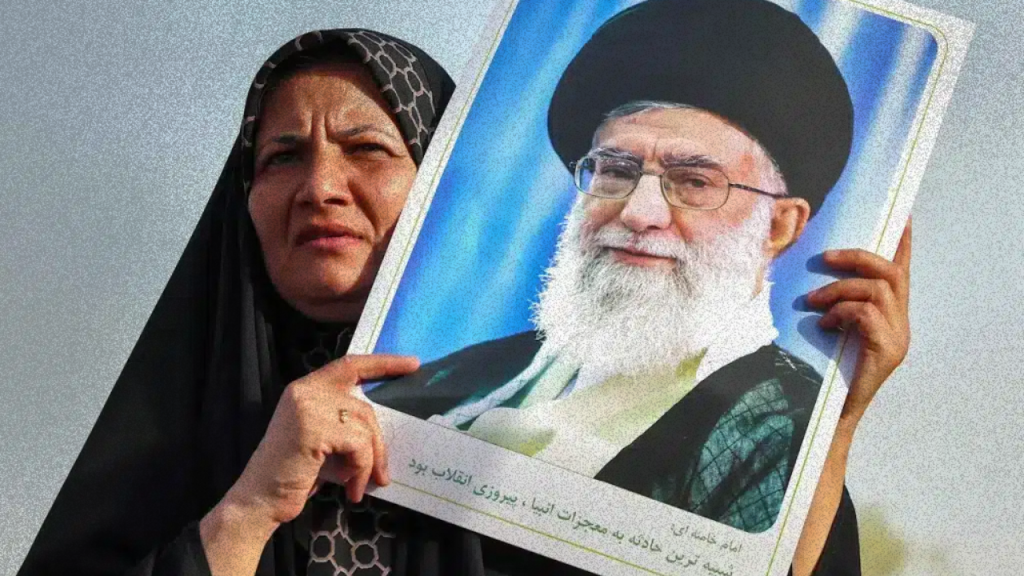
Operation Epic Fury has now run for more than four weeks. The results are in, and they do not support the strategic logic that launched the campaign. CSIS confirmed the core assessment: Iranian military capacity has been degraded — its missile capability severely curtailed, its navy destroyed, its nuclear facilities hit again — and yet the Iranian government has not collapsed, has not sued for terms, and maintains de facto control over the Strait of Hormuz. The regime has installed a new Supreme Leader and the IRGC is consolidating power. The effects of the strikes are real but fall short of achieving the more ambitious U.S. goals. Iran, CSIS notes, “believes, probably correctly, that if it can survive the bombing, it can achieve many of these goals.” This is not a temporary lag before decisive results materialize. It is the structural ceiling of the instrument being used.
Air Power’s Ceiling Is Built Into Air Power Itself
The US has relied overwhelmingly on air strikes because air power offers the specific political advantage of force projection without occupation costs. It looks decisive. It produces footage. It degrades hardware. What it cannot do is eliminate knowledge, disperse materials already dispersed, or address the strategic calculation that drives Iranian behavior in the first place. As LSE researchers documented: while Operation Epic Fury may physically delay a program, it is also likely to intensify nuclear ambition. When a state is actually struck, the “shadow of military force” is no longer a shadow — it is a reality. This removes the incentive for nuclear reversal negotiations and replaces it with a desperate need for a completed deterrent to prevent a further strike.
Iran retains asymmetric reach throughout the region, the capacity to target shipping in the Strait of Hormuz, and a proxy network that extends the conflict outward without requiring a symmetric military response. Each US strike generates the political and strategic justification for an Iranian counter-move, which then justifies the next US strike. The cycle is self-sustaining. It produces intensity without resolution. CSIS confirmed that despite extensive targeting of nuclear sites, Iran still possesses approximately 400 kilograms of highly enriched uranium at 60 percent, and the exact location of that material remains unknown. Air power’s structural role in this conflict is not to end it — it is to escalate it incrementally while the administration searches for a pressure point that doesn’t exist. The question of what comes next is where the escalation ladder becomes visible.
Ground War Is Off the Table for the Same Reason It’s on It
The logic that makes a ground invasion conceivable is identical to the logic that makes it strategically self-defeating. Iran’s geography — mountainous, vast, populated by a state with demonstrated capacity for asymmetric warfare — means that an invading force can seize terrain it cannot hold against a population it cannot pacify. The lessons of Iraq and Afghanistan are not abstract cautionary tales — they are the living political constraint on any administration that floats the option domestically. Iran cannot defeat the United States on the ground, but it can defeat the US politically at home, through the attrition that has ended every American land war in the region since 2003.
CSIS’s analysis of available options makes the structural trap explicit: securing Iran’s enriched uranium stockpile — the war’s most critical objective — would require ground forces, and even those face fundamental limits. Previous strikes already tested the upper limits of bunker-busting technology against Fordow and Natanz. Iran’s nuclear material is likely buried deep in underground facilities, and direct hits may only entomb it rather than destroy it. The decisive conventional option is therefore not merely politically prohibited — it is strategically useless for the stated objective. With air power insufficient and ground war self-defeating, the escalation ladder’s intermediate rungs have been stripped. What remains above them is the question the next section addresses directly. This dynamic is not unique to Iran: it is the same structural logic of coercion through available tools that produces imperial overreach wherever conventional options run out.
Escalation Dominance Requires Options the War Has Removed
US military doctrine has operated for decades on the premise of escalation dominance: the capacity to match or overmatch an adversary at every rung of the conflict ladder, thereby controlling outcomes. The doctrine assumes a full ladder. It assumes that at each stage, a viable option exists that can either resolve the conflict or credibly threaten to if the adversary doesn’t comply. That assumption is the doctrine’s load-bearing wall, and this conflict has knocked it out. When the intermediate rungs are gone — when air power can’t resolve and ground war can’t be sustained — dominance no longer means control over outcomes. It means the capacity to worsen them.
The other side of this dynamic is visible in Iran’s Hormuz strategy. As Al Jazeera reported, the closure of the Strait of Hormuz — through which roughly one-fifth of global oil and gas supplies transit — has produced the largest energy supply disruption since the 1970s energy crisis. Tehran’s deterrence operates precisely through this chokepoint: the threat of even intermittent attacks can trigger geoeconomic disruption and halt traffic through a waterway that powers the global economy. Iran’s strategy is attrition: survival is the victory condition, not battlefield success. The US doctrine of escalation dominance collides with an adversary for whom outlasting the escalation is the goal. The result is not a stable deterrence equilibrium. It is a dynamic in which US capacity to escalate accelerates movement toward the ladder’s upper end. Understanding how great-power competition actually operates — through leverage, proxy enablement, and the weaponization of economic dependencies — makes this dynamic legible. The US expected Iran to break. Iran expected to survive. Only one of those expectations has been validated by four weeks of war.
Nuclear Weapons Are the Terminus the Structure Has Produced
Nuclear weapons have entered this conflict’s conversation not as a symptom of recklessness but as the logical output of the structure described above. The Arms Control Association stated before the strikes began that another wave of attacks on Iran would “strengthen the argument inside Iran that only possessing nuclear weapons can protect the state.” That argument is now being made in real time, in rubble. IAEA Director General Grossi confirmed on March 2 that there was “no structured program to manufacture nuclear weapons” at the time of the strikes — meaning the war was not launched to stop an imminent nuclear threat. It was launched against a non-nuclear state that is now receiving the strongest possible argument for becoming one.
The calculus shift is the critical story. As LSE analysis confirmed, Iran maintained strategic ambiguity for years — staying just below the threshold to avoid the very strikes that have now occurred. That virtual deterrent strategy failed to prevent a decapitation strike. Tehran’s new leadership now faces a grim calculation: while the pursuit of nuclear weapons was dangerous, having an unfinished bomb was the fatal mistake. By framing the war’s justification around nuclear prevention, the Trump administration has ensured that the war’s resolution must also carry a nuclear answer. There is no victory condition that doesn’t involve the nuclear question, which means there is no exit that doesn’t run through it. The management of this conflict as a story of Iranian aggression obscures this structural terminus — which is, as always, the point. This is not a warning about where the conflict might go. It is a description of where the structure has already arrived.
Sources
- CSIS — Who Is Winning the Iran War?, April 2026
- CSIS — Operation Epic Fury and the Remnants of Iran’s Nuclear Program, March 2026
- CSIS — Options for the United States to Resolve the Iran Nuclear Challenge, April 2026
- Al Jazeera — How US-Israel attacks on Iran threaten the Strait of Hormuz, oil markets, March 2026
- LSE — US Strikes May Have Turned Iran Into a State With a Nuclear Grievance, March 2026
- Arms Control Association — Trump’s Chaotic and Reckless Iran Nuclear Policy, February 2026
- Arms Control Association — Did Iran’s Nuclear and Missile Programs Pose an Imminent Threat? No., March 2026





 Spark Solidarity