
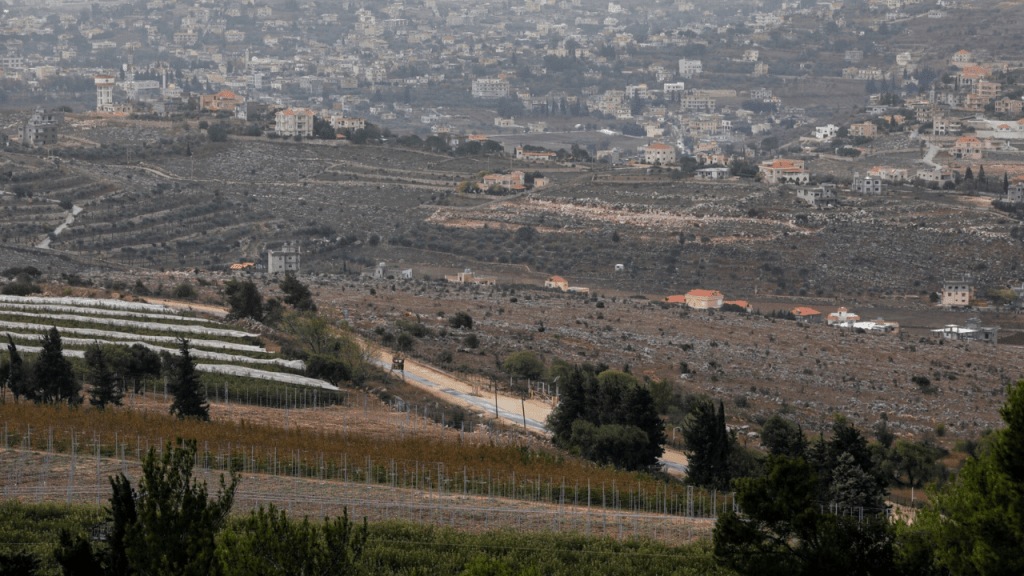
Israel Lebanon occupation: over one million displaced — not as side effect but as operational logic, backed by U.S. weapons and diplomatic cover.
Depopulation Is the Operation, Not the Consequence
Since March 2, 2026, Israel has issued sweeping displacement orders across southern Lebanon, the Bekaa Valley, and Beirut’s southern suburbs. Al Jazeera’s verified mapping confirmed more than 100 towns and villages under forced evacuation orders covering 14 percent of Lebanon’s territory — nearly one-fifth of the entire population displaced. The orders were not targeted at specific military positions. They covered entire regions. The Israeli military’s own language made the logic explicit: “Where there is terror and missiles, there will be no homes and no residents.” The expansion of displacement orders from the Litani River north to the Zahrani River — 40 kilometres from the Israeli border — makes area clearance the operational objective, not a side effect of it.
Al Jazeera verified the destruction of every major bridge crossing the Litani River — the Qasmiyeh, Coastal Highway, Khardali, and Zaraiya-Tirseflay bridges — making the cleared zone physically unreachable for those displaced. This is what displacement-as-strategy looks like in practice. The civilian population is not caught between combatants. The civilian population is the terrain. Remove them, sever the bridges, render the villages uninhabitable, and the military problem of controlling southern Lebanon becomes a logistics problem instead. That reframing — from security operation to territorial transformation — is the foundation of everything that follows.
The Security Zone Is the Annexation
Once the territory is cleared, the question of what Israel does with it has already been answered. Al Jazeera reported Defense Minister Katz’s statement verbatim: “At the end of the operation, the IDF will establish itself in a security zone inside Lebanon… and will maintain security control over the entire area up to the Litani River.” More than 600,000 residents are barred from returning until an undetermined standard of Israeli security is met — meaning indefinitely. UN Under-Secretary-General Tom Fletcher asked the Security Council directly: “Given the trajectory that some Israeli ministers have described and given what we have seen in plain sight in Gaza, how will you protect civilians?” The Council produced no answer.
The zone would cover nearly one-tenth of Lebanese territory. De facto control over movement, return, infrastructure access, and the physical ground is not a step toward annexation. It is annexation by operational reality. The legal declaration is a trailing indicator — a formalization of something already accomplished on the ground. The formal/informal distinction collapses the moment you control who goes where. This mechanism has a prior iteration the West prefers not to cite: Israel occupied a southern Lebanon “security zone” from 1978 to 2000, requiring armed resistance to dislodge. Al Jazeera confirmed Netanyahu is explicitly framing the current operation as replicating the “Gaza model” of occupation. The pattern is not new. The scale is.
Smotrich Names What Katz Is Already Building
On March 23, 2026, Finance Minister Bezalel Smotrich gave an interview making the territorial claim explicit. Al Jazeera confirmed his exact words: “The bombardment of Lebanon needs to end with a different reality entirely, which includes a change of Israel’s borders. The new Israeli border must be the Litani.” Democracy Now! confirmed that Katz simultaneously declared his forces would establish a security zone stretching to the Litani, cutting off Lebanon’s south from the rest of the country. Netanyahu’s office made no comment. That silence is the answer.
Western coverage frames Smotrich as an outlier — a far-right provocateur operating beyond official Israeli policy. That framing inverts the actual relationship. Smotrich is not proposing something the Defense Ministry opposes. He is naming in political language what the Defense Ministry is constructing in military facts. The de facto security zone up to the Litani already exists as a declared Israeli objective. Smotrich’s contribution is to strip the procedural language and state the territorial claim openly. When the Defense Minister and the Finance Minister are describing the same geography using different vocabularies, calling one of them a fringe actor is not political analysis. It is narrative management designed to preserve the fiction of a moderate center that the military facts have already abandoned.
Ninety Thousand Tons: The U.S. Role Is Structural
This campaign does not sustain itself. Since October 7, 2023, the United States has provided at least $16.3 billion in direct military aid to Israel across three pieces of legislation, including an $8.7 billion supplemental appropriations act in April 2024. By May 2025, the Israeli Defense Ministry reported the U.S. had delivered 90,000 tons of arms and equipment on 800 transport planes and 140 ships — tank and artillery ammunition, bombs, rockets, and small arms. The Costs of War Project at Brown University concluded that the Israeli military “could not have done the damage they have done in Gaza or escalated their military activities throughout the region without U.S. financing, weapons, and political support.”
The accountability dimension is equally structural. In February 2025, the Trump administration rescinded NSM-20 — the memo requiring congressional reporting on how U.S. weapons provided to Israel are used. The instrument that would produce inconvenient documentation was removed by executive action. U.S. diplomatic cover at the Security Council performs the same function: vetoing ceasefire resolutions signals to every actor in the region that the rules do not apply here, which shapes the operational environment for everything Israel does next.
The U.S. and Israel are not separate actors with aligned interests. They are functionally integrated components of a single strategic apparatus in the region. Understanding the Lebanon campaign without that integration is like analyzing a manufacturing process while ignoring who owns the factory. The diaspora and civil society networks that provide political cover in Western capitals complete the circuit — the military hardware, the diplomatic veto, and the narrative infrastructure all serve the same territorial project.
The Strategy Produces What It Claims to Prevent
The internal logic of this project carries a structural contradiction it cannot resolve. Displacement generates dispossession. Dispossession generates organized resistance. Israel’s 22-year occupation of southern Lebanon from 1978 to 2000 did not produce a pacified buffer zone — it produced Hezbollah as a mass political and military organization rooted precisely in the population that occupation displaced and humiliated. The current campaign reproduces the causal sequence at greater scale with a more thoroughly cleared baseline, which means the dispossession is deeper, and the political conditions for reconstituted resistance are stronger, not weaker. Al Jazeera’s correspondent in Tyre reported Hezbollah’s explicit strategic response: “They know the imbalance of power. They are not going to be able to stop this invasion, and the Israeli army will most likely reach until the Litani River, but they will not make it easy for them to consolidate control.”
Control achieved through mass displacement requires constant military maintenance. It does not neutralize the source of resistance — it relocates and concentrates it. The 600,000 people barred from returning to the Litani zone do not cease to exist politically because they have been displaced. They become a refugee population with a specific, legible grievance about a specific piece of territory that Israeli forces are physically occupying. That is not a hard political problem to organize around. Regional fragmentation — weakened neighboring states, displaced populations, destroyed infrastructure — does not produce a manageable security environment. It produces a landscape where the actors capable of exploiting instability proliferate and the diplomatic tools for managing conflict atrophy.
What is being constructed in southern Lebanon is not a stable order. It is a volatile one that requires permanent military commitment to maintain, generates the political conditions for escalating resistance, and locks in the regional dynamics that make large-scale conflict more likely. The strategy trades a tractable military problem for an intractable political one — and does so with the full material and diplomatic support of the most powerful state on earth. That combination does not produce security. It produces the permanent condition of its own necessity.
Sources
- Al Jazeera — From Iran to Lebanon: four million people displaced by US-Israeli war, March 2026
- Al Jazeera — UN aid chief warns of new Israeli occupation in southern Lebanon, March 2026
- Al Jazeera — Netanyahu orders military to expand invasion of southern Lebanon, March 2026
- Al Jazeera — Smotrich urges Israel to annex southern Lebanon as assault intensifies, March 2026
- Al Jazeera — Israel says four soldiers killed as army pushes deeper into south Lebanon, March 2026
- Democracy Now! — Israeli Finance Minister Smotrich Calls for Annexation of Southern Lebanon, March 2026
- Council on Foreign Relations — U.S. Aid to Israel in Four Charts
- Costs of War Project, Brown University — U.S. Military Aid and Arms Transfers to Israel, October 2023–September 2025




 Spark Solidarity