
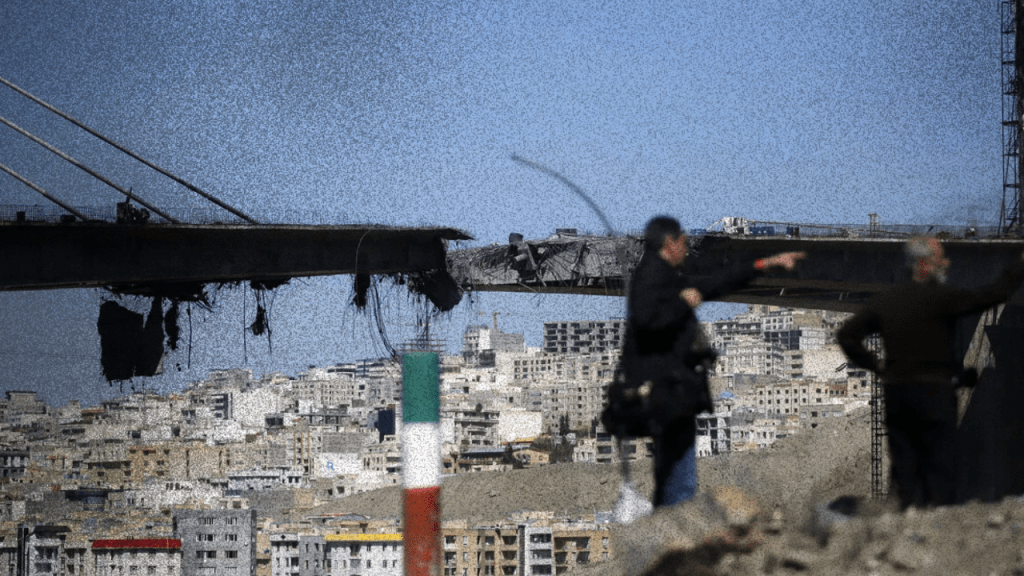
Iran infrastructure war economy: the IRGC named Apple, Google, and Meta as retaliation targets — confirming what the AWS strikes already proved.
The IRGC Named the Corporations, Not the Soldiers
In early April 2026, the Islamic Revolutionary Guard Corps published a list of 18 retaliation targets through its Telegram channel and the semi-official Tasnim news service. Eighteen targets. Not a military base. Not a naval asset. Apple. Google. Meta. Nvidia. Palantir. JPMorgan. Boeing. The IRGC framed these companies as “the main element in designing and tracking terror targets” — meaning U.S. and Israeli assassination operations against Iranian leadership run on commercial technology infrastructure. That framing is not propaganda. It is a precise operational assessment. The platforms that serve billions of users for messaging, search, and commerce are the same platforms through which targeting data moves, through which drone operations are coordinated, through which the architecture of assassination is maintained. The IRGC did not threaten corporations to make a symbolic point. It threatened them because they are load-bearing nodes in the system conducting the war against Iran.
Western coverage processed this as irrational escalation — Iran targeting civilian infrastructure. That framing inverts the sequence. The United States and Israel have spent years assassinating Iranian scientists, military commanders, and nuclear officials. Those operations depend on commercial AI and data infrastructure. Iran identified the dependency and named it. That is not irrationality. That is strategic clarity about how modern warfare actually functions — and it forces a question the Western framing is designed to prevent: if assassination logistics run on commercial platforms, what exactly is the civilian/military distinction defending?
The Commercial-Military Merger Was Already Functional
The IRGC’s targeting list did not create the merger between commercial technology and military operations. It identified one that was already structurally complete. Palantir’s chief technology officer described this conflict to Bloomberg in late March as the first major war driven by AI — not metaphorically, but operationally. The Joint Warfighting Cloud Capability and Joint All-Domain Command and Control networks the Pentagon uses to coordinate strikes run on the same commercial cloud infrastructure that processes bank transactions and delivery app orders. James Henderson, CEO of risk firm Healix, told CNBC: “Tech assets are now treated as part of the conflict, not peripheral to it.” He added that future crises will target data centers and cloud platforms as readily as traditional strategic sites. This is not a prediction. It is a description of what had already happened weeks before the IRGC published its list.
The political economy logic is not complicated. Decades of privatization and outsourcing converted state military logistics into dependency on commercial infrastructure. The Pentagon did not build its own cloud — it contracted Amazon. It did not build its own AI targeting pipeline — it contracted Palantir, Google, and Microsoft. When military power is exercised through commercial platforms, those platforms become military infrastructure. The IRGC’s list is the consequence of decisions made in Washington boardrooms over the past thirty years, not a departure from the rules of war.
The Strikes on AWS Proved It Before the Threat Was Issued
The declaration matters less than what preceded it. On March 1, 2026, Iranian drones struck three Amazon Web Services data centers — two in the UAE, one in Bahrain. AWS confirmed structural damage, disrupted power delivery, and fire suppression water damage. Two of the UAE region’s three availability zones went offline simultaneously. Banking applications failed across the Gulf — Emirates NBD, First Abu Dhabi Bank, Abu Dhabi Commercial Bank all reported disruptions. Payment systems Alaan and Hubpay went down. Delivery and ride-hailing platform Careem went down. Enterprise software services across the region went dark. As Fortune confirmed, the IRGC explicitly claimed responsibility, citing AWS as hosting AI systems being used by the U.S. military for intelligence analysis and war simulations. The data centers were not collateral damage. They were the target.
Researchers at Georgia Tech concluded that the events had resolved a debate already underway: cloud infrastructure cannot continue to be governed as a commercial utility. It must be governed as a strategic asset at the intersection of economic power and conflict. That conclusion is correct but incomplete. It treats the vulnerability as a governance problem to be fixed. The actual situation is that no governance framework resolves the contradiction — because the contradiction is structural. The U.S. military chose to build its warfighting capacity on privatized commercial infrastructure. That choice cannot be undone by reclassifying the infrastructure afterward. The merger is permanent, and its costs now fall on every civilian population connected to those systems.
The Strait Closure Lands on Civilians, Not on Governments
The AWS strikes are one node in a wider system of economic warfare now operating at full integration. The Strait of Hormuz disruption is the other. Fortune’s analysis confirmed that seventeen submarine cables pass through the Red Sea, carrying the majority of data traffic between Europe, Asia, and Africa — and with Iran’s closure of the Strait of Hormuz and renewed Houthi threats in the Red Sea, both critical data and energy choke points are now in active conflict zones simultaneously. The IEA’s characterization of the Strait closure as the largest supply disruption in the history of the global oil market understates the scope. Oil is one commodity. The Strait is the passage for metals, agriculture, and automotive components serving the entire global supply chain. For Gulf Cooperation Council states, the bulk of caloric intake transits the Strait. By mid-March food import disruptions were cascading, retailers were moving to airlifts for staples, and consumer prices had spiked sharply across multiple product categories.
None of that price spike lands on the governments making the decisions. It lands on the working populations of states that are not parties to the conflict — on Gulf workers, on South Asian migrant laborers, on the populations of countries whose governments have no vote in Washington or Tel Aviv. This is the structural logic of economic warfare: it is calibrated to impose costs on systems, and systems distribute those costs downward. Sanctions function the same way. Infrastructure strikes function the same way. The IRGC threatening Apple and Google functions the same way. When shipping corridors and communication networks are the terrain of conflict, civilian populations absorb the damage that was politically impossible to impose through direct military action. The economy is not collateral to this war. It is the mechanism through which the war is being fought.
The West Built This Architecture and Is Now Surprised
The dominant Western response to Iran’s targeting list and the AWS strikes frames both as Iranian aggression against neutral civilian infrastructure. That framing requires ignoring thirty years of U.S. policy. The United States constructed the sanctions regime that made economic warfare the primary instrument of geopolitical coercion. It built military logistics on commercial cloud platforms. It used AI systems sourced from private contractors to enable assassination campaigns. It treated global financial networks — SWIFT, correspondent banking, dollar clearing — as instruments of war, cutting off entire economies at will. Having built an architecture in which economic infrastructure and military power are fully merged, Washington now expresses alarm that an adversary has read the architecture correctly and is targeting it accordingly. The U.S. normalized economic warfare as a tool of hegemony, and the moment a targeted state applies the same logic in reverse, it becomes an act of terror.
The proportionality principle applies here without equivocation. Iran has been subjected to decades of sanctions that the UN Special Rapporteur on unilateral coercive measures has repeatedly documented as causing mass civilian harm — in medicine, food, and essential imports. The United States assassinated General Qasem Soleimani in a third country without declaration of war. It has provided material support to strikes on Iranian territory. Iran’s targeting of commercial platforms that service those operations is a response to an ongoing campaign of economic and military aggression, not its initiation. The IRGC list did not create this conflict. It named the infrastructure through which the conflict has always been conducted — and that naming is itself an act of strategic transparency that U.S. doctrine has never extended to its own targets.
This Is What Was Always True, Now Made Visible
The Iran conflict has not introduced a new form of warfare. It has made visible the form that was already operating beneath the surface of every U.S. geopolitical confrontation since the end of the Cold War. Sanctions are economic warfare. SWIFT exclusions are economic warfare. Dollar dominance weaponized against adversaries is economic warfare. Privatized military logistics built on commercial cloud infrastructure is economic warfare waiting to be returned. What is new is not the logic but its visibility — the moment when the system becomes legible because it is being targeted rather than deployed. The AWS strikes and the Strait closure did not create the condition in which civilian economic life is a terrain of geopolitical conflict. They revealed that it always was.
The political consequence for working populations globally is the same regardless of which state is conducting the targeting: the costs of geopolitical conflict are now structurally embedded in daily economic life. Food prices, banking access, logistics, communication — these are no longer insulated from the decisions made in Washington, Tel Aviv, or Tehran. They are the medium through which those decisions are executed. Any political analysis of this conflict that does not begin from that structural fact — that the economy is the battlefield and its casualties are civilian populations — is not analysis. It is perception management dressed as reporting.
Sources
- Al Jazeera — Iran declares US-Israeli economic and banking interests as targets, March 2026
- CNBC — Iran threatens Nvidia, Apple and other tech giants with attacks, April 2026
- CNBC — Banking, payments services disrupted after Amazon UAE data centers hit in drone strikes, March 2026
- Fortune — Iranian attacks on Amazon data centers signal a new kind of war, March 2026
- The Conversation / Georgia Tech — Why Iran targeted Amazon data centers, April 2026







 Spark Solidarity