
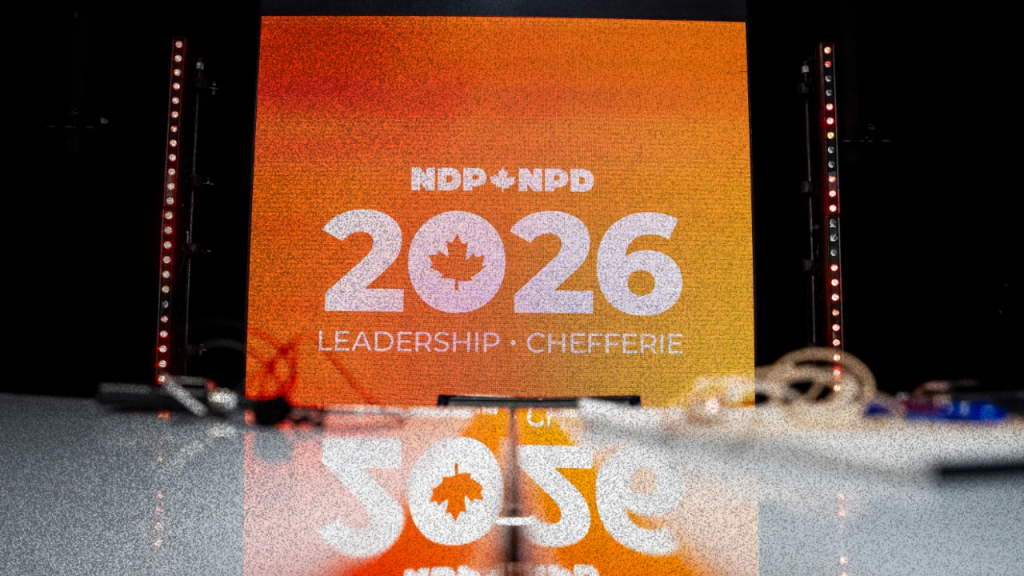
NDP convention Winnipeg 2026 was billed as renewal — the exclusions, protests, and silences that defined it told a different story about what the party has become.
The NDP arrived at the RBC Convention Centre in Winnipeg with the usual language of renewal. A leadership race would conclude. A new face would take over. The party — reduced to seven seats in the 2025 federal election and stripped of official party status for the first time since 1993, its own leader defeated in his home riding — would begin again. The delegates filed in. The banners went up. Inside, the messaging was controlled: rebuild, reconnect, refocus. Outside, in the cold, a small group of protesters held banners accusing the party of supporting militarism, imperialism, and a corporate power structure it once claimed to challenge.
The distance between the two wasn’t geographic. It was the whole story of the convention in miniature — and it had been building for months before anyone boarded a plane to Manitoba.
To understand what Winnipeg actually revealed, you have to start not with the convention itself but with the process that preceded it: a sequence of exclusions that, taken together, constituted the most explicit statement the NDP has made about its political limits in decades.
The Exclusion of Yves Engler
On November 10, 2025, Yves Engler submitted his application to enter the NDP leadership race. By any formal measure, he was qualified. He had raised over $110,000 — without access to the party’s membership list and without any institutional backing — from a grassroots fundraising base that demonstrated real support for his platform. He had the backing of the NDP Socialist Caucus. His campaign proposed nationalizing energy, banks, and telecommunications; halting oilsands development; cutting military spending toward something closer to Mexico’s 0.7 percent of GDP rather than NATO’s escalating targets; redirecting those resources toward housing, climate, and social services; and ending Canadian complicity in what he called the genocide in Gaza.
On November 25, the party’s three-person vetting committee rejected his application. The stated grounds were extensive: “credible evidence of harassment, intimidation and physical confrontation” of party members, staff, and volunteers; echoing “Russian state propaganda” on Ukraine; making comments “consistent with antisemitic rhetoric”; and an “unclear commitment to the NDP” — the last of which referenced a Bluesky account impersonating Engler that had posted about running for the Greens, which was very clearly fabricated. An independent review committee upheld the decision on December 8.
In the Globe and Mail, Engler put the challenge directly: “If they really believe I’m a Putin asset, a Rwanda genocide denier, antisemitic — let the members decide. I’ll get no votes. But I think they fully understand that there’s actually quite a bit of sympathy among NDP members for this.” No member was given the chance to decide. The race continued without him.
The harassment allegations centered significantly on Engler’s confrontational street journalism practice — filming public interactions with politicians and posting them to social media. The most cited example involved him following Liberal MP Anna Gainey down a street while asking whether she had comment on Israel and Gaza. Engler’s lawyers noted there was no evidence he had assaulted or threatened anyone. The committee’s assessment of what constitutes harassment — applied specifically to an anti-imperialist candidate questioning politicians about genocide in a public space — was not applied with equivalent scrutiny to the approved candidates’ records or public conduct.
Then They Blocked His Wife
In January 2026, Bianca Mugyenyi entered the race. Mugyenyi is not a peripheral figure. She is a veteran organizer, former director of the Canadian Foreign Policy Institute, and a co-founder of The Leap — the same organization co-founded by the race’s frontrunner, Avi Lewis. She announced her candidacy publicly, raised the funds, and stated clearly that if the party reversed its decision on Engler, she would step aside. That transparency, the vetting committee decided, was itself disqualifying. It constituted an “explicit proxy candidacy” in breach of standards of “honesty, professionalism and integrity.”
At a press conference after her rejection, Mugyenyi named what was happening directly: “I stepped forward to carry a shared vision, a shared platform that was built collectively, and that is democracy. I am the first Black woman in fifty years to seriously contest the leadership for the NDP since Rosemary Brown in 1975, and that matters. The establishment talks a lot about diversity but by blocking the first Black woman to seek this leadership in fifty years, it shows that diversity is welcomed when it protects the status quo.” In her formal appeal, she argued the committee had relied on “sexist tropes implying a woman cannot have her own ideas, that she must live in the shadow of her husband.” The Leadership Review Committee upheld the rejection in a single brief letter stating the decision was final and no further review would be considered.
As Canadian Dimension noted, the vetting committee’s logic meant that the act of transparency itself became grounds for disqualification. A candidate who had concealed her motivations would have had a better chance of passing vetting than one who stated them plainly. That is not a bug in the system. It is the system working exactly as designed: to filter out challenges to the party’s political parameters before members have any say in them.
Expulsion, Then Credential Withdrawal
In early March 2026, as voting opened, the NDP terminated Engler’s party membership entirely. A letter from the party’s national director stated he had “engaged in conduct fundamentally inconsistent with the obligations of membership and contrary to the constitution and principles of the party.” He was given no right of appeal. Three days before the convention opened, National Director Lucy Watson withdrew the convention credentials of Barry Weisleder — Socialist Caucus chair, Engler campaign co-manager, and a fixture of federal NDP conventions for decades — citing conduct at a previous convention, including supporting anti-genocide protesters outside the hall.
The sequence is worth stating plainly: block the candidate, block the replacement, expel the candidate from the party, strip the organizer’s credentials so he cannot be present on the convention floor. What was being excluded was not individuals. It was an argument — specifically the argument that Canadian foreign policy, military spending, and complicity in genocide are legitimate subjects of debate inside the NDP’s own leadership race. For how the convention’s frontrunner handled that exclusion, see the separate piece on Avi Lewis.
The Historical Pattern This Belongs To
This is not the first time the NDP has suppressed foreign policy debate from within. The pattern stretches back to the party’s founding predecessor. In 1949, the CCF expelled two elected Manitoba legislators for criticizing the Marshall Plan and NATO. During the 1950 federal convention, British Columbia CCF President Dorothy Steeves — one of the party’s most experienced foreign policy thinkers — was blocked from providing a full report to delegates. The party’s national secretary pressured her to moderate her positions rather than let members hear them. In 1949, the federal CCF also moved to deter members from engaging with the Canadian Peace Congress, treating association with anti-war organizing as a liability rather than a natural expression of the party’s stated values.
The vetting system is the current mechanism for doing this without requiring anything as visible as a formal expulsion vote. An unnamed three-person committee, operating without public accountability, can exclude a candidate before any member votes, on grounds broad enough to encompass almost any form of confrontational activist politics. The committee cited harassment, disinformation, and antisemitism. None of these characterizations were tested before members. All of them functioned to make the argument — that Canada participates in imperialism and genocide — unutterable inside the party’s own leadership race. The specific mechanism changes across decades. The function is identical.
Kinew’s Speech and the Gap It Could Not Close
Manitoba Premier Wab Kinew opened the convention with remarks positioning him — and by implication the party — against war and the escalation of global conflict. The framing was familiar: civilian suffering is unjustifiable, Canada must not be dragged into reckless military adventurism, the NDP stands for peace. It landed as it was designed to land: moral clarity, political distance from American escalation, a reaffirmation of the party’s claimed identity.
But the clarity dissolved the moment you looked past the speech itself. Canada is not standing outside the structures that make such conflicts possible. The country coordinates with NATO. It runs surveillance operations. It deploys naval assets. It provides intelligence. Its airspace is used for operational missions during active military conflicts involving its allies. Canadian participation in the structures of imperial warfare is rarely framed as aggression, but it remains participation — ongoing, structural, and materially significant.
The protesters outside the hall were not there because they misunderstood Kinew’s speech. They were there because they understood it perfectly, and understood what it deliberately did not say. Inside, applause. Outside, the same questions as before. The gap between what Kinew said and what Canadian foreign policy actually is was not incidental to the convention’s politics. It was the convention’s politics. The party’s claim to anti-war identity depends on maintaining exactly that gap — condemning war in general terms while avoiding any specific accounting of Canada’s role in the military structures that produce the wars being condemned. The excluded candidates had tried to close that gap. That is why they were excluded.
Inside: Process Without Confrontation
The convention’s internal proceedings unfolded without interruption. Candidates delivered final pitches. Delegates moved between sessions. The mechanics of leadership selection played out as designed — five approved candidates, a ranked ballot, a result announced Sunday morning. The tone was controlled throughout. Nothing acknowledged the exclusions that had defined the preceding four months. Nothing engaged with the protesters thirty metres from the main entrance. Nothing confronted the contradiction between the party’s stated commitment to grassroots democracy and the specific political content it had spent six months blocking from its own leadership race.
That silence was not accidental. It was functional. A convention that acknowledged the exclusions would have had to explain them — and the only honest explanation is that an unnamed three-person committee had decided, without member input, that an anti-imperialist, anti-NATO, pro-Palestine platform was incompatible with NDP membership in good standing. That explanation would have been impossible to square with the language of renewal filling the hall. So it was not offered. As Spark Solidarity documented during the Singh years, performing opposition and exercising it are not the same thing — and Winnipeg offered no evidence that the party had reckoned with the distinction.
What the Numbers Reveal
The NDP’s own polling context is worth sitting with. An Angus Reid Institute survey conducted ahead of the convention found that among past NDP voters from the previous decade, roughly a quarter considered the party irrelevant and nearly 40 percent said its best days were behind it. Of the same group, 44 percent did not recognize the names of any of the five leadership candidates. Twenty-one percent said they didn’t know who among them would be the best choice.
The party had grown its membership from 60,000 to approximately 100,000 during the leadership race — a significant increase driven by the contest itself. But polling suggested the party remained between five and ten percent nationally, roughly where it was on election night. What those numbers describe is a party that activated its existing base through a leadership contest while failing to reach the voters who had already decided to look elsewhere.
The grassroots energy that Engler and Mugyenyi’s excluded campaigns represented — campaigns that raised over $100,000 each without access to the party’s membership list, without institutional backing, without the party machine — pointed toward exactly the kind of activated, ideologically motivated mobilization that could have extended the party’s reach. Engler argued that had he been allowed to run, he would have finished in the top three. Looking at the final results, that argument is hard to dismiss. Lewis won with 56 percent, McPherson took 29 percent, and Johnston, Ashton, and McQuail split the remaining 14 percent among 70,930 voters. The grassroots fundraising base Engler assembled — over $110,000 raised without institutional access — was larger than what Ashton and Johnston could generate in the same conditions with full party access. The anti-imperialist vote that Engler represented had no candidate on the ballot. It had nowhere to go.
The Result and What Came With It
Lewis won on the first ballot with 56 percent — a decisive margin, slightly outstripping what Jagmeet Singh won in 2017. He inherits a party with six MPs, approximately $13 million in debt, and polling between five and ten percent nationally. He does not currently hold a seat in the House of Commons and offered no timeline for seeking one. Provincial NDP leaders in Alberta and Saskatchewan immediately distanced themselves from him over his oil and gas positions, with Alberta NDP leader Naheed Nenshi releasing a statement saying Lewis’s direction “is not in the interests of Alberta” within minutes of the result.
The convention’s internal elections, held the day before the leadership announcement, produced one result worth noting. The new NDP executive slate — Niall Ricardo as president, Libby Davies as vice-president, and Keira Gunn as treasurer — ran on a platform of empowering riding associations and building between elections rather than operating as an electoral machine that activates only at campaign time. They beat a union-backed establishment slate. Ricardo, a Montreal labour lawyer and organizer, said the party needs ground organizers, not just infrastructure. Davies, a former deputy leader and longtime Vancouver East MP, said the first resolution passed at convention was to adopt a permanent organizing model — a genuine structural shift if implemented. Gunn, an Alberta organizer, framed the task as getting resources out of headquarters and into EDAs in places the party needs to eventually win.
This is the closest thing the convention produced to a genuine opening. A new executive with a grassroots mandate, a commitment to permanent organizing, and at least rhetorical distance from the electoral machine model that produced the Singh years — these are not nothing. Whether they translate into actual structural change, or get absorbed into the same institutional logic that has governed this party for decades, is a question the next year will begin to answer. The history is not encouraging. But the mandate is real, and the people who won it said the right things. That is worth noting, even from a critical distance.
What Social Democracy Does Under These Conditions
The NDP’s electoral collapse was not simply the product of bad timing or a weak campaign. It reflected the accumulated cost of a decade of triangulation — of a party that positioned itself as opposition while functionally enabling the Liberals, that claimed movement politics while enforcing the boundaries of acceptable discourse from above, that condemned war in general while refusing to name the specific alliances producing it. The convention produced a new leader and a new executive with a mandate to change that. What it did not produce was any reckoning with the specific exclusions that defined the six months preceding it.
The party operates within structural constraints that define what it can and cannot be — and those constraints are actively enforced, by named and unnamed officials, against specific people advancing specific arguments, through mechanisms that bypass member input entirely. A new executive with good intentions does not automatically change those mechanisms. The vetting committee that excluded Engler and Mugyenyi remains. The financial opacity that allowed the exclusions to proceed without member scrutiny remains. The institutional logic that treats anti-imperialist politics as a liability rather than a platform remains.
The NDP can advocate for reforms, but not structural breaks. It can criticize war in general terms, but not the specific alliances that produce it. It can absorb symbolic dissent — photograph it, applaud it, include it in the highlight reel — but it cannot organize around it. It can invoke grassroots democracy, but only after an unelected committee has already decided which grassroots arguments are permissible. These are not temporary deviations from the party’s stated values. They are the logic of social democracy operating inside the imperial core — a logic that has been consistent from the CCF’s expulsion of anti-NATO voices in 1949, through the Ontario NDP’s expulsion of Sarah Jama in 2023, to the federal party’s exclusion of Engler and Mugyenyi in 2025 and 2026. The specific targets change. The mechanism is the same. Whether the new executive can change that mechanism from the inside is the only question that matters now. The convention gave no clear answer. The history suggests caution. The mandate, at least, points in the right direction.
Sources
- Self-described ‘agitator’ Yves Engler barred from running for NDP leadership — CBC News
- NDP rejects Yves Engler as leadership candidate — The Globe and Mail
- NDP blocks Bianca Mugyenyi from leadership race — The Globe and Mail
- NDP Excludes Grassroots Left-Wing Anti-War Candidates — JURIST
- NDP leadership committee rejects Engler’s candidacy — rabble.ca
- By barring Bianca Mugyenyi, NDP shows it’s not interested in renewal — Canadian Dimension
- Voting begins for new federal NDP leader — CBC News
- NDP’s long shameful history of blocking foreign policy debate — Yves Engler
- NDP convention kicks off in Winnipeg — The Globe and Mail
- At historic low point, New Democrats descend on Winnipeg — CBC News
- NDP leadership candidates make final pitches — CBC News
- 2026 NDP Convention and Leadership — CPAC
- 2026 New Democratic Party leadership election — Wikipedia
- Avi Lewis and the NDP: Who Gets to Define the Left? — Spark Solidarity
- Jagmeet Singh and the Illusion of Opposition — Spark Solidarity
- Jagmeet Singh Swings Too Late as NDP Fades Into Political Irrelevance — Spark Solidarity
- Avi Lewis elected Leader of NDP — NDP.ca, March 29, 2026
- The NDP has a new leader. What does Avi Lewis’s arrival mean? — CBC News
- Ricardo, Davies, Gunn elected to lead NDP executive committee — rabble.ca
 Spark Solidarity