
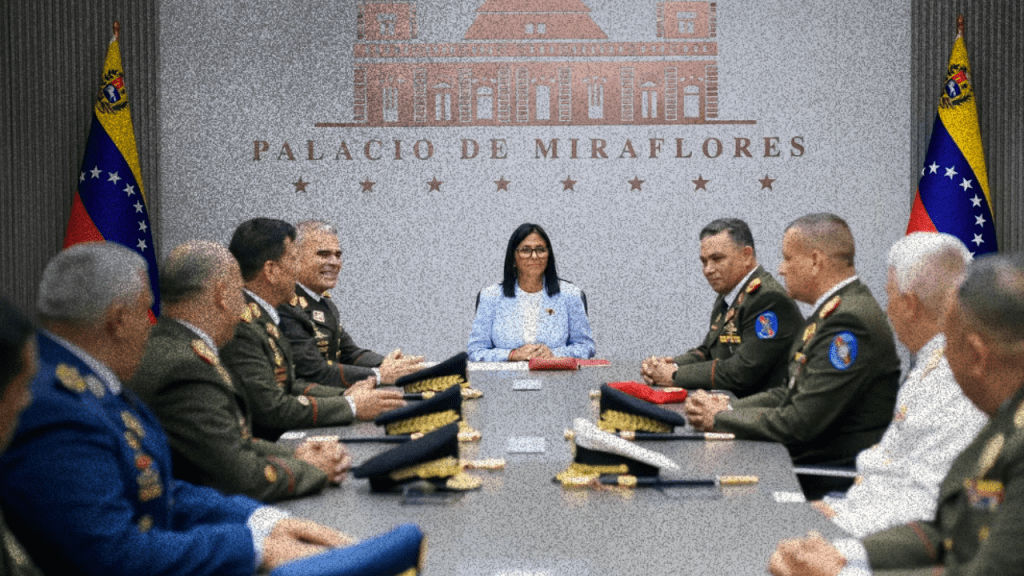
US Venezuela normalization is being reported as a diplomatic thaw. What it actually is: the administrative phase of a completed military intervention.
The Embassy Reopening Is the Occupation’s Paperwork
The U.S. State Department announced the resumption of normal diplomatic operations at its embassy in Caracas after a seven-year closure — framing it as a straightforward return to bilateral engagement. The American flag is back over the compound. Diplomats are on the ground. Formal channels are open. The official presentation treats this as an unremarkable administrative step, the kind of thing that happens when two governments decide to talk again after a long silence.
That framing omits one fact that changes the entire structure of what is being described. On January 3, 2026, the United States removed Nicolás Maduro from power through military action — Operation Absolute Resolve — capturing Maduro and his wife Cilia Flores in a predawn raid on Caracas and transporting them to New York to face narco-terrorism charges. Trump announced from Palm Beach that the U.S. had used “overwhelming military power, air land and sea” and that the country would be run by the United States “until we can do a safe, proper and judicious transition.” The embassy reopening, the sanctions licenses, the investment discussions around Venezuela’s energy sector — none of this preceded that removal. All of it followed it. This is not a government deciding to engage with a rival. It is a government administering a country it just remade.
Seven Years of Regime Change Ended the Only Way It Could
From 2019 onward, U.S. policy toward Venezuela operated on a single declared premise: the Maduro government was illegitimate, engagement was collaboration, and sustained economic pressure would produce political change. The sanctions architecture built during that period was designed to strangle Venezuela’s state capacity — blocking PDVSA from international markets, freezing sovereign assets, and making financial transactions with the Venezuelan government a criminal liability for any entity operating within U.S. jurisdiction. The stated goal was democratic transition. The operational logic was collective punishment until the government collapsed.
That policy did not fail and then get quietly replaced. It was eventually complemented by direct military action. The removal of Maduro in January 2026 was the terminal expression of the same objective the sanctions had been pursuing for seven years. The narrative now circulating — that “confrontation has given way to engagement” — presents this as a maturation of diplomacy. What it papers over is that the engagement became possible because the confrontation was militarily concluded. When the method used to achieve a stated democratic objective is a special forces raid on a capital city, the democratic legitimacy framing has not succeeded. It has been abandoned.
Venezuela’s Oil Reserves Are the Logic Behind Every Move
Venezuela holds approximately 303 billion barrels of proven oil reserves — the largest of any country on Earth, accounting for roughly 17 percent of the global total. This is not background context. It is the entire reason the United States maintained seven years of costly, internationally criticized pressure on a government that posed no military threat to anyone. Trump stated explicitly, in the lead-up to and aftermath of the January operation, that the U.S. would effectively run Venezuela and sell its oil. On January 6, 2026, Trump stated that Venezuelan officials would turn over “sanctioned oil” worth approximately $3 billion, with proceeds to be deposited into U.S.-controlled accounts for the benefit of “the American people and the Venezuelan people.” That statement was treated as bluster. It was a policy declaration, and it was operationalized within days.
On January 9, 2026, Trump signed Executive Order 14373, formally establishing that Venezuelan oil revenue would be held in U.S. Treasury accounts and shielded from judicial process. As Morgan Lewis confirmed, General License 46, issued January 29, 2026, requires that all payments to the Venezuelan government pursuant to the license be deposited into “Foreign Government Deposit Funds” as defined in EO 14373 — meaning PDVSA does not receive the proceeds of its own production through normal channels. The sanctions relief did not return Venezuela’s oil wealth to Venezuela. It redirected that wealth through a mechanism Washington controls while Venezuela’s national oil company remains a blocked entity.
The License Bars China and Russia — That Is the Whole Point
The Treasury licenses that enable Venezuelan oil purchases explicitly exclude Russian, Iranian, North Korean, Cuban, and certain Chinese entities from participating. As Crowell & Moring documented, GLs 46B, 48A, 49A, and 50A all exclude persons located in or organized under the laws of Russia, Iran, North Korea, Cuba, and China, as well as entities owned or controlled by such persons. This provision is being reported as a standard sanctions carve-out. It is structurally something else. For the period when the U.S. refused to engage with Venezuela, Chinese and Russian companies deepened their presence in Venezuelan energy infrastructure. China’s CNPC and state-linked financial institutions extended billions in credit to Caracas when Western capital was locked out. Russia’s Rosneft developed operational relationships with PDVSA. That presence was the material basis for Venezuela maintaining any production capacity during the sanctions years.
The new licenses do not just open Venezuela’s energy sector to U.S.-aligned capital. They wall out the capital that sustained Venezuela when U.S. policy was designed to destroy it. The result is a sanctions architecture that now functions as market capture: Venezuelan oil flows toward U.S.-linked buyers, revenue passes through U.S. Treasury accounts, and the competitors who filled the vacuum during the isolation period are legally prohibited from the new arrangement. The same logic applied to the Panama Canal — China’s presence in adjacent infrastructure was named as the threat justifying U.S. reassertion. In Venezuela, the threat is not named. It is just written into the license terms.
This is why understanding what Chinese engagement in the Global South actually represents matters analytically. China’s presence in Venezuela was built during a period of U.S.-imposed isolation, through state-directed credit lines that kept Venezuelan production from complete collapse. The U.S. response to that presence, now that it has military control of the country, is to legally exclude China from the reconstruction. That is not competition between two equivalent imperialisms. It is one imperial power eliminating the alternative relationships a targeted state built to survive the first power’s assault.
The Silence About January 2026 Is Not an Oversight
The framing circulating about the embassy reopening describes a “quiet normalization” — diplomatic relations restored without a formal announcement, economic ties reopening without a declared policy shift, the whole transition proceeding as if the previous seven years of stated U.S. objectives no longer require explanation. This quietness is being treated as a curiosity or as standard foreign policy realpolitik. It is neither. It is the narrative management of a military intervention whose stated justification — democratic transition, rule of law, human rights — was invalidated by the method used to achieve it.
The U.S. spent seven years insisting that Venezuela required a democratic solution and that external imposition would be illegitimate. The military removal of Maduro obliterated that rhetorical framework. Acknowledging the embassy reopening as the post-intervention administrative phase would require acknowledging the intervention — which would require accounting for the gap between the democratic legitimacy rationale and the military execution. The silence is not awkward. It is functional. It preserves the broader ideological infrastructure of democracy promotion for deployment against the next target, while allowing the extraction from the current one to proceed without sustained political cost.
What Follows Depends on Venezuelan Resistance, Not Goodwill
An embassy operating in a country whose government was removed by the embassy’s home state, with a sanctions architecture routing resource revenue through the intervening power’s Treasury accounts, and licenses explicitly barring the previous government’s main economic partners — this is not a bilateral relationship with uncertain stability. It is an administered dependency with a diplomatic facade.
The geopolitical objective encoded in the license terms is not ambiguous. U.S. officials stated explicitly their intent to “limit the role of U.S. adversaries in the sector” — the same sector that China and Russia sustained through the isolation years. Beijing’s response made the stakes plain: China’s Foreign Ministry stated that Washington must “immediately lift its illegal unilateral sanctions against Venezuela” rather than use general licenses to entrench exclusions that “harm the legitimate rights and interests of all parties involved, including Venezuela.” The embassy is not a marker of transition. It is a forward operating position. The variables that actually determine what follows are the ones the current framing refuses to examine: the degree of Venezuelan popular resistance to the post-intervention order, the capacity of remaining regional governments to maintain non-aligned relationships with Caracas, and whether China and Russia treat the exclusion from the new licenses as a negotiating condition or a line that triggers parallel support structures. The question is not how durable Washington’s commitment to engagement proves to be. The question is how durable Venezuelan resistance to this arrangement proves to be — and on that, Washington has no say.
Sources
- CBS News — Trump announces U.S. military capture of Maduro, January 2026
- Congressional Research Service — U.S. Sanctions Against Venezuela: Overview, January 2026
- Morgan Lewis — Venezuela Oil Sector Sanctions Update: General License 46, February 2026
- Mayer Brown — OFAC Issues New General Licenses for Venezuela Energy Sector, February 2026
- Crowell & Moring — Eight Takeaways on OFAC Venezuela General Licenses, March 2026
- Telesur — China Criticizes U.S. General Licenses Targeting Venezuela, April 2026



 Spark Solidarity