
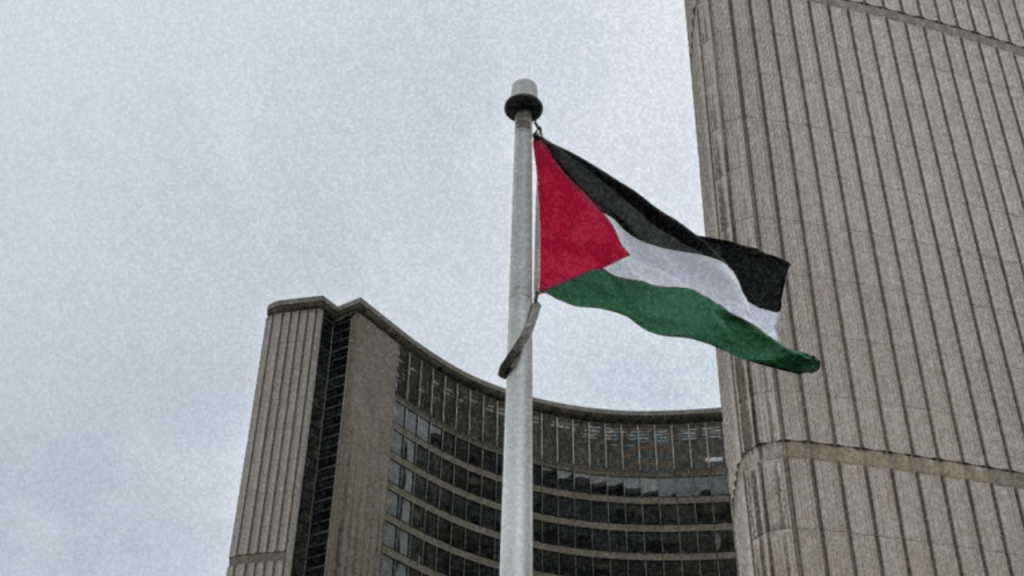
Tafsik claimed Toronto’s foreign-flag ban as a victory after losing its bid to stop the Palestinian flag raising, but causation remains unproven.
Tafsik went to court in November trying to stop Toronto from raising the Palestinian flag. The court refused the emergency injunction, and the flag raising proceeded. Four months later, City Council adopted a rule barring foreign-national flags from courtesy poles beginning December 1, 2026.
The next afternoon, Tafsik declared victory.
TorontoToday reported that the organization called Council’s decision a “monumental victory,” said it had “won the long game” and reframed its failed injunction as the “opening move” in a broader campaign.
The claim arrived less than a day after the vote, turning the timing itself into part of Tafsik’s message. Instead of treating November as a defeat, the organization presented the two events as stages of one campaign.
The outcome closely matched what the organization had wanted. Once the rule took effect, the Palestinian flag would become ineligible for Toronto’s courtesy-pole program alongside other foreign-national flags. Tafsik could point to a concrete policy result that aligned with the position it had taken months earlier.
That alignment, however, does not prove influence. Council’s March 26 decision was a general policy change. It barred foreign-national flags, including flags depicting another nation’s flag, from courtesy poles at City Hall and civic centres. The final motion did not mention Tafsik, executive director Amir Epstein or the November court fight.
Councillors publicly discussed divisiveness, national unity and geopolitical conflicts spilling into local civic space. Nothing in the official record shows them crediting Tafsik, taking its direction or adopting the policy because of its campaign. Nor does the record establish that Tafsik shaped the amendment that produced Council’s narrower final policy.
Tafsik nevertheless had a compelling story to tell about itself. It had challenged the flag raising, failed to secure emergency relief and then watched Council remove foreign-national flags from the program. By calling the lawsuit an opening move, the organization turned a courtroom defeat into the first chapter of an eventual political win.
That reframing served Tafsik: Toronto ended up where it wanted, without proof that Tafsik had brought the city there.
By March 27, Tafsik had an outcome it could claim. What the public record did not show was that its campaign had produced that outcome.
Sources
- “Pro-Israel group that tried to halt Palestinian flag raising celebrates Toronto’s foreign-flag ban,” TorontoToday, March 27, 2026.
- City of Toronto, MM39.35 — One Country, One Flag; Celebrating the Canadian Flag, adopted March 26, 2026.
- Tafsik Organization et al. v. The City of Toronto, 2025 ONSC 6386, Ontario Superior Court of Justice, Divisional Court, November 19, 2025.