
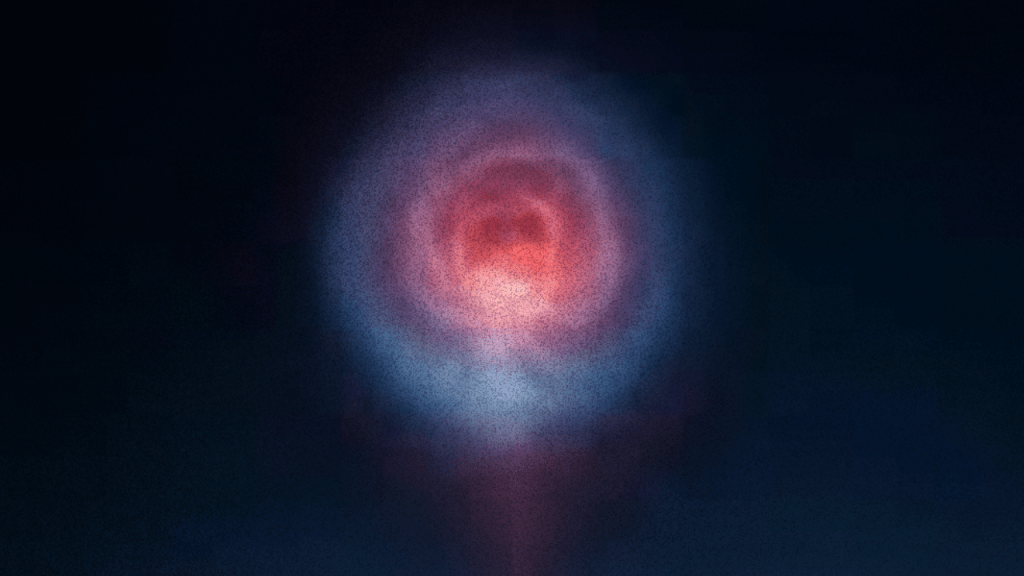
Arrow defense interceptions at exoatmospheric altitude produce plasma clouds civilians mistake for meteors. The visual gap between modern warfare and public literacy is structural, not accidental.
Iranian Missiles Met Israeli Defense Systems at the Edge of Space
On March 22, 2026, air raid sirens sounded across southern Israel as Iranian ballistic missiles approached. Israel’s Arrow 3 system intercepted one of them outside Earth’s atmosphere — an exoatmospheric kill at over 100 kilometers altitude. Footage circulated immediately showing a silent, expanding bloom of light in space above the Dimona area. Social media filled with speculation. Meteor. UFO. Unknown object. Almost no one recognized what they were actually watching: a kinetic intercept in near-space, the eighth Iranian attack on Israel that day alone, conducted by a system most people have never seen operate in combat.
This was not the first time. On October 1, 2024, Iran launched 181 ballistic missiles at Israel in two waves — intercepted at altitudes exceeding 100 kilometers, outside the atmosphere. The first operational exoatmospheric interception had occurred on November 9, 2023, widely described as the first instance of space warfare since the collision took place beyond Earth’s atmosphere. During Operation Rising Lion in June 2025, Iran fired over 530 ballistic missiles with an 86% interception rate. In the current conflict, Israel has intercepted approximately 92% of the over 400 ballistic missiles Iran has fired since February 28, 2026. Each of those interceptions produced light, plasma, and debris in near-space. Almost none of it has been explained to the public watching from the ground.
High-Altitude Interceptions Produces Plasma
When a missile is intercepted during its midcourse phase, the interaction does not resemble a conventional explosion. There is no dense atmosphere to carry a shockwave. The collision releases energy into a thin, near-vacuum environment where particles behave differently. The kinetic impact between an interceptor and its target ionizes surrounding material. Fragments, fuel residues, and atmospheric particles become electrically charged. This creates a glowing cloud that expands outward as light, not fire. Israeli defense analysts have confirmed that the “firework-like” clouds seen in Israeli skies during Iranian missile attacks reflect the dispersal of high-altitude interception events — specifically the blue-pink light signatures of ionized particles returning to lower energy states and emitting photons in the process.
These clouds do not dissipate instantly. At altitude, they persist. They stretch. They distort. They hang in the sky longer than any meteor trail people are familiar with. To someone on the ground, this does not look like a rock burning up. It looks controlled. Intentional. Sometimes even stationary. What is being seen is not an object moving through the sky but the aftermath of something colliding within it. The March 22 footage from Dimona is the clearest recent example: witnesses described the visual as unlike anything they had seen before. It is unlike anything they had seen before — because nothing in civilian visual experience prepares people for a kinetic kill at 100 kilometers altitude.
No Public Literacy Around What Modern Missile Defense Looks Like
Most people understand war through a limited visual vocabulary. Aircraft. Explosions. Smoke. Ground impact. Even when people think of missiles, they imagine ascent and descent — a launch, a strike, something visible, linear, and contained. None of that prepares anyone for a high-altitude interception. When people see these events, they reach for the closest available explanation. If it moves fast and burns, it becomes a meteor. If it glows and lingers, it becomes a UFO. If it behaves strangely, it becomes something unknown. The same clip can circulate with three completely different interpretations, each reinforced by the audience consuming it.
The underlying issue is not belief. It is vocabulary. These events exist outside the everyday visual framework people use to interpret the sky. Without that framework, everything collapses into approximation. We are watching the same sky but describing it in completely different languages. This is not a failure of intelligence or critical thinking. It is the predictable result of a public that has never been shown what these systems look like when operating at scale, in real combat, against real targets. The absence of that shared interpretive structure is itself a form of control — not through suppression of information but through the maintenance of a gap between what the state knows warfare looks like and what the public is equipped to recognize.
Multiple Phenomena Overlap in Time and Space
The problem is not that people are misidentifying a single phenomenon. The problem is that multiple phenomena are happening simultaneously. Meteors are real. Space debris re-entry is real. Solar-driven atmospheric effects are real. And now, layered on top of that, high-altitude missile interceptions are real — happening at frequencies that have no historical precedent in the civilian visual record. These events do not occur in isolation. They overlap in time. They overlap geographically. They overlap visually. A meteor and an interceptor can produce superficially similar streaks. Debris and missile fragments can both burn and break apart. Plasma from an interception can resemble atmospheric effects people associate with auroras.
From the ground, especially through a phone camera, these distinctions collapse. A single night sky can contain natural objects entering the atmosphere, artificial objects leaving it, and defensive systems interacting in between. Without context, they all get categorized the same way. This is the core confusion — not that something unexplainable is happening, but that too many separately explainable things are being seen at once and collapsed into one undifferentiated category of strangeness.
Plasma Interacts With the Electromagnetic Environment
At the energies involved in missile interception, matter does not behave in familiar ways. The collision of objects moving at several kilometers per second generates extreme heat and ionization. Electrons are stripped from atoms. Gas becomes conductive. Light is emitted not as flame but as radiation from excited particles. This is plasma — the same fundamental state of matter seen in lightning and in auroras, but here generated dynamically, at altitude, on a scale rarely visible to civilians.
Plasma does not look like fire. It expands differently. It interacts with electromagnetic fields. It can form shapes that appear structured or layered. It can persist and drift, carried by high-altitude winds. This explains the visuals people struggle with: lingering glowing clouds, expanding spherical blooms, color shifts across a single event, light that appears to pulse or fade unevenly. None of this requires unknown physics. It requires recognizing that the sky is now host to processes most people have never had reason to observe.
Interception is not just a physical event. It is an interaction with the atmosphere itself. Research published in peer-reviewed journals confirms that ballistic missile plumes create ionospheric holes and electron density depletion — documented as early as 1973 when the Saturn V launch produced an ionospheric hole 1,000 kilometers in diameter at 300 kilometers altitude, reducing electron density by nearly 50% and interrupting shortwave communication across the Atlantic. Under the conditions of an active ballistic missile exchange involving hundreds of launches, these effects are not theoretical. Ionized trails, temporary disruptions, and localized changes in electromagnetic conditions can produce visible phenomena — faint glows, distortions, structures that resemble natural atmospheric events but are driven by different processes.
This Is Warfare at Scale, Not Testing in Isolation
What is unfolding now is not a test. It is real-world use, at scale, under pressure, with hundreds of interceptions occurring across multiple conflict theaters simultaneously. The public sees new forms of warfare only after they have already been normalized within military doctrine. Stealth aircraft, drone warfare, electronic warfare — each appeared suddenly in the public visual record not because they were new, but because they were finally visible. High-altitude interception has existed for years. But the combination of frequency, geographic spread, and civilian video documentation at this scale is new. People are not just reading about these systems. They are watching them operate from their balconies, through dashcams, on their phones.
The Interpretation Gap Is Structural, Not Technological
The gap is not technological. It is interpretive. Media defaults to the simplest explanation available. A streak in the sky becomes a meteor. A glowing cloud becomes debris. Complexity is flattened for clarity. At the same time, online spaces amplify the opposite extreme. The same visuals become unidentified phenomena, detached from any grounded explanation. Between these two poles, something is lost: there is no widely understood framework for recognizing what modern interception looks like, no shared language for distinguishing between natural, artificial, and hybrid events in the sky. Different causes. Same category. The result is not secrecy. It is confusion — and confusion serves the same function as secrecy when the effect is that nobody knows what they are looking at.
The sky has not changed in a fundamental sense. Meteors still enter the atmosphere. Solar activity still drives auroras. Space debris still burns on reentry. But something has been added. Human systems now operate at altitudes and energies that intersect with these natural processes. Objects are intercepted where space meets atmosphere. Energy is released in environments most people have never had reason to think about. What people are seeing is not one phenomenon. It is layers — space, atmosphere, and warfare occupying the same field of view at the same time. Without a way to separate them, they blur into something that feels unfamiliar and unexplained. Not because it is beyond explanation. But because the explanation has never been made available to the people watching.
Sources
- Athens Times — Stunning footage of exoatmospheric Arrow 3 interception over Dimona, March 22, 2026
- JNS — Watch: Arrow 3 system intercepts Iranian missile in space, March 22, 2026
- Wikipedia — Arrow missile family, operational history and interception altitudes
- Air Force Technology — Arrow 3 Air Defence Missile System, including Operation Rising Lion data
- Calcalist — Israel needs significantly more Arrow 3 interceptors, March 23, 2026
- Advances in Mathematical Physics — Numerical Simulation of Ionospheric Disturbance Generated by Ballistic Missile, 2019
- Wikipedia — Arrow 3






 Spark Solidarity