
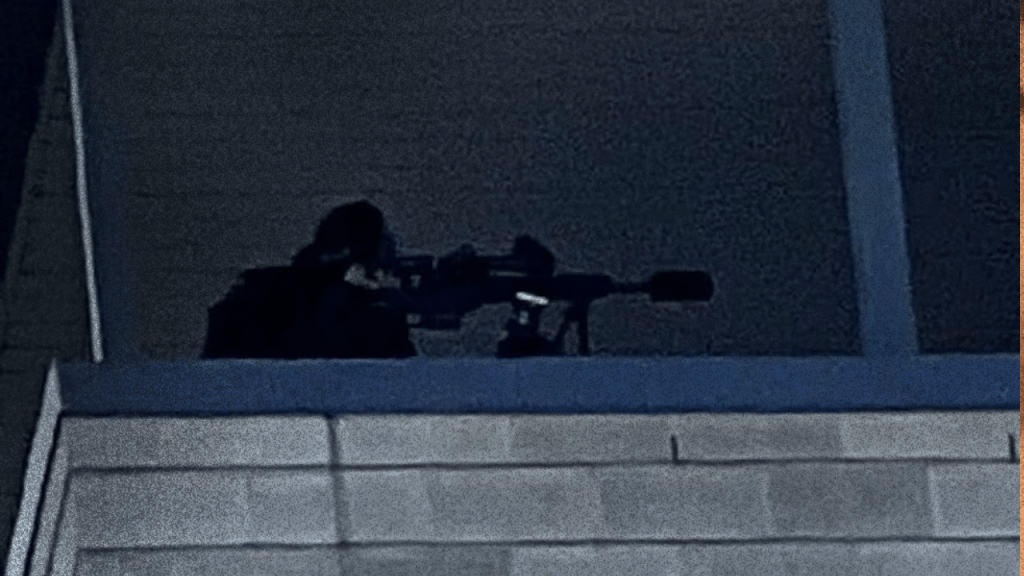
Waterloo sniper deployment at a St. Patrick’s Day street party wasn’t a rogue decision — police called it standard protocol for all large gatherings. The mayor found out from social media.
A Sniper on the Roof of a University Street Party
On March 14, 2026, Waterloo Regional Police deployed a tactical officer — positioned at an elevated vantage point on Marshall Street — to monitor an unsanctioned St. Patrick’s Day street party in the city’s university district. The event has been running for roughly 15 years. This year’s crowd peaked at approximately 7,500 people. Attendees photographed the officer and the images circulated on social media within hours. Mayor Dorothy McCabe said she was “surprised and shocked” to learn of the deployment. She had not been informed of any concerns about weapons, extreme violence, or any other specific threat that would require a sniper. She requested a meeting with Police Chief Mark Crowell to find out why.
Police answered the mayor’s question — and the public’s — not with an apology or an explanation of what specific threat had justified the deployment, but with a policy statement. Const. Melissa Quarrie told CBC News that having a tactical officer is “standard protocol for all major events.” It happens regularly, she said, at planned and unsanctioned gatherings across Ontario and Canada. The mass casualty events of recent years, she explained, have reshaped how police approach every large gathering. Chief Crowell later confirmed the same position, saying the deployment was “very deliberate to mitigate any mass casualty considerations.”
No Specific Threat. Standard Protocol.
This is the sentence that matters. Not “we had intelligence suggesting a threat.” Not “a specific credible risk warranted this response.” Standard protocol. Every large gathering. All types of events. The security posture that once required a specific, assessed threat to justify a specific, proportionate response has been replaced by a blanket framework in which the potential for mass violence is assumed to exist at all times and in all crowds, and in which tactical overwatch is the default rather than the exception.
The police board chair, Ian McLean, supported the decision. “We have to live in the world in which we find ourselves and be prepared for this type of event,” he said. “When you’ve got up to 20,000 people within an unsanctioned kind of environment, we have to be prepared with all the tools that the chief and his team deem necessary.” The framing is worth noting: the tools the chief deems necessary. Not the tools that evidence of a specific threat justifies. Not the tools that civilian oversight has authorized. The tools the chief deems necessary — with the mayor, the elected representative of the city, finding out from a Reddit post.
The Mayor Didn’t Know. That’s Not a Bug.
McCabe’s shock is understandable. It is also structurally informative. In Ontario’s two-tier municipal system, the police chief does not report to the mayor. McCabe noted this herself. The chief reports to the police services board — a body with limited civilian accountability — and makes operational decisions independently. The mayor governs the city. The police govern themselves. When McCabe said she was “surprised and shocked,” she was describing not an anomaly but the ordinary functioning of a system in which elected officials are not in the chain of command for decisions about how police arm themselves and what weapons they deploy at public events.
This is the same dynamic that appears every time security failures produce no accountability for the institutions responsible. The apparatus expands, the oversight doesn’t. Parliament Hill in 2014 produced Bill C-51. The Toronto synagogue shootings produced injunction attempts against pro-Palestinian protests and snipers at student parties. The failure is never punished. The expansion is never questioned. The mayor finds out from social media and requests a meeting. The chief says it went as planned.
The Sniper Was Visible. That Was Also Deliberate.
One detail in the coverage cuts through the stated justification. A policing expert quoted by CBC noted that snipers remain invisible when deployed in a position where they may need to shoot. In this case, the tactical officer was photographed clearly and the images spread immediately. The expert’s explanation: visible deployment is intentional when the goal is deterrence rather than intervention. The officer was meant to be seen.
An Australian exchange student who spotted the officer told CBC News she was terrified and left immediately with her friends. She said she understood in retrospect why police thought it was necessary, but that the visible placement “made it seem more of a threat than protection.” If she had the choice, she said, she would not attend the following year. That is also a function of visible tactical deployment: it contracts the public space. The crowd shrinks. The gathering becomes associated with danger rather than community. The street party that has run for 15 years becomes something people think twice about attending. Whether or not that outcome was intended, it is the outcome.
218 Charges. Zero Weapons. No Violence.
Police laid 218 charges over the St. Patrick’s Day period in Waterloo, including six criminal offences. The charges were consistent with what you’d expect at an unsanctioned university street party: noise, nuisance, bylaw violations. No weapons charges. No violence. Nothing that would retroactively justify a sniper on the roof. The chief called the operation a success. He said it went as planned. He did not explain what specific scenario the tactical officer was there to address, because there was no specific scenario. There was a large gathering. That, now, is enough.
That is the state of public space in Canada in March 2026: a student beer party in a university district, running for 15 years without incident, treated as a mass casualty event requiring tactical overwatch. The mayor didn’t know. The chief says this is standard. The police board says the chief gets to decide. The public finds out from Reddit. And next year, the framework will be exactly the same — because no one with authority over it has any reason to change it.
Sources
- CBC News — Waterloo mayor shocked by sniper deployment, March 15, 2026
- CBC News — Sniper is tactical officer in emergency plan, March 16, 2026
- CBC News — Police anticipated worst-case scenario, says former officer, March 17, 2026
- CBC News — Police chief stands by sniper deployment decision, March 18, 2026
- CBC News — Over 200 charges issued during St. Patrick’s Day festivities, March 20, 2026
- CP24 — Police respond to online reaction after sniper spotted, March 16, 2026




 Spark Solidarity