
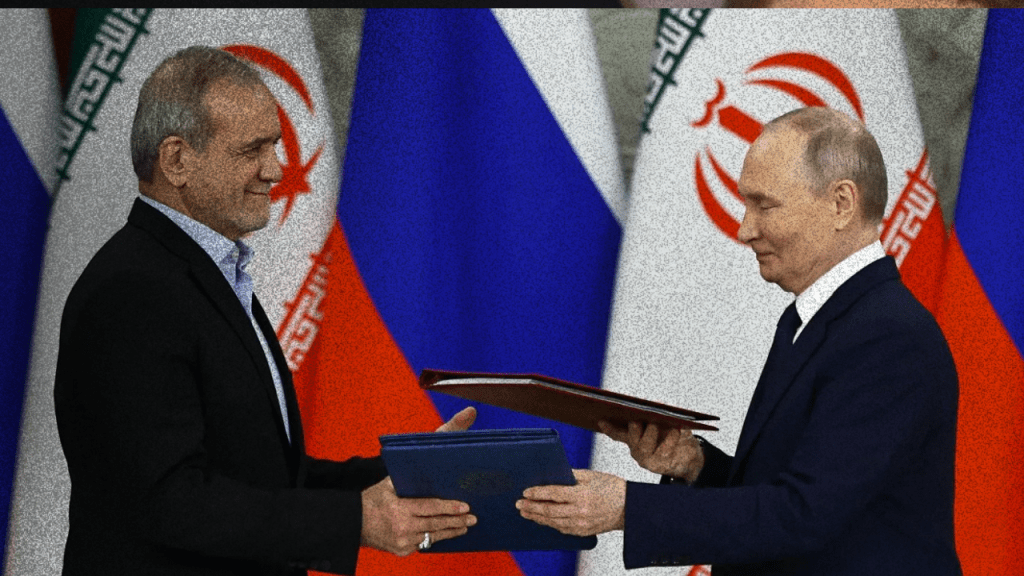
Russia-Iran military partnership exposes how Western proxy enablement works — Washington’s outrage reveals exceptionalism, not principle.
Russia’s Drone Transfer to Iran Is Now Multiply Confirmed
The technical facts are no longer in dispute. Russia is transferring modified Shahed drone components to Iran — improvements to communication systems, navigation, and targeting developed through continuous operational use in Ukraine. CNN confirmed via a Western intelligence official that Russia is providing Iran with specific tactical advice on drone deployment strategies developed in Ukraine — including wave attacks with multiple drones changing course regularly to elude air defenses. FPRI analysis confirms that the Shaheds Iran is now deploying have been upgraded: Russian forces took the Iranian design, mass-produced it, refined it through 60,000 operational deployments against Ukraine, and are now returning those refinements to Iran. These are not theoretical upgrades. They are battlefield-tested refinements extracted from one of the highest-intensity drone warfare environments in modern history.
Beyond drone hardware and tactics, the Washington Post first confirmed — and CNN, NBC News, and AP subsequently corroborated — that Russia is providing Iran with satellite imagery and intelligence on the locations and movements of American troops, warships, and aircraft in the Gulf. The White House did not deny it. The picture is clear: Russia is supplying Iran with weapons adaptation, tactical knowledge, and targeting-grade satellite intelligence simultaneously. As NBC News reported, the Iranian aerial attacks appear more precise than in previous conflicts — focused specifically on radar sites and communication posts — suggesting enhanced intelligence is being received and operationalized.
Ukraine as Testing Ground: How These Weapons Cross Theaters
The Russia-Iran transfer is not a discrete arms deal. It is an output of a systemic process. Since 2022, Russian forces have deployed Iranian-designed Shahed drones at scale in Ukraine, turning that theater into the most intensively tested strike-drone environment in history. Each operational cycle produced new data — on evasion patterns, on swarm deployment, on the failure modes of Western air defense systems. That data fed back into drone design. Iranian engineers absorbed it. Russian doctrine absorbed it. The feedback loop between the two producers is the mechanism by which a weapon designed in Iran became a weapon refined in Russia and returned to Iran as something more lethal than it was.
The transfer runs in the opposite direction too. Ukraine has deployed 228 military specialists to Gulf states to help counter the same Iranian drones it has been shooting down at scale for years. Lessons from Kyiv are entering Riyadh, Abu Dhabi, Doha, and Kuwait City. Tactics tested against Russian Gerans are being adapted for Iranian Shaheds. As Breaking Defense reported, almost every nation Iran is attacking is trying to reach Ukraine’s drone industry through every available channel. This is not coincidence — it is the defining structural feature of what modern conflict has become: a shared laboratory in which the walls between theaters are operationally thin.
Washington Is Condemning the Mechanism It Built
Washington’s reaction to the Russia-Iran partnership has been immediate and loud: this is destabilizing, escalatory, a dangerous deepening of adversarial alignment. None of those characterizations are false on their face. But they collide with a structural problem that no amount of rhetorical management can dissolve. The United States has, for years, provided Ukraine with weapons systems, tactical training, continuous intelligence sharing, and satellite targeting data. Ukraine has adapted its operations based on that support. Russia is now doing a functionally equivalent set of things for Iran — providing tools, knowledge, and targeting intelligence that enable a partner to fight more effectively without deploying Russian troops as direct combatants. The mechanism is identical. What differs is the actor performing it.
This is not a rhetorical point. It is a structural one. The architecture of indirect proxy enablement — weapons transfer, knowledge transfer, intelligence transfer — is not a Russian invention. It is the foundational instrument of American power projection across the post-Cold War period. From the Mujahideen to the Contras to Kurdish militias to the Ukrainian Armed Forces, Washington has consistently framed this mechanism as legitimate when it operates under American direction and criminal when deployed by states outside the Western order. Russia has not invented a new form of warfare. It has adopted the form that already existed and pointed it somewhere Washington does not want it pointed.
The Moral Asymmetry Claim Is Exceptionalism, Not Analysis
Western analysts and officials respond to the structural parallel by asserting a moral asymmetry: Russia is helping Iran target American troops, which is categorically different from the U.S. helping Ukraine defend against an invader. That argument deserves engagement rather than dismissal. Ukraine was the target of a full-scale military invasion. Iran is an active belligerent that has struck U.S. positions. These contexts are not identical. But the analytical move being made — that context determines whether indirect proxy enablement is legitimate — is exactly what needs to be interrogated, because the United States applies that contextual test selectively and always in its own favor.
Washington does not apply contextual legitimacy tests to its own behavior. U.S. weapons and intelligence have enabled Saudi Arabia to conduct years of strikes against civilian infrastructure in Yemen. U.S. satellite and targeting intelligence has been integral to Israeli military operations in Gaza. In neither case did the U.S. characterize its own enablement role as destabilizing or escalatory. The contextual legitimacy test only activates when the actor providing indirect support is Russia, China, or Iran. That is not analysis. That is exceptionalism performing as analysis. As this site has documented, the management of adversary narratives runs on this logic: actions taken by Western-aligned states are standard, contextually justified, and consistent with international norms; the same actions taken by designated adversaries are unprecedented, destabilizing, and demanding of immediate response.
Washington Is Outraged at the Mirror, Not the Threat
Wars are no longer isolated events. They are interconnected through shared weapons ecosystems, real-time tactical adaptation, and intelligence networks that span theaters. A drone variant tested over Kharkiv is adapted over the Gulf of Oman. A counter-drone protocol developed in Zaporizhzhia is deployed in a Gulf emirate. The boundaries between conflicts are operationally thin, and decisions made in one theater cascade into another with a speed and directness that renders the old geopolitical category of “regional conflict” largely fictional.
Washington built this system. The post-Cold War American strategy of projecting power through partners, proxies, and technology transfer — rather than direct deployment — created the operational logic that Russia is now applying. The United States established that the correct unit of analysis in modern conflict is the enablement network, not the combatant state. Russia accepted that framework and is operating inside it. Washington’s outrage is not a response to an alien form of warfare. It is a response to seeing its own method returned to it by an adversary with the capacity and willingness to use it. Understanding how great-power competition actually operates — through economic leverage, proxy enablement, and technological transfer rather than mass troop deployment — is the prerequisite for reading any of these conflicts clearly. The Russia-Iran partnership is not an aberration in an otherwise rules-based international order. It is that order, functioning as designed, with the West no longer holding exclusive operational control over who uses its own tools.
Sources
- Washington Post — Russia is giving Iran intelligence to target U.S. forces, March 2026
- CNN — Russia is aiding Iran’s war effort by providing intel on US military targets, March 2026
- CNN — Russia is giving Iran specific advice on drone tactics, March 2026
- NBC News — Russia is providing intelligence to Iran on the location of U.S. forces, March 2026
- FPRI — US and allies race toward Ukrainian counter-Shahed technology, March 2026
- Al Jazeera — Ukraine sends 201 military experts to Gulf to counter Iranian drones, March 2026
- Breaking Defense — Gulf nations “trying to reach out” for Ukrainian counter-drone capability, March 2026







 Spark Solidarity