
Toronto Al-Quds Day arrests on March 14 targeted pro-Israel counter-protesters — not the march. The rally has never produced criminal charges against its participants in 30 years.
Police Arrested Two Counter-Protesters for Hate Crimes
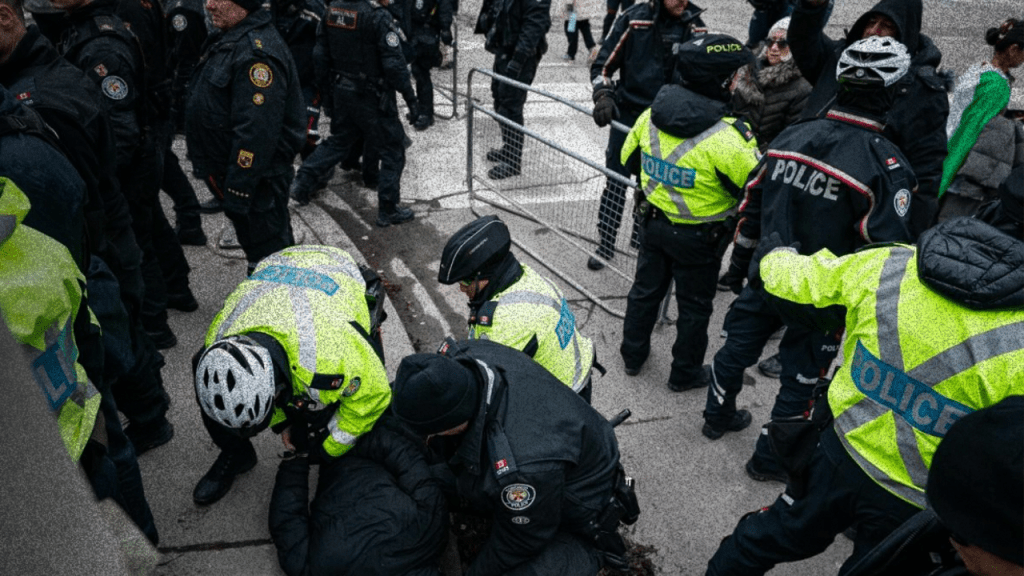
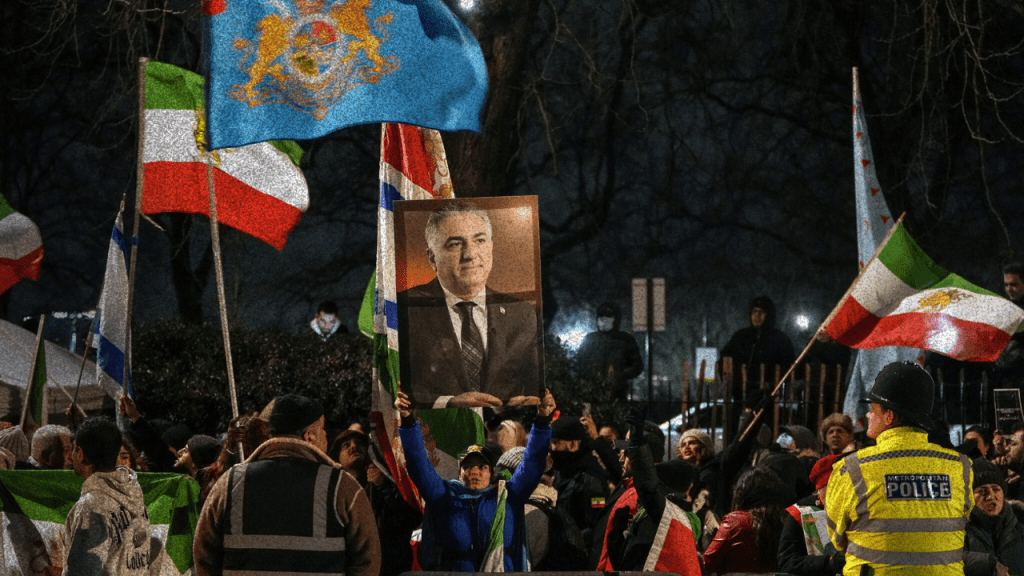
On March 14, 2026, Toronto Police arrested two counter-protesters at the annual Al-Quds Day rally. Farshid McVandifar, 56, was charged with assault and mischief after allegedly swinging his arms and fists at a demonstrator holding an Iranian flag, breaking the flagpole and causing pieces to strike the victim’s head. Mostafa Shabanian Bashmandoost, 39, was charged with assault, criminal harassment, theft under $5,000, possession of property obtained by crime, and public incitement of hatred — after allegedly following a demonstrator, spitting on them, ripping an Iranian flag off their back, then lighting the flag on fire and wearing Iranian flags on the soles of his shoes. Both investigations are classified as suspected hate-motivated offences.
This contradicts the widely circulated claim that police enforcement at Palestinian solidarity events operates exclusively against pro-Palestine demonstrators. At this specific event, the state arrested Zionist counter-protesters — not the marchers. The provincial government’s own lawyers acknowledged during the court hearing on Ford’s injunction attempt that there was no evidence the rallies had ever resulted in criminal charges against demonstrators. Thirty years. No charges against participants. The enforcement risk at the March 14 event flowed from the counter-protest, not the march.
Police Investigated Antisemitic Signs at a Separate Event
Toronto Police also investigated antisemitic signage at a pro-Palestine protest — at a different event the following Sunday. Police released images and requested public assistance in identifying individuals. This investigation happened and is documented. The timeline matters: the Al-Quds arrests came first, at the march Ford tried to ban. The antisemitic signs investigation came days later, at a separate event. Treating them as part of a single enforcement story erases the sequence.
The framing that police ignore pro-Israel violence while criminalizing Palestinian expression does not hold for March 14. The documented enforcement went the other direction. This does not invalidate broader policing patterns — it means this specific event is not evidence of them, and using it as such weakens the structural argument.
B’nai Brith Pushes IHRA Training Into Law Enforcement
The broader enforcement structure the article must be read against: B’nai Brith advocates explicitly for law enforcement training using the International Holocaust Remembrance Alliance definition of antisemitism — a definition whose examples include “denying the Jewish people their right to self-determination” and “applying double standards” to Israel as potential forms of antisemitism. Their seven-point plan calls for IHRA implementation in “civil service and law enforcement protocols” at every level of government. They also advocate for a national ban on Al-Quds Day rallies, framing the event as promoting hate speech and extremism.
These organizations do not hide their political objectives. They function as lobby groups that also provide police training frameworks. The material question is whether that training apparatus shapes enforcement to treat criticism of Israeli state policy as a hate crime category. The IHRA definition’s inclusion of anti-Zionist expression as potential antisemitism creates the structural opening for that conflation — not as conspiracy, but as the ordinary functioning of institutions that reproduce the interpretive frameworks they are given. This is diaspora weaponization operating at the institutional level: mobilizing ethnic community organizations as enforcement-framework providers for a foreign state’s political interests.
Project Resolute Targeted Palestinian Organizing Directly
The March 14 arrests do not erase the broader enforcement pattern. Toronto Police operated Project Resolute, targeting pro-Palestinian activists with surveillance, pre-dawn raids, attempts to recruit informants, and hate crime charges following October 7. Policing scholars described the operation as “strategic incapacitation” — using the criminal system to disrupt organizing capacity regardless of conviction outcomes. The unit was expanded from six officers to thirty-two and operated a fully-integrated intelligence sharing model with federal police and national security agencies.
The policing apparatus operates at two levels. Project Resolute represents systematic targeting of Palestinian organizing infrastructure — pre-dawn raids, charges against activists for postering a bookstore, surveillance of university lectures. The March 14 arrests represent what happens when counter-protesters commit documented assaults in public view with multiple witnesses and cameras. These are not contradictory — they describe different enforcement thresholds applied to different political formations. One requires years of surveillance and pre-dawn raids to produce charges. The other requires a man spitting on someone and lighting a flag on fire in front of police.
Selective Enforcement Manages Dissent by Design
The state does not need to arrest every pro-Palestine demonstrator to achieve its objective. It needs to create enough uncertainty that organizing becomes costly. Pre-dawn raids accomplish this. So does publicizing investigations into antisemitic signs while arrests of counter-protesters for assault receive minimal mainstream coverage. When enforcement does occur against pro-Israel counter-protesters, it follows a different trajectory: physical assault and documented hate speech, captured on video, in front of crowds. Compare that threshold to Project Resolute’s charges against activists for postering, for attending protests, for speech activity. The evidentiary bar shifts depending on the target’s political position.
Organizations like B’nai Brith do not need to control every enforcement decision to shape the overall structure. They provide the ideological framework through which police understand antisemitism and Palestinian solidarity. They supply the definitions. They deliver the training. They maintain the institutional relationships. The individual officer making an enforcement decision operates within that pre-existing interpretive structure. When anti-Zionism is defined as potential antisemitism in police training materials, the officer who investigates a “Free Palestine” sign as a hate crime is not acting against policy. They are implementing it.
Sources
- Toronto Police Service — Two men arrested at Al-Quds Day demonstration, March 15, 2026
- CP24 — 2 counter-protesters at Al-Quds Day rally charged, March 15, 2026
- Global News — 2 counter-protesters arrested at Al-Quds Day rally, March 15, 2026
- B’nai Brith Canada — Seven Point Plan to Combat Antisemitism (IHRA/law enforcement training)
- The Breach — Inside the police operation targeting pro-Palestine activists in Toronto




 Spark Solidarity